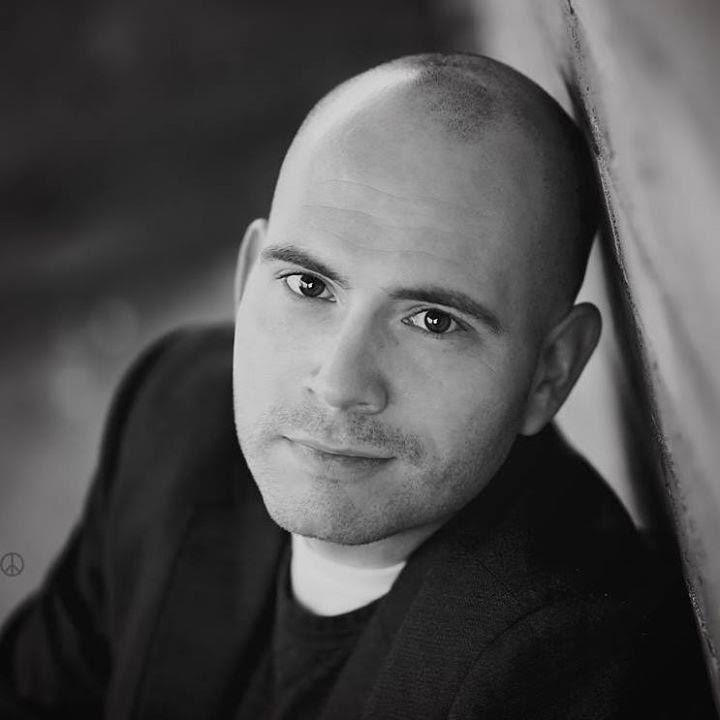
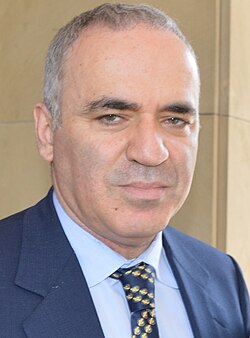
Garry Kasparov
The most dominant champion of the modern era. From 1985 to 2000 Garry Kasparov held the world crown, and for roughly two decades he was the world's top-ranked player — a ferocious, dynamic attacker whose opening preparation was so deep it reshaped chess theory itself. He also produced what many consider the single greatest game ever played.
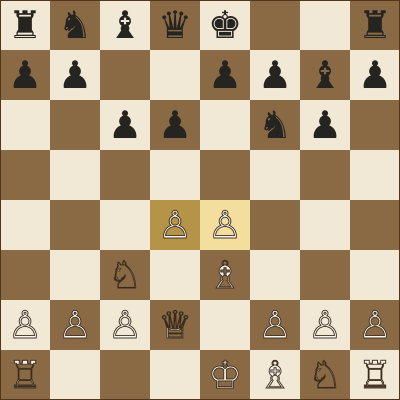
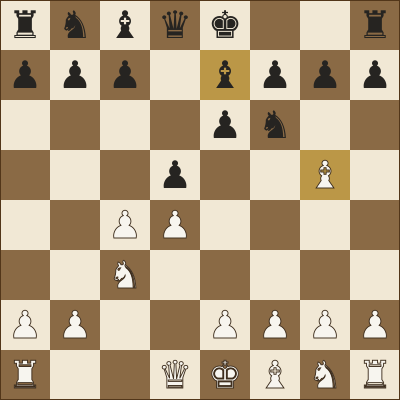
Kasparov–Topalov, Wijk aan Zee 1999 — the opening of the "greatest game ever." From this quiet Pirc Defence (the Be3 + Qd2 "150 Attack," big e4/d4 centre highlighted), Kasparov would later detonate the 24.Rxd4 rook sacrifice and a king hunt across the entire board.
Born
1963 · Baku, Azerbaijan (then USSR)
World Champion
1985–2000 — youngest undisputed champion at 22; world #1 for ~20 years
Signature Game
Kasparov–Topalov, Wijk aan Zee 1999 — the 24.Rxd4 immortal
Peak Rating
2851 — a record until Magnus Carlsen surpassed it
Two decades at the top
Kasparov became the youngest undisputed world champion in history in 1985, at 22, by defeating Anatoly Karpov. He then did something no one else has matched: he stayed at world #1 almost without interruption for the next twenty years, until he retired from professional chess in 2005. His style was dynamic and uncompromising — he fought for the initiative from move one and backed it with the deepest opening preparation the game had ever seen.
He modernized chess preparation, treating the opening as a battlefield to be mapped with computers and seconds months in advance. The effect on theory was enormous: whole systems were reshaped by his novelties, and elite players still build on the analytical methods he pioneered.
Kasparov–Topalov, Wijk aan Zee 1999
From an unremarkable Pirc Defence, Kasparov produced a combination that many publications — including Chess.com — have ranked the greatest game in chess history. On move 24 he sacrificed a rook to rip open Topalov's position, then chased the black king from its shelter on a suicidal march across the entire board, all the way to the far side, before the attack crashed home.
6. f3 b5 7. Nge2 Nbd7 8. Bh6 Bxh6 9. Qxh6 Bb7 10. a3 e5
… the slow build-up … 24. Rxd4!! cxd4 25. Re7+ — the king hunt begins
What makes the game immortal is not just the rook sacrifice but the calculation behind it: Kasparov later said he had already seen ideas more than a dozen moves deep when he played 24.Rxd4. The black king is driven from c8 across to the queenside and back, hunted by White's pieces every step, until it cannot escape. It is a combination of romantic beauty and modern precision — the two halves of Kasparov's chess in a single game.
Kasparov vs Karpov — five matches
No rivalry in chess history compares to Kasparov against Anatoly Karpov. Between 1984 and 1990 the two played five World Championship matches. The first, in 1984–85, was halted without result after an exhausting 48 games and five months of play — a decision that remains controversial. Kasparov won the 1985 rematch to seize the title and then defended it against Karpov three more times. Their contrasting styles — Kasparov's dynamism against Karpov's positional python-squeeze — produced some of the deepest chess ever played.
Where his games live in this library
The Najdorf Sicilian
As Black against 1.e4, Kasparov was a lifelong devotee of the Najdorf Sicilian and the Scheveningen — the sharpest, most theory-heavy defenses in chess, perfectly suited to a player who wanted to fight for the win with both colors.
Dynamic defenses
He also wielded the King's Indian and the Grünfeld — counterattacking systems that cede the centre to strike back. It was a Grünfeld, in fact, that Kramnik cracked with a prepared novelty to help dethrone him in 2000.
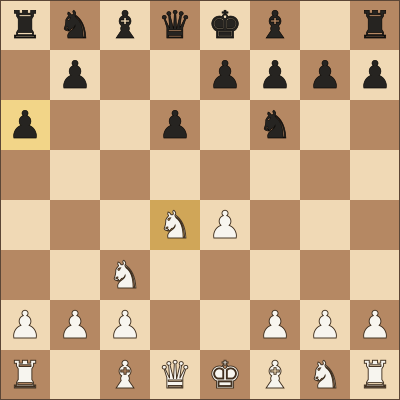
The Najdorf Sicilian (1.e4 c5 2.Nf3 d6 3.d4 cxd4 4.Nxd4 Nf6 5.Nc3 a6) — Kasparov's lifelong weapon as Black, and the theoretical battleground where his preparation did the most damage.
Garry Kasparov — FAQ
Why is Kasparov–Topalov 1999 called the greatest game ever?
From a quiet Pirc Defence, Kasparov played 24.Rxd4!! — the first of a series of rook sacrifices that chased Topalov's king across the entire board. The depth of calculation, the beauty of the king hunt, and the soundness of the combination led many publications, including Chess.com, to rank it the greatest chess game ever played.
How dominant was Garry Kasparov?
He was the world's top-ranked player almost continuously from 1984 until his 2005 retirement — about two decades at #1. He became the youngest undisputed world champion in 1985 at 22, and his peak rating of 2851 stood as the record until Magnus Carlsen surpassed it.
What was the Karpov–Kasparov rivalry?
They played five World Championship matches between 1984 and 1990. The first (1984–85) was controversially halted without result after 48 games; Kasparov won the 1985 rematch to take the title and held it through three more matches against Karpov.
Kasparov–Topalov 1999 — the Pirc that became the greatest game ever, and the launch pad for 24.Rxd4.
The Najdorf Sicilian — Kasparov's lifelong defense to 1.e4 and the deepest theory in chess.
Classical 1.d4 battlegrounds — the kind of mainline theory Kasparov reshaped with his preparation.
- Kasparov, G. My Great Predecessors (5 vols.) and Garry Kasparov on Garry Kasparov.
- Kasparov–Topalov, Wijk aan Zee 1999 ("Kasparov's Immortal," game record).
- Karpov–Kasparov World Championship matches, 1984–1990.
- FIDE rating records (peak 2851).
Garry Kasparov — Part 1 of 3
His dominance was forged in fire. Part 2 covers the defining rivalry of his career — five world championship matches against Anatoly Karpov.