
English Opening Variations
The English splits by how Black answers the flank pawn. Grab the centre with ...e5 and you get the Reversed Sicilian; mirror with ...c5 and you reach the Symmetrical English; develop both knights and you arrive at the Four Knights. This guide walks through each with board diagrams.
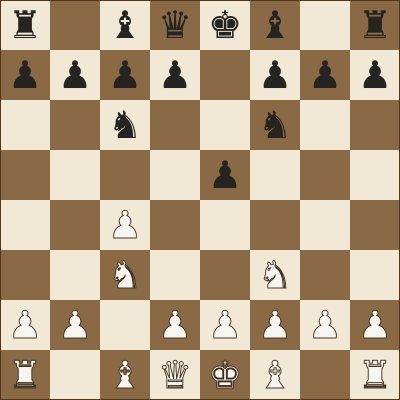
A typical English tabiya — the Four Knights, with all four knights developed after 1.c4 e5 2.Nc3 Nf6 3.Nf3 Nc6. From flexible starting moves the English branches into a handful of rich, distinct structures.
The Reversed Sicilian (1...e5)
Black's most ambitious reply: claim the centre at once. The position is a Sicilian with colors reversed and White a full tempo ahead. White develops with 2.Nc3 (the King's English) and a kingside fianchetto, then uses that extra tempo to press for the d5 break or a slow positional bind. Because White is essentially playing the Black side of a Sicilian, all of those familiar attacking schemes are available — but with the initiative.
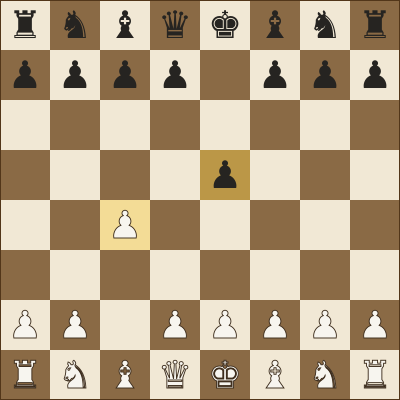
The Reversed Sicilian, 1...e5. A Sicilian with the board flipped and White a move up. The King's English (2.Nc3) and a g3/Bg2 setup are the standard route to a small, durable pull.
The Symmetrical English (1...c5)
Black mirrors White move for move. The Symmetrical English is the choice of solid players who are happy to let the position stay balanced until someone finds a constructive way to break the symmetry. Typical plans involve a double fianchetto, a knight maneuver to the strong d5 or d4 square, and a well-timed d4 or b4 break. It often flows into the Hedgehog structures of Part 3.
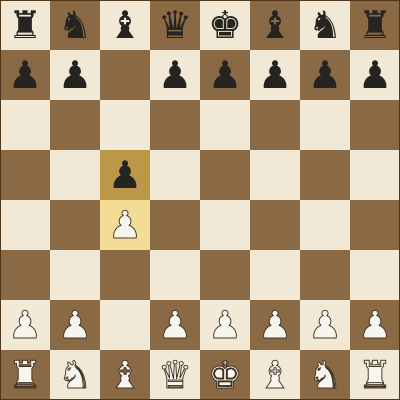
The Symmetrical English, 1...c5. Mirror-image pawns and pieces. The symmetry rarely lasts: whoever breaks it constructively — usually with d4 or a knight to d5 — takes the initiative.
The Four Knights English
When both sides develop their knights naturally, the game reaches the Four Knights English — one of the central tabiyas of the whole opening. From here White chooses between the quiet fianchetto plan with 4.g3 and the more direct central strike with 4.d4 exd4 5.Nxd4, transposing into a reversed Open Sicilian. Both lead to balanced, instructive positions where small strategic decisions add up.
The Four Knights English after 3...Nc6 — all four knights out. White picks the slow 4.g3 fianchetto or the central 4.d4. Either way, the extra tempo gives White a pleasant, risk-free edge.
English Variations — FAQ
What is the King's English?
The King's English is the Reversed Sicilian after 1.c4 e5 2.Nc3. White develops the queen's knight and prepares g3 and Bg2. Black can play ...Nf6 and ...Bb4, or ...Nc6 and ...g6, reaching rich positions where White's extra tempo gives a small but lasting pull.
How should Black meet the English Opening?
There is no single best answer. Active players grab the centre with 1...e5; solid players mirror with 1...c5; players with a King's Indian or Nimzo background steer toward those structures with ...Nf6, often transposing.
Is the Symmetrical English drawish?
Not necessarily. The symmetry usually breaks within a few moves, and the resulting Hedgehog and Maroczy positions are rich and double-edged. The Symmetrical is solid for Black but still gives White real winning chances with the extra tempo.
What is the Four Knights English?
It arises after 1.c4 e5 2.Nc3 Nf6 3.Nf3 Nc6, with all four knights developed — a main tabiya of the Reversed Sicilian. White continues with g3 and Bg2 or strikes with d4, reaching balanced, instructive middlegames.
The Reversed Sicilian — Black grabs the centre with ...e5, and White plays the Black side of a Sicilian a tempo up.
The Symmetrical English — mirror-image play where the first constructive break decides the initiative.
The Four Knights English — the central tabiya, with the choice between a quiet g3 fianchetto and the sharper d4 break.
- Marin, M. (2009). A Grandmaster Repertoire: The English Opening, Vols. 1–3. Quality Chess.
- Kosten, T. (1999). The Dynamic English. Gambit.
- ECO classification A20–A39. Online: Lichess opening explorer (English / Reversed Sicilian filter).
Every opening belongs to a family — browse the three theme clusters: Romantic & Attacking Gambits · Flank & Hypermodern Systems · Solid Defenses.
The deep strategy of the English
Part 3 covers the most sophisticated side of the opening — Botvinnik's bulletproof setup, the famous Hedgehog structure, and the transposition tricks that make 1.c4 so hard to prepare against.