
English Opening: Advanced
Beneath the English's quiet surface lies some of the deepest strategy in chess: Botvinnik's bulletproof setup, the coiled energy of the Hedgehog, the sharp Mikenas-Carls Attack, and the transposition web that makes 1.c4 the hardest first move to prepare against.
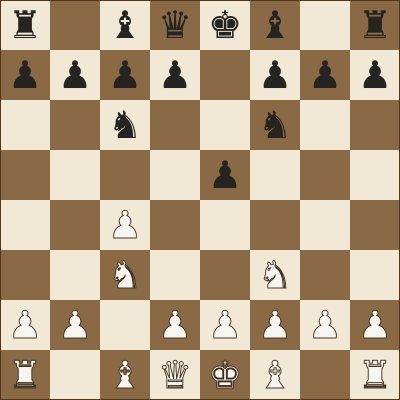
The English is an opening of structures, not memorized lines. Master a few key pawn formations — the Botvinnik grip, the Hedgehog, the Maroczy bind — and you can play 1.c4 against anything Black throws at you.
The Botvinnik System
The Botvinnik system is the English at its most solid. White builds a fixed structure: pawns on c4 and e4, knights on c3 and e2, a bishop fianchettoed to g2, and supporting pawns on d3 and g3. The result is an iron grip on the d5 square and a harmonious position that is extremely hard to crack. Botvinnik used it to neutralize sharp opponents and grind from a position of total safety — and it remains a model of strategic clarity for improving players.
From the Four Knights and King's English, White heads for the Botvinnik formation: pawns on c4 and e4, Nge2, g3, Bg2, d3 — a fortress-like grip on d5 that can be played against almost any Black setup.
The Hedgehog
The Hedgehog is one of the most instructive structures in all of chess, and it grows naturally out of the Symmetrical English. Black retreats into a low, flexible shell — pawns on a6, b6, d6, e6 — and develops quietly behind it. It looks passive, even cramped, but the position is loaded with latent energy: the whole point is to wait, improve, and then uncoil with the freeing breaks ...b5 or ...d5 at exactly the right moment. White must keep the bind without overextending — push too hard and the Hedgehog's spines draw blood.
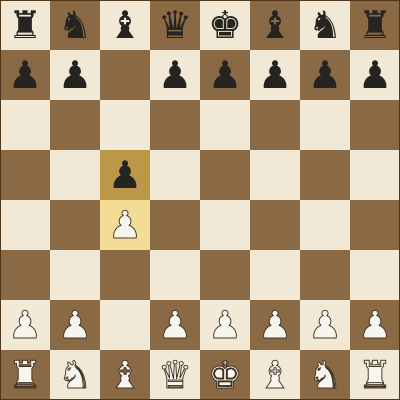
The Symmetrical English is the usual gateway to the Hedgehog. Black coils up behind pawns on a6-b6-d6-e6 and waits to strike with ...b5 or ...d5. Patience and timing decide these tense, double-edged middlegames.
The Mikenas-Carls Attack and central play
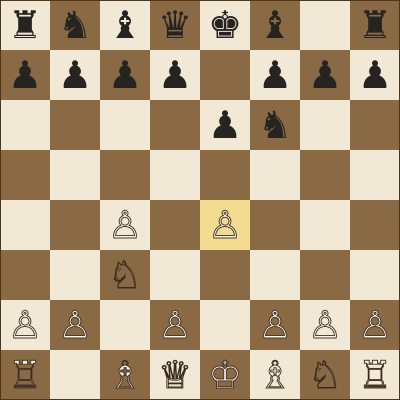
Not every English is slow. Against the Anglo-Indian move order 1.c4 Nf6 2.Nc3 e6, White can grab the centre immediately with 3.e4 — the Mikenas-Carls Attack — threatening e5 and a direct space advantage. It is a jolt of aggression that catches players expecting the usual fianchetto, and a reminder that 1.c4 is not committed to a quiet game.
One move, many openings
The deepest weapon in the English is not a variation at all — it is the move order itself. Play 1.c4 and follow with d4, and the game can become a Queen's Gambit or a Catalan. Meet ...g6 with a kingside fianchetto and you can reach a reversed King's Indian. Allow ...Bb4 and you may be in Nimzo-Indian territory.
This is why elite players love 1.c4: it lets them choose the battlefield after seeing the opponent's plan, sidestepping deep preparation and steering toward whatever structure they understand best. For the improving player, the lesson is the same one the whole English teaches: learn the structures, and the move orders take care of themselves.
Advanced English — FAQ
What is the Botvinnik system in the English?
A rock-solid setup with pawns on c4 and e4, knights on c3 and e2, a g2 bishop, and pawns on d3 and g3. It creates a firm grip on d5 and a structure that is very hard to break down. Named after Mikhail Botvinnik, it can be played against almost anything.
What is the Hedgehog?
A famous structure from the Symmetrical English: Black sets pawns on a6, b6, d6, and e6 — a low, flexible wall — and waits to uncoil with ...b5 or ...d5. It looks passive but is full of latent energy, and mishandling it as White can be dangerous.
What is the Mikenas-Carls Attack?
An aggressive Anglo-Indian line: 1.c4 Nf6 2.Nc3 e6 3.e4, grabbing the centre and threatening e5. A sharp, direct way to play the English against ...Nf6 and ...e6 setups.
Why is the English so hard to prepare against?
Transpositions. 1.c4 can become a Queen's Gambit, Catalan, King's Indian, Nimzo-Indian, or pure English depending on move order. Opponents must understand many structures, not one line — which is exactly why Carlsen and other elite players use it to reach fresh middlegames.
The Botvinnik grip grows from the Four Knights and King's English — c4, e4, g3, Bg2, and an iron hold on d5.
The Symmetrical English is the road to the Hedgehog — coiled, patient, and dangerous to face carelessly.
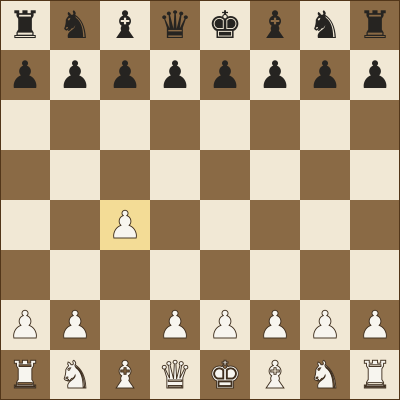
It all begins with 1.c4 — and ends wherever White wants it to, thanks to the English's unmatched transpositional reach.
- Botvinnik, M. — collected games (the Botvinnik system in practice).
- Marin, M. (2009). A Grandmaster Repertoire: The English Opening. Quality Chess.
- Suba, M. (1991). Dynamic Chess Strategy (the Hedgehog philosophy).
- ECO classification A10–A39. Online: Lichess opening explorer (English filter).
Every opening belongs to a family — browse the three theme clusters: Romantic & Attacking Gambits · Flank & Hypermodern Systems · Solid Defenses.
You've finished the English Opening series
The English rounds out the site's coverage of the four major first moves. Compare it with the 1.d4 systems it so often transposes into, or return to the 1.e4 classics.