
Ceres
Ceres is the giant of the Asteroid Belt and the only dwarf planet in the inner Solar System — a battered, clay-rich world hiding brilliant salt deposits, a briny layer beneath its crust, and more fresh water, locked as ice, than you might expect this close to the Sun.

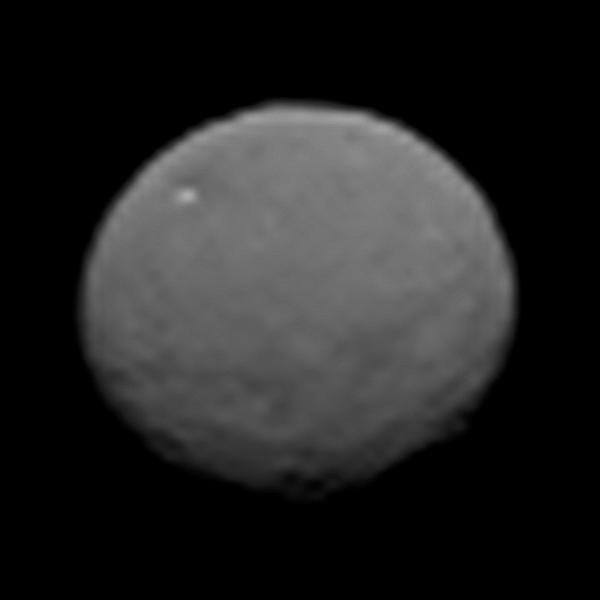
Image credit: NASA/JPL-Caltech/UCLA/MPS/DLR/IDA. A full-disk color view of Ceres assembled from images taken by NASA's Dawn spacecraft, processed to approximate the muted grey-brown hues of its surface. The small bright patch near the limb is Occator Crater, where salts from a briny subsurface reached the surface.
Type
Dwarf planet (Asteroid Belt)
Diameter
940 km
Location
Between Mars and Jupiter
Discovered
1 January 1801, by Giuseppe Piazzi
The little world that was a planet twice
Ceres has one of the odder résumés in the Solar System. When Giuseppe Piazzi discovered it on the very first night of the 19th century — 1 January 1801 — it was hailed as a new planet between Mars and Jupiter. As more bodies turned up in the same region, Ceres was demoted to "asteroid," the largest of many. Then, in 2006, the same reclassification that changed Pluto's status promoted Ceres to dwarf planet. It is the only dwarf planet orbiting closer to the Sun than Neptune.
NASA's Dawn spacecraft orbited Ceres from 2015 to 2018 and found a far more interesting world than a dead rock. Ceres is rich in clays and carbonates, and its interior holds a large fraction of water ice. Most striking are the bright spots — deposits of salt, mainly sodium carbonate, concentrated in Occator Crater. These formed when briny liquid welled up from a salty layer beneath the crust and evaporated, leaving the salts behind. Ceres, in other words, has been geologically and chemically active in the recent past, and may still be. It sits at the heart of the Asteroid Belt as its single largest resident, holding about a quarter of the belt's entire mass.
The easiest dwarf planet to find
Of all five dwarf planets, Ceres is by far the most accessible. At its best oppositions it reaches about magnitude 7 — just beyond naked-eye visibility, but a comfortable target in ordinary binoculars from a reasonably dark site. It looks exactly like a faint star; the way to confirm it is to check its position against a chart and watch it drift over a night or two.
The reward is conceptual rather than visual: no telescope will show Occator's bright spots or any surface detail (that took a spacecraft). But knowing that the little point in your binoculars is a 940-kilometer dwarf planet, salted with the residue of an ancient briny sea, is its own quiet satisfaction — and it is a world you can find yourself, unlike its distant icy cousins.
New to stargazing? See how to observe the night sky, and if you're choosing gear, the no-hype telescope buying guide.
The goddess of the harvest — and the word on your cereal box
Ceres carries the name of the Roman goddess of agriculture, grain, and the harvest — a fitting title for the mother-world of the belt. The connection is closer than you might think: the word cereal comes straight from her name. Her Greek counterpart is Demeter, whose grief when her daughter Persephone was carried into the underworld was said to strip the earth of its green and bring on the barren months of winter — an ancient explanation for the turning of the seasons.
A common misconception, born of science fiction, is that Ceres and its belt are a hazardous field of tightly packed rocks. Not so — the belt is mostly empty space, and Ceres orbits alone in a vast volume. It is a world unto itself, not a boulder in a swarm.
Primary sources: NASA — Ceres, NASA/JPL Photojournal PIA21079 (Ceres in color from Dawn), and NASA/JPL Photojournal PIA19172 (Ceres from Dawn, January 2015 approach). Image credit: NASA/JPL-Caltech/UCLA/MPS/DLR/IDA.
Discovered on the first night of a new century and named for the goddess of the harvest, Ceres has been called a planet, an asteroid, and a dwarf planet in turn — a small grey world that keeps quietly rewriting where it belongs.
More astronomy notes
Continue through the astronomy section for beginner-friendly notes, image credits, viewing tips, history, and the stories behind the night sky.
Asteroid Belt · Pluto · Dwarf Planets · Astronomy · Interests