
Makemake
Makemake is a bright, reddish, methane-frosted world in the Kuiper Belt — the second-brightest object out there after Pluto, with a small dark moon, no real atmosphere, and a name drawn from the creator god of Easter Island.
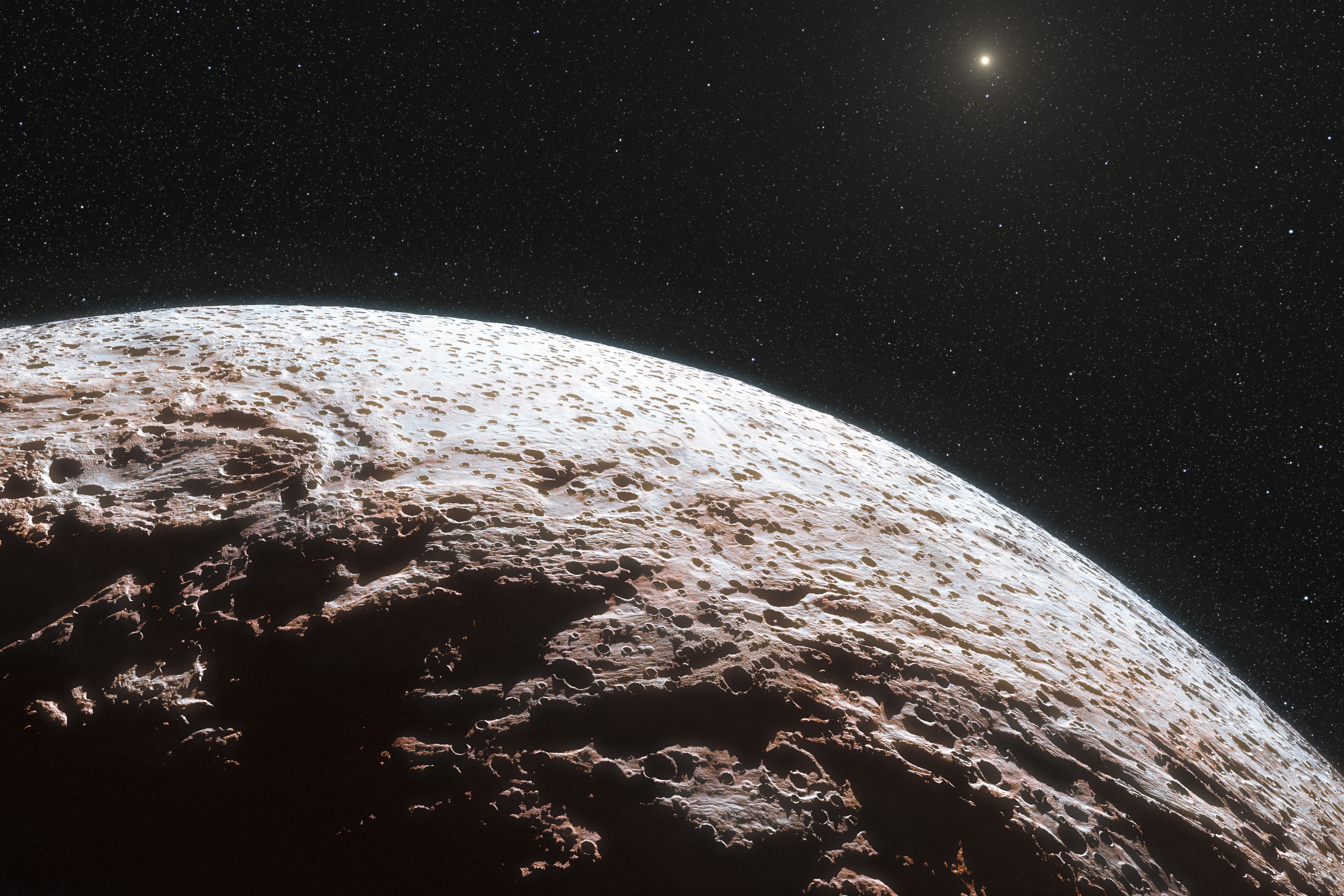
Image credit: ESO/L. Calçada/Nick Risinger. An artist's impression of Makemake's surface — bright frozen methane, tinted red by sunlight-processed organics, under a Sun reduced to a brilliant distant star.
Type
Dwarf planet (Kuiper Belt)
Diameter
~1,430 km
Surface
Bright frozen methane, tinted red
Moon
One — nicknamed MK2 (found 2016)
A frozen, methane-bright world at the edge of the light
Makemake was discovered in 2005 and sits in the classical Kuiper Belt, beyond Neptune. After Pluto, it is the brightest object in that region, and the reason is its surface: it is coated in frozen methane and other ices that reflect sunlight well, tinted a reddish-brown by tholins — sticky organic compounds created when sunlight and cosmic rays break down the methane over eons. It is about two-thirds Pluto's size and takes about 305 years to circle the Sun.
Two findings sharpened the picture. When Makemake passed in front of a background star in 2011, the star winked out abruptly rather than dimming gradually — evidence that Makemake has no significant global atmosphere, in contrast to Pluto's thin one. Then in 2016 the Hubble Space Telescope spotted a faint companion: a small, charcoal-dark moon, nicknamed MK2, circling the bright dwarf planet. A dark moon around a bright world is a striking pairing at the edge of the Sun's reach.
Bright for the Kuiper Belt, still faint for us
By Kuiper Belt standards Makemake is luminous, but it is still a demanding target for Earth-bound observers. At around magnitude 17 it requires a large telescope and dark skies simply to register as a dim point, with no surface detail visible. Like its distant siblings, Makemake is a world we understand through measurement — occultations, spectra, and a single Hubble glimpse of its moon — far more than through direct viewing.
New to stargazing? See how to observe the night sky, and if you're choosing gear, the no-hype telescope buying guide.
The creator god of Rapa Nui
Makemake's name carries one of the loveliest bits of timing in modern astronomy. It was discovered just after Easter in 2005, and the discovery team wanted a name that honored that season without repeating the tired classical gods. They chose Makemake (pronounced "mah-kay-mah-kay"), the creator god and chief deity of the Tangata manu "birdman" cult of the Rapa Nui people of Easter Island. It is a name from Polynesian myth, not Greek or Roman — and, like Haumea and Sedna, a deliberate widening of the sky's storytelling beyond the Mediterranean.
Because Makemake belongs to Rapa Nui tradition, there is no Greek or Roman equivalent to point to, and inventing one would be a distortion. The honest and more interesting note is the naming itself: a frozen world at the edge of the Solar System, discovered at Easter, carrying the name of an island creator god.
Primary sources: NASA — Makemake and the ESO image "Artist's impression of the surface of Makemake" (eso1246a). Image credit: ESO/L. Calçada/Nick Risinger.
Discovered at Easter and named for an island's creator god, Makemake shines at the edge of the light — a bright, reddish crust of frozen methane, shadowed by a single dark moon, keeping its own quiet corner of the Kuiper Belt.
More astronomy notes
Continue through the astronomy section for beginner-friendly notes, image credits, viewing tips, history, and the stories behind the night sky.
Haumea · Kuiper Belt · Dwarf Planets · Astronomy · Interests