
Haumea
Haumea is the oddball of the dwarf planets — spinning so fast that it has been stretched into the shape of an egg, trailed by two small moons and a family of icy shards, and wearing a narrow ring no one expected to find this far from the Sun.
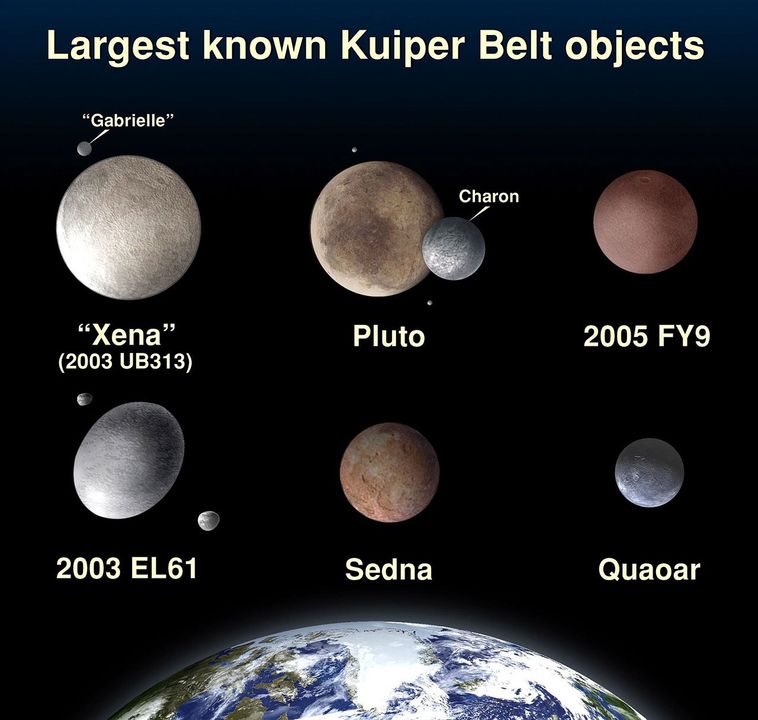
Image credit: NASA/JPL-Caltech. The largest known objects beyond Neptune — among them Pluto, Eris, Makemake and Haumea — shown to scale with one another and with Earth. Haumea's true shape is an elongated ellipsoid; its ring and egg-like form were deduced from stellar occultations rather than direct imaging.
Type
Dwarf planet (Kuiper Belt)
Shape
Elongated ellipsoid — ~2,100 km long, ~1,000 km across
Day length
About 4 hours — one of the fastest spins known
Moons / rings
Two moons (Hiʻiaka, Namaka) and a ring
A world reshaped by its own spin
Haumea, discovered in the mid-2000s, is one of the strangest large bodies known. It rotates once every roughly four hours — an extraordinary rate for an object its size — and that furious spin has flung it out of round into a stretched, egg-shaped ellipsoid, perhaps twice as long as it is wide. The most likely explanation is a colossal ancient collision that spun Haumea up and blasted off much of its icy mantle, leaving a dense, rocky body coated in bright water ice.
The debris from that impact is still around. Haumea has two small moons, Hiʻiaka and Namaka, and it is the parent of a "collisional family" — a scattering of small icy objects sharing similar orbits in the Kuiper Belt, all thought to be shrapnel from the same event. Then, in 2017, astronomers watching Haumea pass in front of a star found something no one had predicted this far out: a narrow ring, the first ever detected around a dwarf planet or any trans-Neptunian object. For a small, remote world, Haumea is remarkably eventful.
A specialist's target
Haumea is out of reach for casual observing. At around magnitude 17 it is a very faint point requiring a large telescope and dark skies even to glimpse, and it shows no detail whatsoever — its egg shape and ring were deduced from careful measurements, not seen directly. This is a world to appreciate through what science has pieced together rather than through an eyepiece: a spinning, ringed ellipsoid in the deep cold, known almost entirely by the way its light flickers and blinks.
New to stargazing? See how to observe the night sky, and if you're choosing gear, the no-hype telescope buying guide.
A goddess from Hawaiʻi, not from Greece or Rome
Haumea breaks the classical pattern, and deliberately so. It is named for Haumea, the Hawaiian goddess of fertility and childbirth — a fitting choice for a world that gave rise to a whole family of smaller bodies. Its two moons carry the names of two of the goddess's daughters: Hiʻiaka, patron of the island of Hawaiʻi and of hula dancers, and Namaka, a water spirit. It is a reminder, like Makemake and Sedna, that the naming of the outer Solar System has reached well beyond the Greek and Roman gods to honor the myths of many peoples.
Because Haumea is Polynesian in origin rather than classical, there is no Greek or Roman counterpart to hand off to — and forcing one would misrepresent it. The honest note is simply that this world belongs to a different tradition, and carries its stories faithfully.
Primary sources: NASA — Haumea and NASA/JPL Photojournal PIA17308 (largest objects beyond Neptune, to scale). Image credit: NASA/JPL-Caltech.
Spun to the shape of an egg by some ancient collision, trailing its own shattered family and circled by a ring no one expected, Haumea is proof that even the smallest, coldest worlds can keep the strangest secrets.
More astronomy notes
Continue through the astronomy section for beginner-friendly notes, image credits, viewing tips, history, and the stories behind the night sky.
Makemake · Kuiper Belt · Dwarf Planets · Astronomy · Interests