
Eris
Eris is Pluto's distant, heavyweight twin — a frozen world in the scattered disk almost the same size but more massive, so far away that a year there lasts 559 of ours. Its discovery in 2005 is the reason Pluto is no longer a planet, and its name — the goddess of discord — is the astronomers' knowing joke.
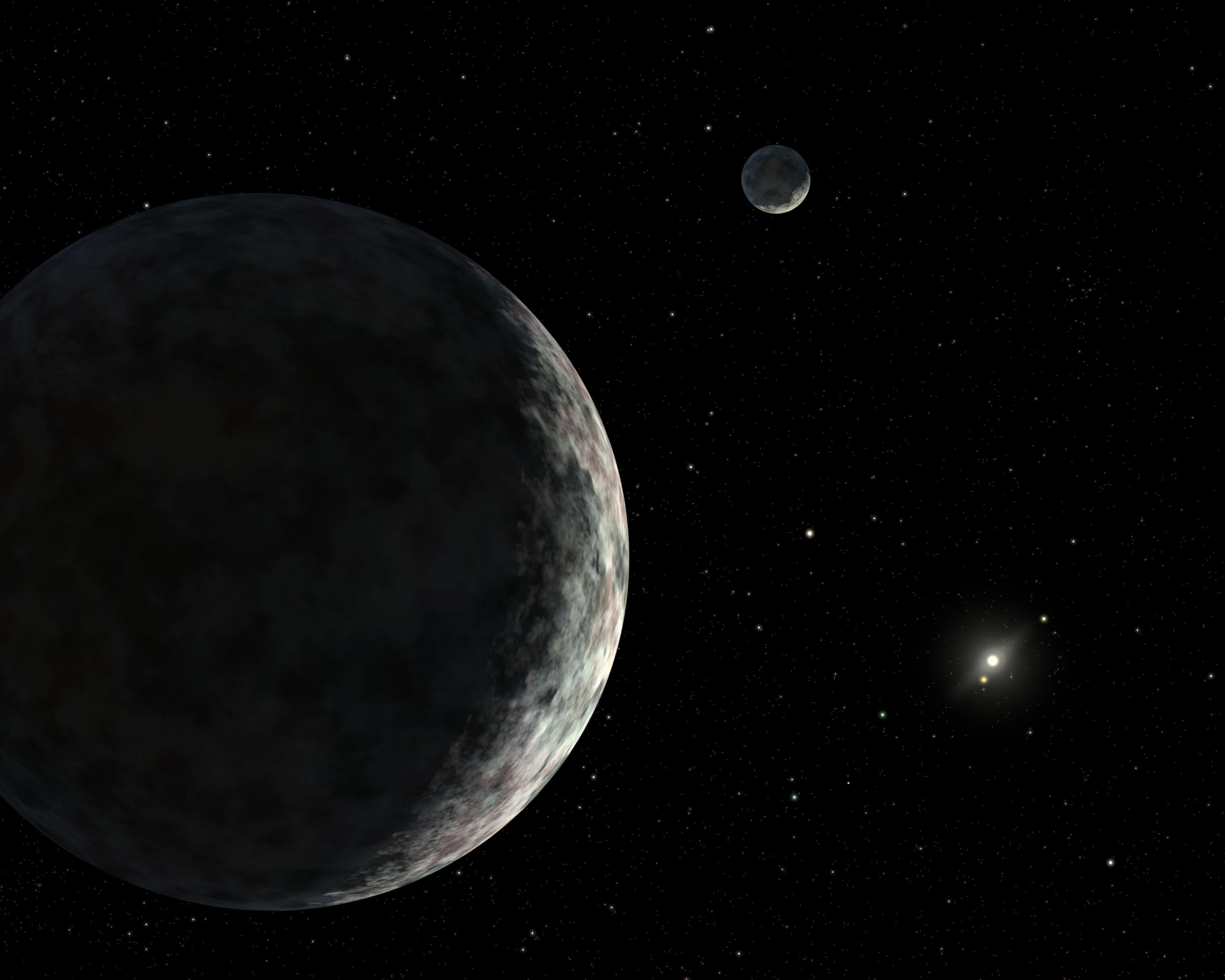
Image credit: NASA/JPL-Caltech. An artist's concept of Eris with its moon Dysnomia; the Sun is the bright star at upper right. Eris has never been resolved as more than a point of light, so its appearance is imagined from what we can measure.
Type
Dwarf planet (scattered disk)
Diameter
~2,326 km (just under Pluto)
Mass
~27% more than Pluto — the most massive dwarf planet
Moon
Dysnomia
Pluto's twin, and the reason the rules changed
Eris was discovered in 2005 by a team led by Mike Brown, from images taken in 2003. It sits in the scattered disk, far beyond the Kuiper Belt, on a wildly stretched and tilted orbit that currently places it about 96 astronomical units from the Sun — some three times farther than Pluto. At that distance a single orbit takes roughly 559 years. It is bright because it is coated in highly reflective ice, likely frozen methane and nitrogen that snow out of a thin atmosphere as Eris moves to the colder, far end of its orbit.
The crucial fact is how much Eris resembles Pluto. The two are almost identical in size — Pluto's diameter is a hair larger, but Eris is about 27% more massive, making it the heavyweight of the dwarf planets. A precise measurement came in 2010 when Eris passed in front of a distant star (a stellar occultation), letting astronomers time the blink and pin down its diameter. Eris has one known moon, Dysnomia. When it was found, Eris looked like a clear tenth planet — and that is precisely the problem it created.
Realistically, a target for research telescopes
Be honest with yourself: Eris is essentially unobservable with ordinary equipment. At around magnitude 18.7 it is the faintest of the five dwarf planets and lies beyond the reach of all but large amateur telescopes under superb skies, and even then only as an impossibly dim point that must be identified by its slow motion over many nights. For nearly everyone, Eris is a world to know about rather than to see — a reminder that some of the most important objects in the Solar System are, to human eyes, simply too far into the dark.
New to stargazing? See how to observe the night sky, and if you're choosing gear, the no-hype telescope buying guide.
The goddess of strife, and a very deliberate joke
The naming of Eris is one of astronomy's best in-jokes. Eris is the Greek goddess of strife and discord — the deity who, uninvited to a wedding of the gods, tossed a golden apple inscribed "for the fairest" into the hall and set off the vanity contest that spiraled into the Trojan War. The object that threw the definition of "planet" into chaos and cost Pluto its status was named, quite knowingly, after the goddess who sows exactly that kind of quarrel. Its moon Dysnomia means "lawlessness" — Eris's daughter in myth, and a sly nod to the actress Lucy Lawless, since the team had nicknamed the world "Xena" before it was formally named.
The lasting misconception is that Eris is the "tenth planet." It briefly wore that headline in 2005, but the 2006 decision made it a dwarf planet instead — not a lesser world, but the trigger that forced astronomy to say clearly what it means by "planet" at all. Unlike most dwarf planets, Eris is Greek from the start, so no Roman detour is needed to reach the myth.
Primary sources: NASA — Eris and NASA/JPL Photojournal PIA17307 (Eris and Dysnomia, artist concept). Image credit: NASA/JPL-Caltech.
Named for the goddess who starts quarrels, Eris did exactly what she was named to do — one faint point of light, three times farther than Pluto, that quietly forced humanity to decide what a planet really is.
More astronomy notes
Continue through the astronomy section for beginner-friendly notes, image credits, viewing tips, history, and the stories behind the night sky.
Scattered Disk & Oort Cloud · Pluto · Dwarf Planets · Astronomy · Interests