
The Réti Opening
The purest hypermodern opening — 1.Nf3. Refuse to occupy the centre with pawns; undermine it from the wings with c4 and g3, keeping every transposition open. Réti used it to hand Capablanca his first loss in eight years.
Réti Gambit: A09
KIA setups: A07–A08
Réti main: A04–A06
c4 + g3 + Bg2 hit d5
from the wings, keeping
the structure fluid.
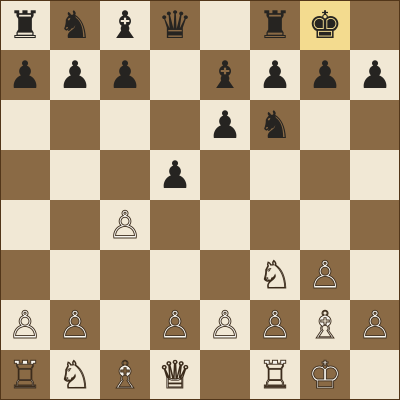
In 1924 Richard Réti opened 1.Nf3, declined to build a big pawn centre, and strangled and beat José Raúl Capablanca — ending the Cuban's eight-year unbeaten streak and announcing hypermodernism to the world. The idea: a big pawn centre is not a strength to be built but a target to be attacked. With 1.Nf3, c4, g3 and Bg2, White pressures d5 from the flanks and keeps the position fluid, ready to transpose into the English, the Catalan, or a King's Indian Attack. It is the ultimate move-order weapon — won by understanding structures, not memorizing lines.
The Réti Gambit: 2.c4
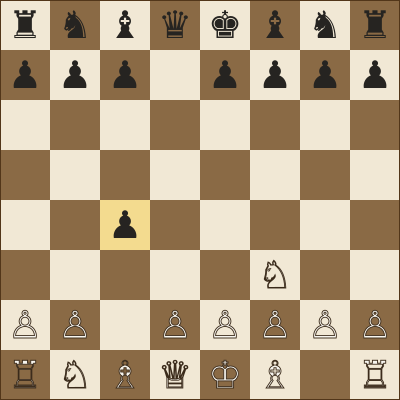
The signature line. After 1.Nf3 d5, White strikes at the centre from the flank with 2.c4 — a gambit in name only, since White easily regains the pawn after ...dxc4 with 3.e3 or 3.Qa4+. Black can decline with 2...e6 (toward Catalan/QGD structures) or 2...c6 (a Slav-like setup), or grab the pawn and try to hold it. Whatever Black chooses, White gets the hypermodern dream: pressure on d5, a fianchettoed bishop on the long diagonal, and a flexible, target-rich position.
The King's Indian Attack Setup
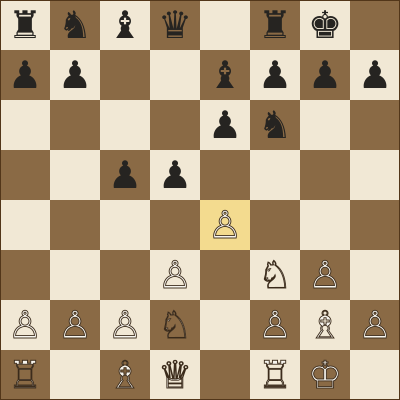
From the Réti move order, White can steer into the King's Indian Attack — a reversed King's Indian with Nf3, g3, Bg2, d3, Nbd2 and a later e4 break. It is one of the most reliable "system" setups in chess: nearly the same moves against many Black formations, then a choice between a kingside attack (e4-e5, Nf1-h2-g4) or central play. Fischer scored famous wins with the KIA.
The Transposition Web
The Réti's greatest weapon is flexibility. Because 1.Nf3 commits to nothing, White can transpose into a whole family of related systems depending on Black's replies:
- Into the English Opening (1.c4 structures) after c4 and Nc3
- Into the Catalan after a later d4 and g3
- Into a King's Indian Attack after d3, Nbd2 and e4
- Into pure Réti structures with the double fianchetto (b3 and g3)
That is why the Réti belongs with the Flank & Hypermodern Systems — alongside the English and the London, three low-theory system openings that reward understanding over memorization.
Frequently Asked Questions
The Réti Opening begins with 1.Nf3 and usually continues with c4 and g3 — a hypermodern flank system where White pressures Black's centre from the wings instead of occupying it. Named after Richard Réti, who used it to beat Capablanca in 1924, it is prized for flexibility and low forced theory.
The Réti Gambit is 1.Nf3 d5 2.c4 — White offers the c-pawn to undermine Black's d5-pawn from the flank. It is a gambit in name only, since White regains the pawn easily after 2...dxc4 3.e3 or 3.Qa4+. It leads to flexible, hypermodern positions.
The King's Indian Attack (KIA) is a reversed King's Indian setup — Nf3, g3, Bg2, d3, Nbd2 and a later e4 break — reachable from the Réti (or 1.e4). It is a 'system' opening: nearly the same moves against many setups, then a kingside or central plan. Fischer scored famous wins with it.
It minimizes forced theory and maximizes understanding. By keeping the move order flexible, White sidesteps deep preparation and steers toward structures White knows well — the English, the Catalan, or a KIA. It's a practical weapon for players who'd rather outplay than out-memorize.
It suits improvers who understand pawn structures and transpositions more than raw beginners, but its system nature (repeatable setups like the KIA) makes it low-maintenance once learned. It teaches the hypermodern lesson that a big centre can be a target, not just a strength.