
The Scattered Disk & Oort Cloud
Past the Kuiper Belt lies the true frontier of the Solar System — a realm of stretched, tilted icy orbits, the far-flung dwarf planet Eris, and, wrapped around it all, the Oort Cloud: a vast spherical shell of frozen worlds that is the nursery of the long-period comets.
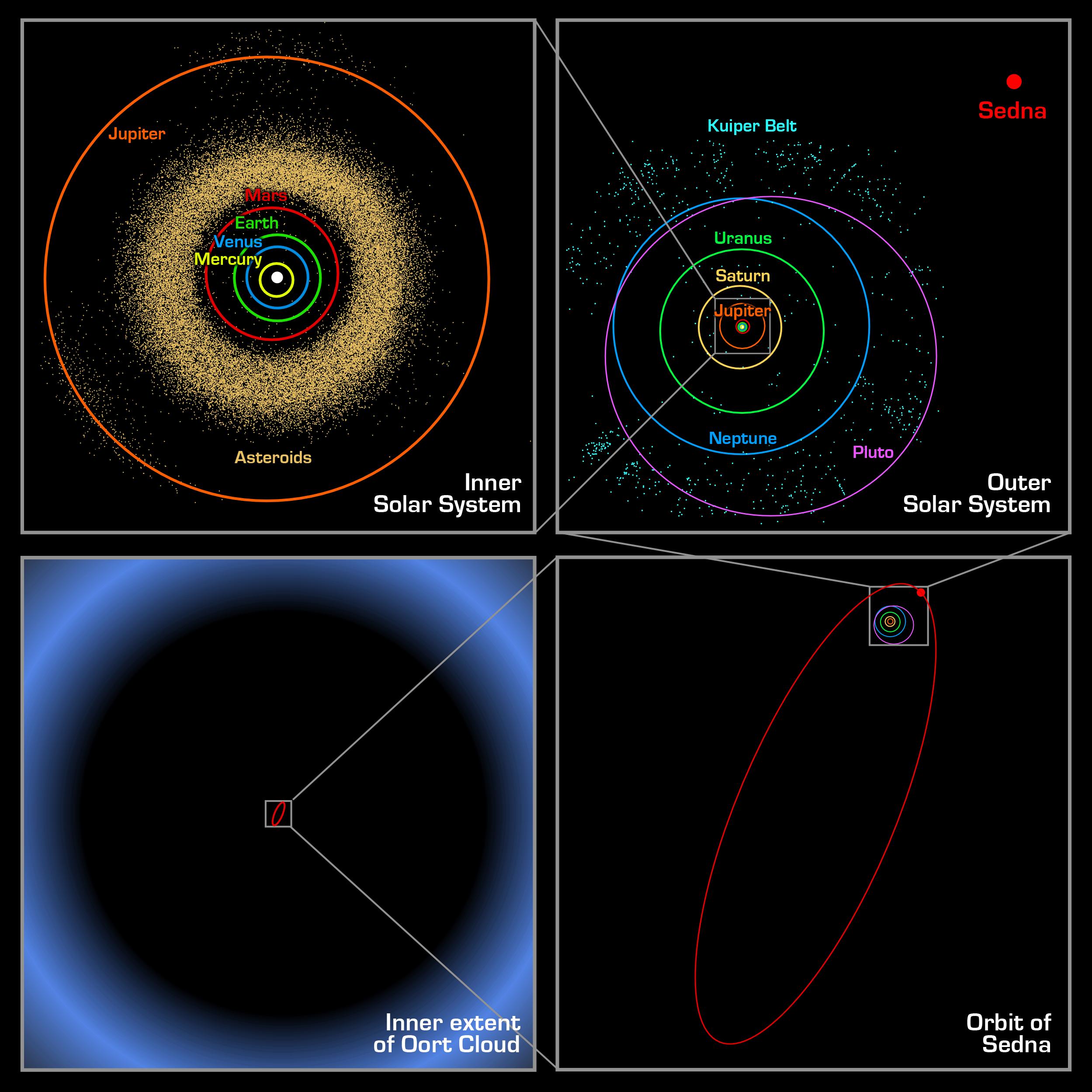
Image credit: NASA/JPL-Caltech. An artist's concept of Sedna — one of the most distant known objects in the Solar System, thought to belong to the inner edge of the Oort Cloud. From Sedna, the Sun would be a brilliant point of light, but no brighter than a distant streetlamp.
Scattered Disk
~30 to 100+ AU, stretched & tilted orbits
Oort Cloud
~2,000 to 100,000+ AU (up to ~1 light-year)
Shape
Disk is flattened; Oort Cloud is a sphere
Notable residents
Eris, Sedna; source of long-period comets
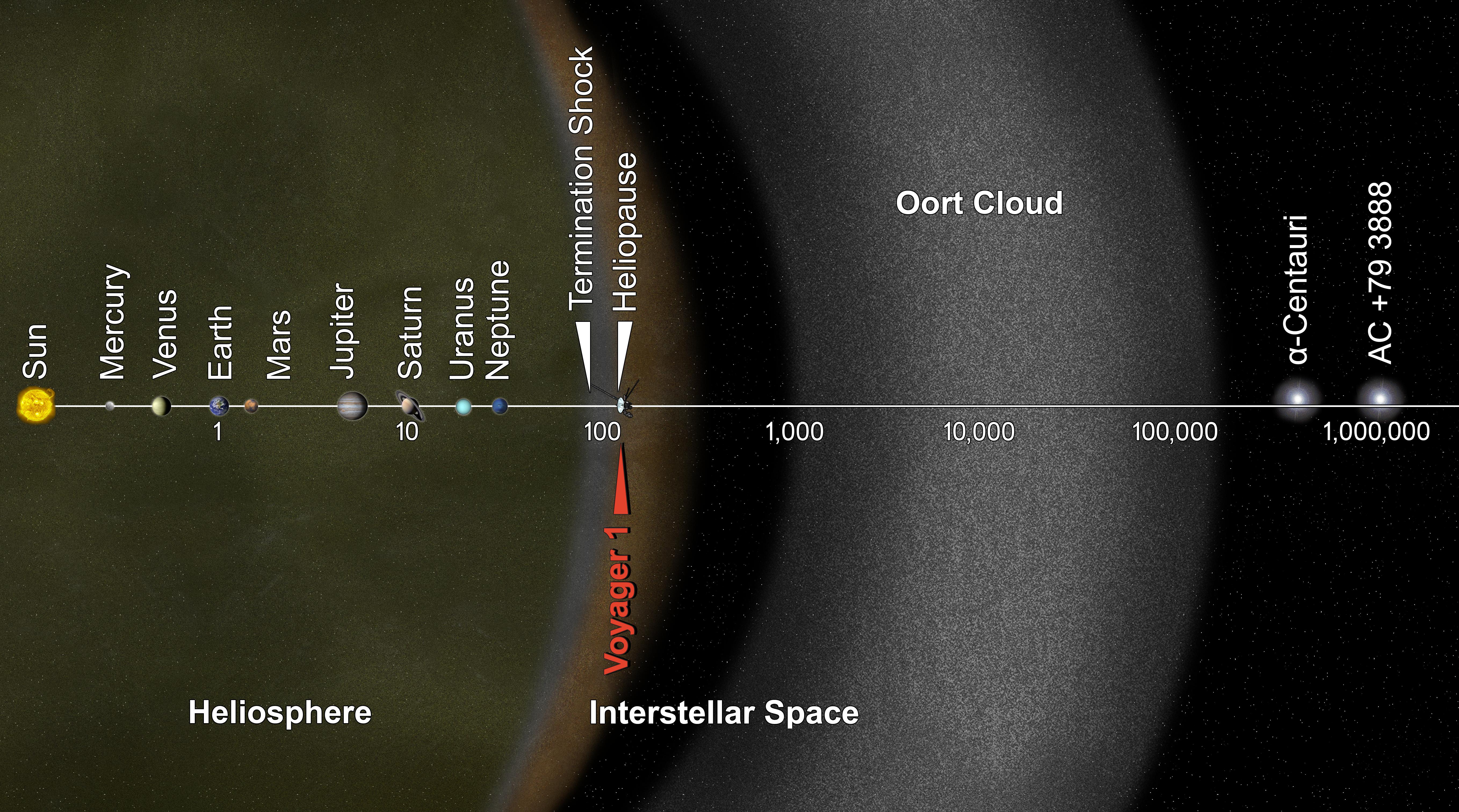
Two frontiers: the scattered disk and the sphere beyond
The scattered disk overlaps the outer edge of the Kuiper Belt but extends much farther, and its objects follow wild, stretched-out, steeply tilted orbits. They got that way by wandering too close to Neptune, whose gravity flung them onto elongated paths. The best-known scattered-disk object is Eris — a dwarf planet almost exactly the size of Pluto but significantly more massive, whose 2005 discovery forced astronomers to reckon with what a "planet" really is.
The Oort Cloud is something else entirely, and the difference is the single most important idea on this page: it is not a belt or a disk — it is a sphere. Every other structure in the Solar System is flat, lying in the same plane as the planets, because they all formed from the same flat disk of gas and dust. The Oort Cloud is a hollow shell surrounding the entire Solar System in every direction, reaching perhaps as far as a light-year from the Sun — a quarter of the way to the nearest star.
Why a sphere? Because its icy bodies did not stay where they formed. Flung outward by the young giant planets, then gently stirred over billions of years by the gravity of passing stars and the tide of the Milky Way itself, their orbits were randomized in every direction. What began as part of a flat disk became a vast, tenuous cloud.
Nothing directly — and that honesty is the point
Let's be straight: you cannot observe the scattered disk or the Oort Cloud from your backyard, and neither can the world's great telescopes see the Oort Cloud at all. Eris, at around magnitude 18, is the faintest of the major dwarf planets and lies beyond all but large research and advanced amateur instruments. The Oort Cloud has never been directly seen by anyone — its bodies are too small, too dark, and too far apart.
So how do we know it is there? We watch its visitors. Every long-period comet that swings through the inner Solar System — arriving from any direction, on an orbit that takes thousands or millions of years to complete — is a messenger from the Oort Cloud. When one blazes into view, you are, in a real sense, observing the Oort Cloud: a single icy body that fell inward from the shell at the edge of the Sun's reach. That is the honest observing target here — not the cloud itself, but the comets it sends us.
The Oort Cloud is inferred, not photographed. Long-period comets arrive from all directions and from enormous distances — exactly the pattern you would expect from a distant spherical shell. The Dutch astronomer Jan Oort worked this out in 1950. The cloud that bears his name has never been seen, and may never be, yet the evidence for it falls toward us a few times a year.
New to stargazing? See how to observe the night sky, and if you're choosing gear, the no-hype telescope buying guide.
The goddess of discord who dethroned a planet
The most consequential object out here is Eris, and its name is a joke that landed perfectly. Eris is the Greek goddess of strife and discord — the deity who, snubbed from a wedding, rolled a golden apple "for the fairest" into the party and set off the quarrel that led to the Trojan War. When astronomers found a body that threw the definition of "planet" into chaos and ultimately cost Pluto its planethood, they named it after the goddess who causes exactly that kind of trouble. Its moon is named Dysnomia — "lawlessness," Eris's daughter. The naming is a wink: the object that broke the rules is named for the spirit of breaking rules.
A common misconception is that the Oort Cloud is a dense, visible shell — a sort of frozen wall at the edge of the Solar System. It is nothing of the kind. It may contain trillions of icy bodies, yet it is so enormous that they are typically tens of millions of kilometers apart. If you stood in the middle of the Oort Cloud, you would see only stars and darkness; you would have no idea you were inside anything at all.
Farther in, on the edge of this realm, orbits Sedna — named not from classical myth but for the Inuit goddess of the sea, who rules the creatures of the frozen Arctic ocean. It is a deliberate and fitting choice for one of the coldest, most remote worlds we know, and a reminder that the sky carries the stories of many peoples, not only the Greeks and Romans.
Eris and its Greek namesake open onto the wider tapestry of myth in the sky. Step into the Greek myths written across the night sky →
Primary sources: NASA — The Oort Cloud, NASA — Eris, and NASA/JPL Photojournal images PIA05569 (Artist's Concept of Sedna) and PIA17046 (Oort Cloud and Scale of the Solar System). Image credit: NASA/JPL-Caltech.
Here the Solar System does not end so much as fade — a flat disk of scattered ice giving way to a silent, invisible sphere, so wide that its farthest members feel the pull of other stars almost as strongly as our own Sun.
Explore the structure of the Solar System
The scattered disk and Oort Cloud are the outermost stop in a tour of the Solar System's belts, rings, and clouds — the leftover architecture between and beyond the planets.
The Solar System (hub) · Asteroid Belt · Kuiper Belt · Scattered Disk & Oort Cloud · Planetary Rings · Zodiacal Cloud
More astronomy notes
Continue through the astronomy section for beginner-friendly notes, image credits, viewing tips, history, and the stories behind the night sky.
The Solar System · Kuiper Belt · Planetary Rings · Astronomy · Interests