
Cosmology: The Whole Story
This is the top of the ladder. The rest of this site climbs outward — from a backyard telescope to the planets, the stars, the nebulae, and the galaxies. Cosmology is the last step: the study of the universe as a single object, its beginning, its contents, and its end. It is the most ambitious question a person can ask — where did all of this come from? — and, remarkably, we have real answers, along with a few enormous mysteries we're honest enough to admit we don't understand.
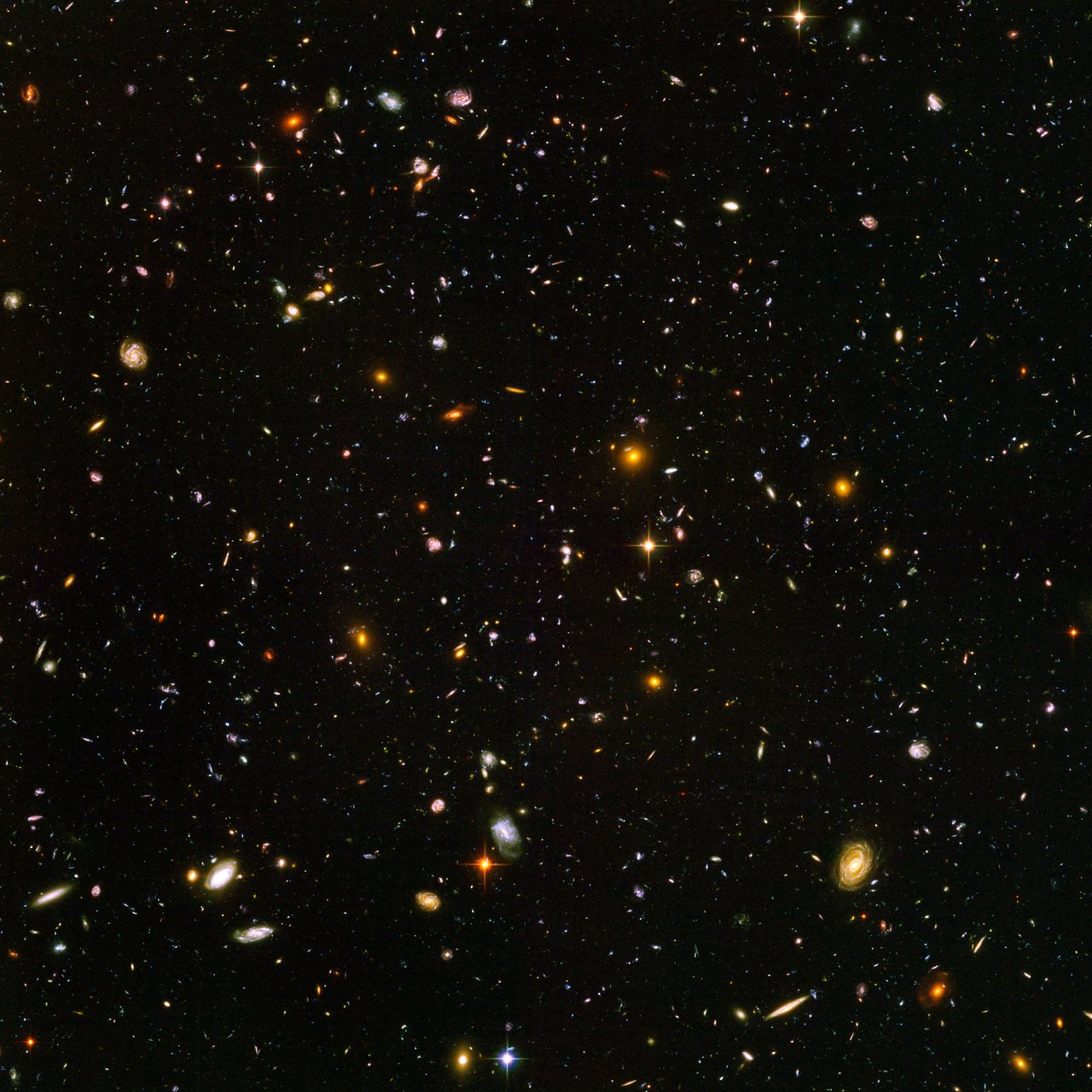
Image: NASA, ESA, and S. Beckwith (STScI) and the HUDF Team. The Hubble Ultra Deep Field — nearly 10,000 galaxies crowded into a patch of sky the size of a grain of sand held at arm's length. The faintest red specks are among the most distant things ever seen, shining when the universe was only a few hundred million years old. This one image is a core of cosmology: look far enough, and you are looking back toward the beginning.
Every telescope is a time machine
Light is fast but not infinitely fast, so it always arrives late. Sunlight is eight minutes old; the nearest star's light is four years old; Andromeda's is 2.5 million years old. Push that to the limit and something wonderful happens: the farther out you look, the further back in time you see. The deepest telescope images show galaxies as they were billions of years ago, when the cosmos was an infant. There is a wall to this — the cosmic microwave background, the oldest light there is — and beyond it, the universe was too hot and dense to be transparent. Cosmology is built on this single strange gift: the sky is a history book, and the pages get older as you read outward.
That's the honest spine of this whole section. Some of what follows we can see directly — the afterglow of the Big Bang, galaxies flying apart, the light of the first stars. Some of it we can only infer from its gravity, and we've given those pieces placeholder names — dark matter and dark energy — that are really admissions of ignorance. This guide keeps the two apart: here is what we know, and here is exactly how we know it.
The universe is mostly stuff we can't see
Add up everything — every star, planet, nebula, and galaxy on this entire site, every atom of every living thing — and you have accounted for about 5% of the universe. The rest is dark. Roughly a quarter is dark matter, an invisible substance we detect only by its gravity. The largest share, more than two-thirds, is dark energy, a mysterious pressure driving the cosmos to expand ever faster. These figures come from ESA's Planck mission, which measured the ancient light of the universe to remarkable precision.
Diagram by Michael Paycer, using Planck (2018) values. The label on that gold sliver is the entire visible universe — everything astronomy has ever photographed.
Where to go from here
The Big Bang
How the universe began — the first second, the first atoms, and why "Big Bang" is a misleading name coined as an insult.
The Cosmic Microwave Background
The oldest light in existence — the afterglow of the Big Bang, and the one piece of the early universe you can literally detect as static.
The Expanding Universe
Space itself is stretching. Hubble's discovery, redshift, and the "Hubble tension" that has two good methods disagreeing today.
Dark Matter
The invisible scaffolding that holds galaxies together — how we know it's there without ever having seen it.
Dark Energy
The biggest mystery in science — the unknown thing making the universe expand faster, and 68% of everything.
The Cosmic Web
On the largest scale, galaxies aren't scattered randomly — they line the walls of a vast web of filaments and empty voids.
The Fate of the Universe
How does it all end? The Big Freeze, the Big Rip, and the Big Crunch — and which one the evidence favors.
The Observable Universe
Why the universe is 13.8 billion years old but 93 billion light-years across — and why the night sky is dark.
Thirteen point eight billion years, in one paragraph
Here is the whole story in miniature, and every chapter has its own page. About 13.8 billion years ago, the universe began in an unimaginably hot, dense state and has been expanding and cooling ever since — the Big Bang. In the first minutes it forged hydrogen and helium; after 380,000 years it cooled enough to become transparent, releasing the cosmic microwave background we still detect today. Gravity, aided by invisible dark matter, pulled that gas into the first stars and galaxies, which arranged themselves along a vast cosmic web. Around six billion years ago, a mysterious dark energy took over and expansion began to accelerate. Where it goes from here — a slow freeze, a violent rip, or a collapse — is the subject of the section's final page. Everything else on this site is a detail inside that sentence.
Made of star-stuff
Cosmology can feel abstract — dark this, cosmic that — but it is the most personal science there is. The hydrogen in every glass of water is nearly as old as the universe, made in the Big Bang itself. The oxygen you're breathing and the calcium in your bones were forged inside stars that lived and died before the Sun was born, then scattered by supernovae into the cloud that became our Solar System. You are, quite literally, the universe examining itself. That's not poetry stretched over physics — it is the physics. Carl Sagan said it best, and it is the through-line of this entire section.
"The cosmos is within us. We are made of star-stuff. We are a way for the universe to know itself."
— Carl Sagan, Cosmos (1980)
What cosmology is not
"The Big Bang was an explosion in space." — No; it was an expansion of space, happening everywhere at once, with no center and no edge (that's covered on the Big Bang page). "Dark matter and dark energy are the same thing." — Not at all — one pulls (holds galaxies together), the other pushes (drives them apart); they just share the word "dark" because both are invisible. "Scientists know what dark energy is." — We don't, and pretending otherwise would be dishonest; naming it is not the same as understanding it. "The universe is expanding into something." — As far as we can tell, no; it isn't expanding into anywhere — space itself is what's growing. "We can see the whole universe." — We can only see the part whose light has had time to reach us; the true universe is larger, possibly infinite (see the observable universe).
Big Bang · CMB · Expanding Universe · Dark Matter · Dark Energy · Cosmic Web · Fate of the Universe · Observable Universe · Galaxies · Stars · Astronomy · Glossary
Return to Michael Paycer
Explore Michael Paycer's professional SQL Server, cloud, ETL, API, automation, and consulting pages, or continue browsing the personal interests section.