
Galaxies: Island Universes
Everything else on this site — the planets, the stars, the nebulae, the black holes — lives inside a single galaxy: ours. A galaxy is a vast island of hundreds of billions of stars, bound by gravity and adrift in a mostly empty cosmos. This is where the site steps outside the Milky Way for the first time, to look at other star-cities. And here's the strange gift of it: to look at a galaxy is to look into the deep past.
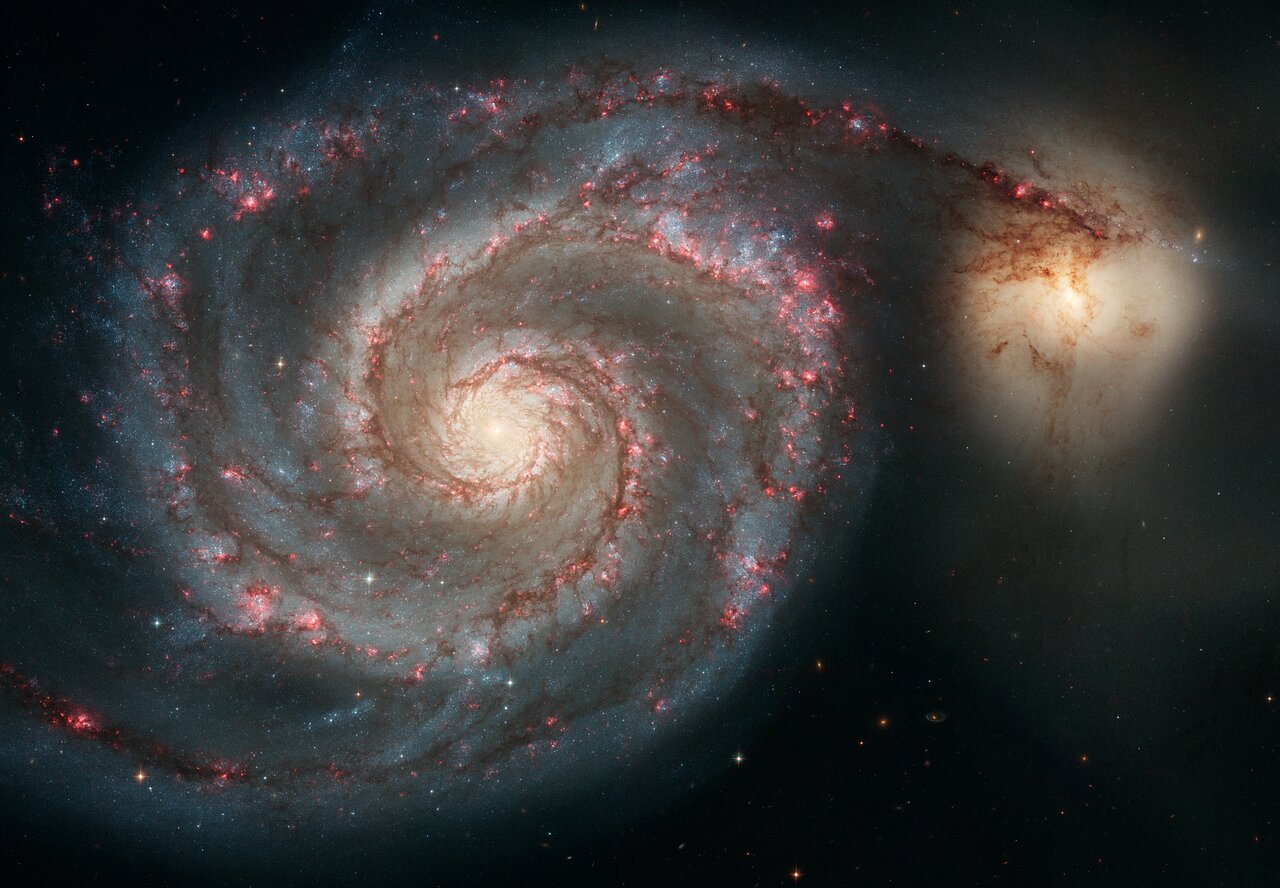
Image: NASA, ESA, S. Beckwith (STScI) & the Hubble Heritage Team. The Whirlpool Galaxy (M51) — a "grand design" spiral about 31 million light-years away, caught interacting with a smaller companion. The light in this image left the Whirlpool 31 million years ago; you are seeing it as it was before humans existed.
Every galaxy is a time machine
Light travels fast, but not infinitely fast — and galaxies are so far away that their light takes millions or billions of years to reach us. So when you look at a galaxy, you never see it as it is now; you see it as it was when that light set out. Andromeda's light is 2.5 million years old — it left before our species existed. The Whirlpool's is 31 million years old. The faintest galaxies in deep telescope images show the universe as an infant, billions of years ago. There is no way to see a distant galaxy in the present tense. Astronomy is the one science that can only study the past.
That's the spine of this whole section: galaxies are not just pretty spirals, they are windows onto cosmic history. It's also why galaxies are the natural bridge from "our neighborhood" to the story of the whole universe — the expanding cosmos is made of galaxies flying apart. This section is the honest field guide to those island universes; the physics of what they're built from lives in the Stars and Black Holes clusters.
Where to go from here
Types of Galaxies
Spirals, ellipticals, lenticulars, and irregulars — the "tuning fork" that sorts every galaxy, and how to tell them apart.
The Milky Way
Our own galaxy, seen from the inside — why it's a band across the sky, where we sit in it, and the black hole at its heart. The one galaxy you can truly see.
When Galaxies Collide
Galaxies crash, merge, and reshape each other — including our own galaxy's uncertain future with Andromeda. Spectacular, and slower than you'd think.
The Andromeda Galaxy
The nearest great galaxy and the most distant thing visible to the naked eye — a trillion-star spiral, and the one Edwin Hubble used to change the universe.
The Whirlpool (M51)
The first spiral structure ever seen — sketched by Lord Rosse in 1845, decades before anyone knew what a galaxy was.
The Sombrero (M104)
An edge-on galaxy with a brilliant bulge and a dark brim of dust — one of the most photogenic objects in the sky, and reachable in a small scope.
The Great Debate — and the night the universe grew
For most of history, nobody knew galaxies existed. The faint spiral smudges in telescopes were called "spiral nebulae," and there was a genuine, bitter argument about what they were. In 1920, astronomers Harlow Shapley and Heber Curtis held the famous "Great Debate": were these smudges clouds within our Milky Way, which many believed was the entire universe — or were they separate "island universes," galaxies in their own right, unimaginably far away?
The answer came in 1924. Using the giant Hooker telescope, Edwin Hubble found a special kind of pulsing star — a Cepheid variable — inside the Andromeda "nebula," and used it to measure the distance. Andromeda was far, far outside the Milky Way. In one stroke, the universe went from a single galaxy to a cosmos of countless galaxies, thousands of times larger than anyone had dared imagine. It is one of the great humbling moments in the history of thought — and it's exactly why this site keeps galaxies and nebulae in separate sections: humanity itself confused the two for a century.
"Equipped with his five senses, man explores the universe around him and calls the adventure Science."
— Edwin Hubble, The Nature of Science (1954)
What galaxies are not
"Galaxy and solar system are the same thing." — Not remotely: a solar system is one star and its planets; a galaxy holds hundreds of billions of stars, and our whole Solar System is a single dot within one. "You can see galaxies well from your backyard." — With rare exceptions, no; even the nearest are faint grey smudges in a telescope, nothing like the photos (that honest gap is covered on each page here). "When galaxies collide, stars smash into each other." — Almost never — galaxies are mostly empty space, so they pass through each other like two swarms of gnats. "The Milky Way is the universe." — People believed exactly that until 1924; it's one of hundreds of billions of galaxies. The real scale is the humbling part, and the reason galaxies are the doorstep to cosmology itself.
Types · The Milky Way · Galaxy Collisions · Andromeda · Whirlpool · Sombrero · Black Holes · Stars · Astronomy · Glossary
Return to Michael Paycer
Explore Michael Paycer's professional SQL Server, cloud, ETL, API, automation, and consulting pages, or continue browsing the personal interests section.