
The Cosmic Web
Zoom out far enough — past stars, past galaxies, past even clusters of galaxies — and the universe reveals its grandest pattern. Galaxies are not sprinkled evenly through space. They are strung along immense glowing filaments and sheets, wrapped around vast, near-empty bubbles of darkness called voids. The whole cosmos, on its largest scale, looks like a web, or a sponge, or the branching threads of a neuron. This is the largest structure that exists.
Galaxies live on the walls of enormous bubbles
If you mapped the position of every galaxy in a large chunk of the universe, you would not get a random scatter. Instead, galaxies clump into clusters, clusters line up into long filaments, and filaments meet at dense nodes — the richest galaxy clusters in the cosmos. Between the strands lie the voids: colossal, nearly empty regions tens or hundreds of millions of light-years across, containing almost no galaxies at all. Picture the froth of soap bubbles: the galaxies ride on the thin soap films, and the great empty spaces are the insides of the bubbles. Our own Milky Way sits in a modest neighborhood on one strand of this web.
Diagram by Michael Paycer (schematic). Real surveys of millions of galaxies show exactly this frothy, weblike pattern across hundreds of millions of light-years.
Grown from the seeds in the CMB
The cosmic web is not decoration — it is the frozen fingerprint of the entire history of structure. It began with the almost imperceptible ripples in the cosmic microwave background: patches of the infant universe that were a hundred-thousandth denser than average. Gravity did the rest. Over billions of years, the slightly denser regions pulled in more material, growing denser still, while the emptier regions gave up their matter and grew emptier — a runaway process that carved the smooth early universe into the sharp web we see now. The invisible dark matter led the way: because it outweighs ordinary matter five to one and feels no pressure to resist collapse, it formed the scaffolding first, and ordinary gas simply fell into the dark-matter framework, lighting up as galaxies along the strands. When you look at the cosmic web, you are really seeing the shape of the dark matter, traced out in glowing galaxies.
Maps and simulations that match
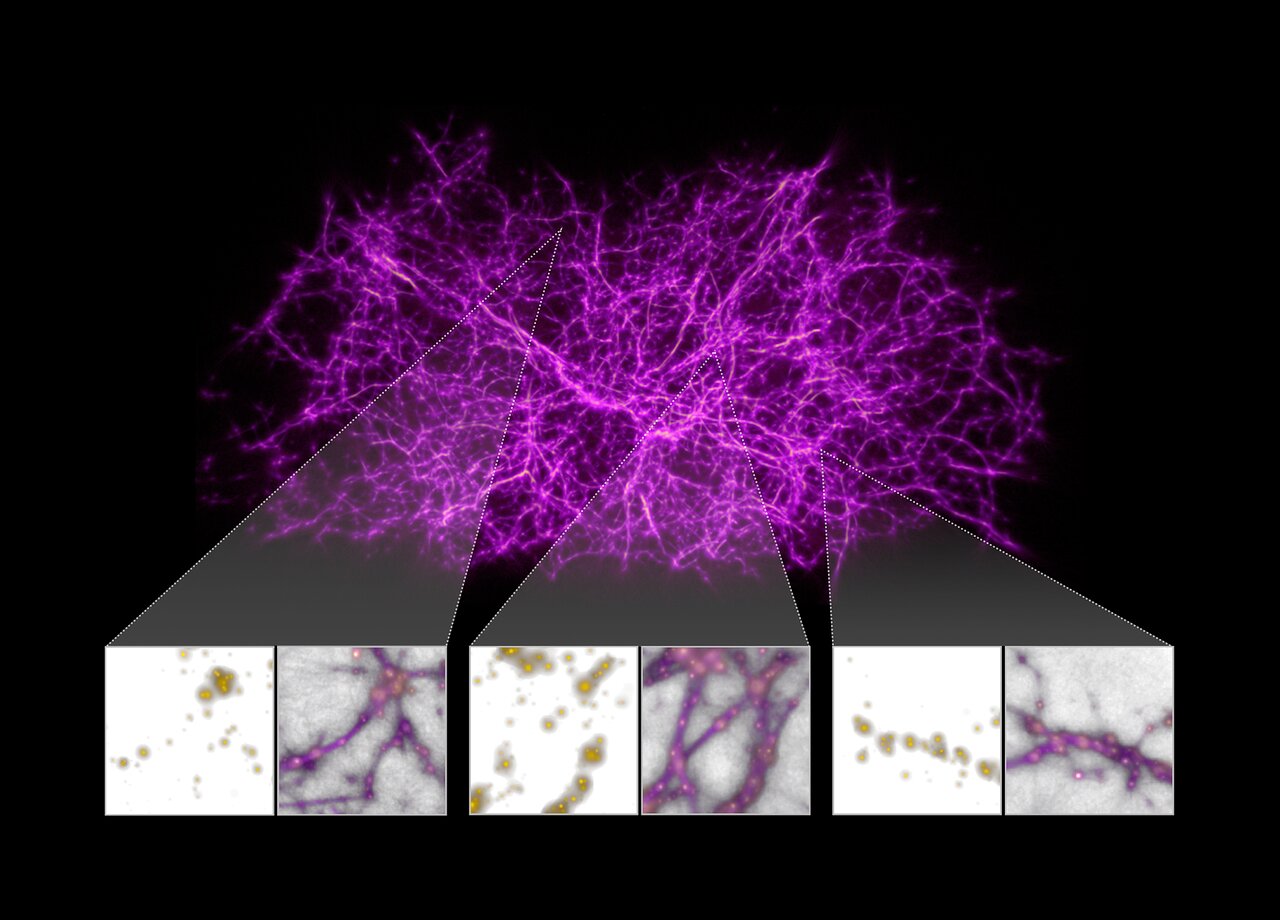
Image credit: NASA, ESA, and E. Wheatley (STScI). A visualization based on supercomputer simulations of the cosmic web — luminous filaments of gas and dark matter meeting at dense nodes, with inset panels zooming in to show how galaxies (gold dots) trace the underlying filamentary structure.
Two independent efforts confirm the web, and their agreement is the point. On the observation side, giant galaxy surveys — the Sloan Digital Sky Survey and its predecessors — measured the distances to millions of galaxies and plotted them in three dimensions, and the froth appeared unmistakably, complete with structures like the Sloan Great Wall, a filament of galaxies over a billion light-years long. On the theory side, supercomputer simulations start from the tiny CMB ripples, apply nothing but gravity acting on dark matter and gas over 13.8 billion years, and grow a virtual universe. The famous Millennium Simulation and its successors produce a cosmic web that looks strikingly like the real maps — same filaments, same voids, same statistics. When a simulation fed only the early-universe seeds reproduces the actual arrangement of galaxies today, it's powerful evidence that we understand how structure grew — and another independent confirmation that dark matter is real.
The night the universe turned out to be mostly empty
For a long time astronomers assumed galaxies were spread more or less smoothly through space. The first cracks appeared in 1981 with the discovery of the Boötes Void, an astonishing near-empty bubble some 330 million light-years across — a hole in the universe so large it was hard to believe. Then, in 1986, Margaret Geller, John Huchra, and Valérie de Lapparent published the first careful 3-D map of a slice of the nearby universe, from the CfA Redshift Survey. Instead of a random spray of galaxies, their map showed thin walls and bubbles and empty gaps — including a great arc of galaxies later called the "Great Wall." It was the moment the frothy, weblike architecture of the cosmos became visible for the first time, and it overturned the tidy assumption of a smooth universe. The structure was far stranger, and far grander, than anyone had pictured — a fitting reminder of an old warning about the cosmos.
"The universe is not only queerer than we suppose, but queerer than we can suppose."
— J. B. S. Haldane, Possible Worlds (1927)
What the cosmic web is not
"Galaxies are spread evenly through space." — Only if you blur your eyes to billion-light-year scales; up close the universe is dramatically clumpy, all filaments and voids. "The voids are completely empty." — Nearly, but not totally — they hold a few lonely galaxies and thin gas; they're just enormously underdense. "The web is made of galaxies." — The visible web is; the real scaffolding is invisible dark matter, with galaxies merely lighting up the densest threads. "It's the same as a single galaxy cluster." — No — clusters are the nodes where filaments meet; the web is the entire network linking them, the largest structure there is. Beyond it, there's only the overall expansion of everything.
Cosmology Hub · Dark Matter · CMB · Galaxies · Galaxy Collisions · Observable Universe · Astronomy · Glossary
Return to Michael Paycer
Explore Michael Paycer's professional SQL Server, cloud, ETL, API, automation, and consulting pages, or continue browsing the personal interests section.