
Dark Matter
About a quarter of the universe is made of something we cannot see, cannot touch, and have never captured — yet we're as sure it's there as we are of the ground under our feet. It gives off no light, but its gravity is everywhere: it holds galaxies together, bends the light of distant objects, and built the scaffolding on which every galaxy hangs. It outweighs all the visible matter in the cosmos by more than five to one, and we still don't know what it is.
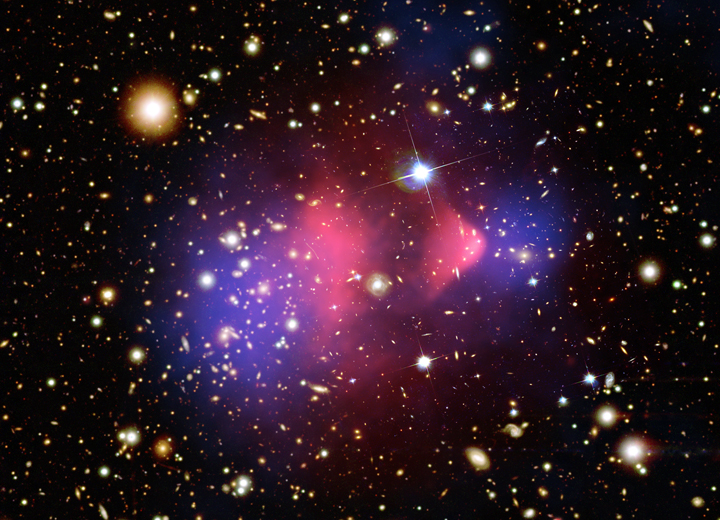
Image: X-ray: NASA/CXC/CfA/M. Markevitch et al.; Lensing map: NASA/STScI, ESO WFI, Magellan/U.Arizona/D. Clowe et al.; Optical: NASA/STScI, Magellan/U.Arizona. The Bullet Cluster — two galaxy clusters that crashed through each other. The pink shows the hot gas (most of the ordinary matter); the blue shows where most of the mass actually is, mapped by its gravity. The two have come apart — direct visual evidence that most of the mass is something other than the gas we can see.
Invisible, but not empty
Dark matter is a form of matter that has mass and gravity but does not interact with light — it neither shines, absorbs, nor reflects, which is why it's "dark" (a better word would be "transparent" or "invisible"). It also barely interacts with ordinary matter or even with itself, except through gravity. It isn't antimatter, it isn't black holes, and it isn't just faint gas or dim stars — astronomers have carefully ruled those out. It appears to be a genuinely new kind of substance, one not included in the familiar list of particles that make up everything you've ever touched. And there's a lot of it: roughly five to six times as much dark matter as ordinary matter, forming vast invisible halos that cradle every galaxy, our own Milky Way included.
Galaxies spin too fast to hold together
The cleanest evidence came from watching galaxies rotate. In a spinning galaxy, gravity is what keeps the outer stars from flying off — so if nearly all the mass is in the bright central bulge, the outer stars should orbit slowly, the way distant planets orbit the Sun far more slowly than Mercury. That's the expectation. But when astronomers measured how fast stars actually orbit at a galaxy's edge, they found something impossible: the outer stars move just as fast as the inner ones. The rotation "curve" stays flat instead of dropping off. The only way to explain it is that the galaxy is embedded in a huge halo of unseen mass extending far beyond its visible edge — enough to keep those fast outer stars gravitationally bound.
Diagram by Michael Paycer (schematic). The gap between the two lines is dark matter. Vera Rubin measured this flatness in galaxy after galaxy in the 1970s, turning a curiosity into a crisis.
Four independent witnesses — and one honest gap
No single observation would be enough. What makes dark matter compelling is that completely different lines of evidence all demand the same missing mass. Rotation curves show galaxies spinning too fast for their visible matter. Gravitational lensing — the bending of background light by a foreground mass, predicted by Einstein — reveals far more mass in galaxy clusters than the stars and gas can account for. The Bullet Cluster pictured above is the clincher: when two clusters collided, the gas (pink) got slowed and stuck in the middle, but the bulk of the mass (blue, mapped by lensing) sailed straight through — exactly what you'd expect if most of the mass is dark matter that barely interacts. And the cosmic microwave background, the fine ripples in the infant universe, only make sense with the right amount of dark matter present from the start.
Now the honest part: for all that, no one has ever directly detected a particle of dark matter. Deep underground labs have hunted for decades with exquisitely sensitive detectors; particle colliders have looked; nothing has been caught. We know its gravity intimately and its identity not at all. The leading candidates are hypothetical particles — WIMPs, axions — that remain undiscovered. A minority of physicists even wonder whether our theory of gravity needs modifying instead. Dark matter is, at once, one of the best-evidenced and least-understood things in all of science, and pretending otherwise would be dishonest.
The dismissed Swiss and the overlooked American
The idea arrived decades before anyone took it seriously. In 1933 the brilliant, abrasive Swiss astronomer Fritz Zwicky studied a cluster of galaxies, found they were moving far too fast to stay bound by their visible mass, and coined the term dunkle Materie — "dark matter." He was largely ignored for forty years; his reputation for calling colleagues "spherical bastards" (bastards no matter which way you looked at them) didn't help. The turning point came in the 1970s, when Vera Rubin and Kent Ford patiently measured the rotation of dozens of galaxies and found the flat curves that couldn't be argued with. Rubin's careful, unglamorous work made dark matter undeniable — and yet she was never awarded the Nobel Prize, an omission many astronomers consider one of the field's clearest injustices. She remained characteristically humble about how much was still unknown.
"We have peered into a new world, and have seen that it is more mysterious and more complex than we had imagined. Still more mysteries of the universe remain hidden. Their discovery awaits the adventurous scientists of the future. I like it this way."
— Vera Rubin, whose galaxy rotation measurements made the case for dark matter
What dark matter is not
"Dark matter is the same as dark energy." — No — dark matter pulls (its gravity holds galaxies together); dark energy pushes (it drives galaxies apart). They share only the word "dark." "Dark matter is just black holes and dim stars." — Those have been counted and ruled out; there isn't nearly enough ordinary dark stuff to do the job. "It's antimatter." — No; antimatter annihilates on contact with matter, releasing light — dark matter doesn't. "Scientists know what it is, they just can't see it." — We know it's there and roughly how much, but its actual identity is genuinely unknown. It's the largest lump of the universe we can name but not explain.
Cosmology Hub · Dark Energy · Cosmic Web · CMB · Galaxies · The Milky Way · Astronomy · Glossary
Return to Michael Paycer
Explore Michael Paycer's professional SQL Server, cloud, ETL, API, automation, and consulting pages, or continue browsing the personal interests section.