
The Cosmic Microwave Background
It is the oldest thing anyone can ever see: a faint glow of microwaves coming from every direction in the sky, released when the universe was just 380,000 years old. It is the afterglow of the Big Bang, cooled by 13.8 billion years of expansion to a whisper just above absolute zero — and it is, quite literally, a baby photograph of the entire cosmos.
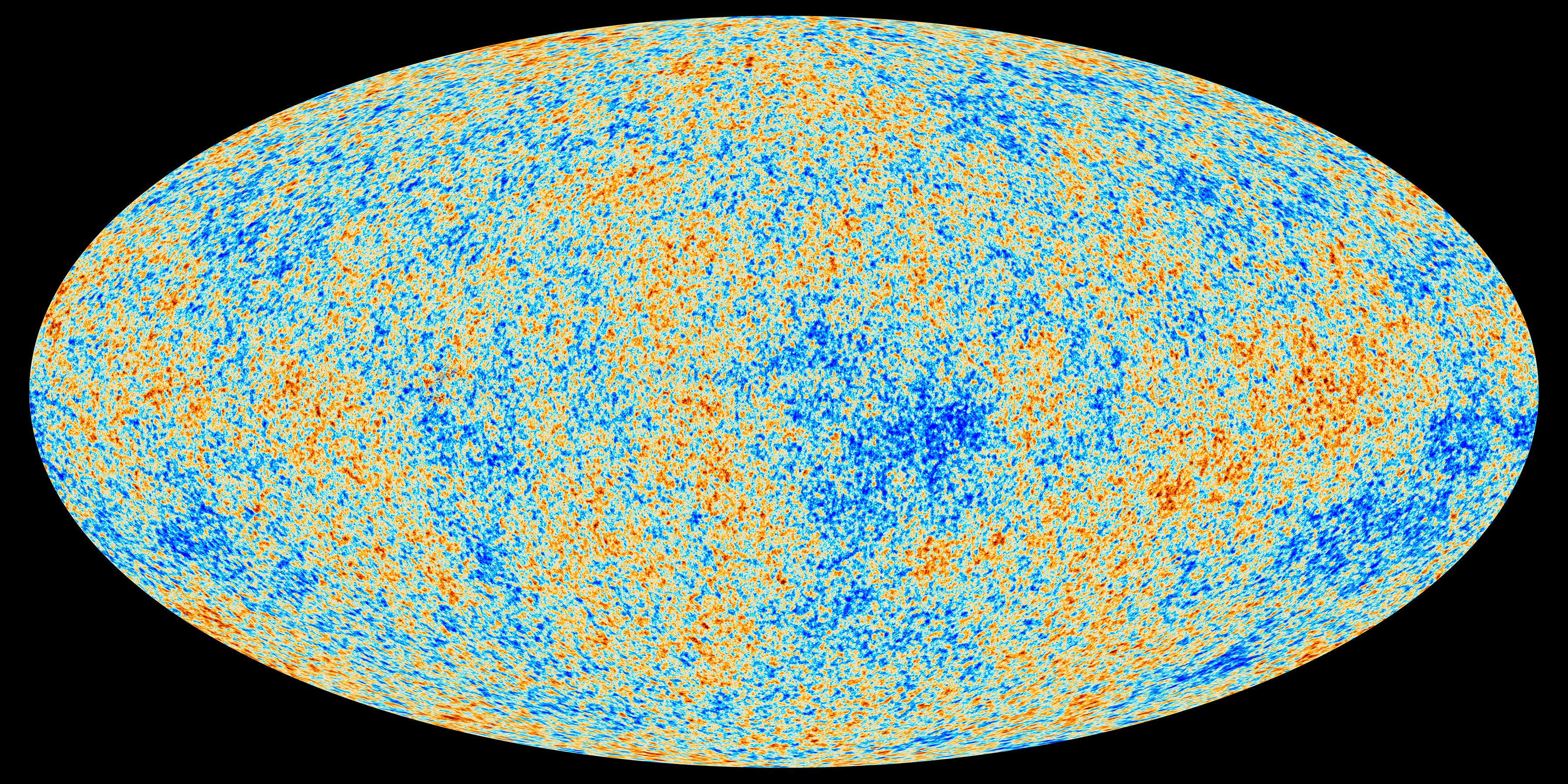
Image: ESA and the Planck Collaboration. The whole sky in a single oval: the cosmic microwave background as mapped by ESA's Planck satellite. The mottled colors are temperature differences of a hundred-thousandth of a degree — hotter and cooler patches in the infant universe that became the seeds of every galaxy that exists today. This is the universe at 380,000 years old.
The moment the fog lifted
For its first 380,000 years, the universe was too hot to be transparent. It was a dense, glowing plasma of loose electrons and nuclei, and light couldn't travel far before bouncing off a free electron — the whole cosmos was an opaque fog, like the inside of the Sun. Then expansion cooled it below about 3,000 degrees, cool enough for electrons and nuclei to join into the first neutral atoms. Suddenly the fog cleared, and light could stream freely for the first time. That light has been traveling ever since. We call the moment it was set free the "surface of last scattering," and the light itself is the cosmic microwave background.
Two things about it are astonishing. First, it comes from every direction — because the early universe was everywhere, its afterglow fills all of space. Second, it is almost perfectly smooth, the same temperature everywhere to about one part in 100,000. Those tiny departures from smoothness — the mottling in the Planck map — are the whole story of everything that came after. The slightly denser patches had a little more gravity, so they pulled in more gas, and over billions of years grew into the cosmic web of galaxies. Every structure in the universe was seeded in that map.
The static between the stations
Here is the honest, wonderful thing about the CMB — unlike almost everything else in cosmology, you don't have to take it on faith or squint at a telescope. You have already seen it. On an old analog television tuned between channels, a few percent of that snowy static was the cosmic microwave background: real photons from the young universe, ending their 13.8-billion-year journey inside your living room. An old radio hissing between stations catches a little of it too. It is the most democratic object in astronomy — no equipment, no dark sky, no aperture required. The afterglow of creation is soaking through you right now, about 400 of those ancient photons in every cubic centimeter of the room you're sitting in.
Why "microwave"? When this light was released it was hot and visible — an orange-white glow. But over 13.8 billion years, the expansion of the universe stretched its wavelength more than a thousandfold, redshifting it all the way down from visible light into microwaves. The glow didn't cool because it hit anything; it cooled because space itself grew. It now sits at just 2.7 degrees above absolute zero.
Found by accident, blamed on pigeons
The greatest discovery in the history of cosmology was, at first, mistaken for bird droppings. In 1964, two radio engineers at Bell Labs — Arno Penzias and Robert Wilson — were trying to use a sensitive horn antenna in New Jersey and kept picking up a faint hiss they couldn't get rid of. It came from every direction, day and night, all year. They checked everything. They evicted a pair of pigeons roosting in the antenna and scrubbed out what Penzias delicately called "a white dielectric material" (the droppings). The hiss remained. Only after talking to physicists at nearby Princeton — who had been about to go looking for exactly this signal — did they realize what they had: the predicted afterglow of the Big Bang, hiding in their static. They won the 1978 Nobel Prize for a discovery they'd spent months trying to eliminate as noise.
The signal had, in fact, been predicted years earlier by George Gamow, Ralph Alpher, and Robert Herman, who calculated in the late 1940s that a hot Big Bang should leave a cold afterglow. Nobody went looking hard enough until Penzias and Wilson stumbled into it. Later missions — COBE in the 1990s, then WMAP and ESA's Planck — mapped its faint ripples in ever-finer detail, and it was those maps that pinned down the universe's age at 13.8 billion years and its recipe of ordinary matter, dark matter, and dark energy. When COBE first resolved the ripples in 1992, the lead scientist, George Smoot, reached for the biggest words he had.
"If you're religious, it's like looking at God."
— George Smoot, on the 1992 COBE map of the CMB's ripples, for which he shared the 2006 Nobel Prize
What the CMB is not
"It's light from the Big Bang itself." — Close, but it's from 380,000 years after the Big Bang — the earliest light that could travel freely, not the event itself. "It's coming from one place, far away." — No; it comes from all directions at once, because it was released everywhere. The "surface" we see is just the shell of space whose light is reaching us right now. "It's a picture of galaxies forming." — Not yet — it's the smooth gas before a single star existed; the mottling shows only the tiny density seeds. "The universe is expanding, so the CMB will disappear." — It's slowly fading and cooling as space grows, but it will be detectable for a very long time. It is the most important fossil in science — a direct look at the universe as an infant.
Cosmology Hub · The Big Bang · Expanding Universe · Dark Matter · Cosmic Web · Observable Universe · Astronomy · Glossary
Return to Michael Paycer
Explore Michael Paycer's professional SQL Server, cloud, ETL, API, automation, and consulting pages, or continue browsing the personal interests section.