
The Panov-Botvinnik Attack
White's most ambitious anti-Caro-Kann — 3.exd5 cxd5 4.c4 — dissolving the solid pawn structure into a sharp isolated-queen's-pawn battle. The purest study of IQP strategy in all of opening theory.
Panov main: B13–B14
5...Nc6 IQP: B14
5...g6 setup: B14
4.c4 opens the centre;
White gets active pieces
vs Black's d5 blockade.
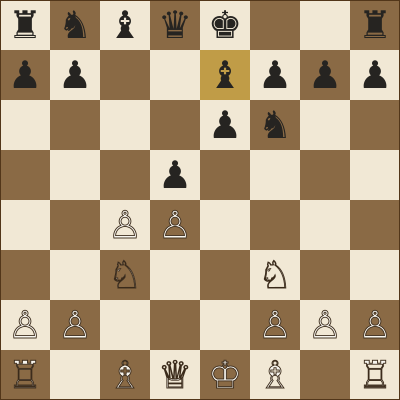
The Panov-Botvinnik turns the Caro-Kann on its head. Instead of the quiet, structure-based game the Caro-Kann usually promises, White plays 4.c4 to create an isolated queen's pawn (IQP) position — the single most instructive middlegame structure in chess. White's side of the IQP is about activity: the pawn grants open lines, the d5-outpost's cousin e5 for a knight, and attacking chances while the pawn stands. Black's side is about restraint: blockade the pawn on d5, trade pieces, and win it in the endgame. Master both sides of the Panov and you master the isolated queen's pawn everywhere it appears.
The 5...Nc6 Main Line
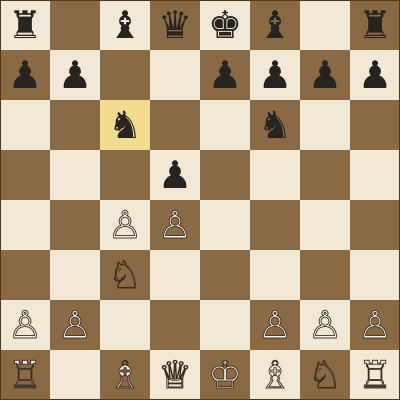
The classical treatment. After 4.c4 dissolves the centre, an isolated queen's pawn appears on d4 — White's pawn. Black develops with ...Nc6, ...e6, ...Be7 and blockades the pawn with a knight on d5 or a piece on d6. The plan is textbook IQP defence: trade pieces, control the blockade square, and steer toward an endgame where the isolated pawn becomes a target. White, meanwhile, plays for piece activity, the e5-outpost, and kingside attacking chances before the pawn can be won.
The 5...g6 Fianchetto
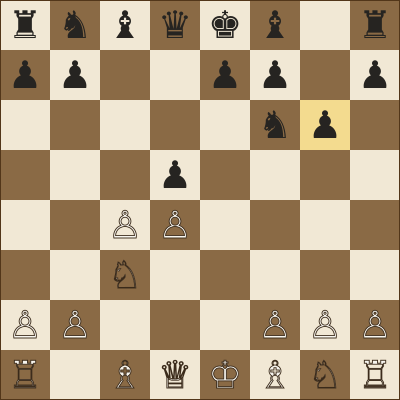
A modern, Grünfeld-flavoured approach: Black fianchettoes to g7 and pressures the isolated d-pawn (and the d4/c4 structure) from afar along the long diagonal. Instead of the direct blockade, Black targets the centre with piece pressure and the ...Bg7, ...0-0, ...Nc6 setup. It is a dynamic way to meet the Panov that avoids the most heavily analyzed blockade lines.
Playing Both Sides of the IQP
White's IQP Plan
Use the pawn while it lives: open lines for the bishops, plant a knight on e5, lift a rook to the kingside (Rd1-d3-g3/h3), and attack before Black consolidates. The d4-d5 break at the right moment can be devastating.
Black's IQP Plan
Blockade d5 with a knight, trade minor pieces to reduce White's attack, and reach an endgame where the isolated pawn is a lasting weakness. Patience and piece trades are Black's allies.
Frequently Asked Questions
The Panov-Botvinnik arises after 1.e4 c6 2.d4 d5 3.exd5 cxd5 4.c4 — White exchanges on d5 and then plays c4 to create an isolated-queen's-pawn (IQP) position. It transforms the usually solid Caro-Kann into a sharp, double-edged game of activity versus structure, and is White's most ambitious try against the Caro-Kann.
An IQP is a pawn (here White's on d4, or Black's on d5 after further trades) with no friendly pawns on the adjacent files, so it cannot be defended by a pawn. The side with the IQP gets open lines and active pieces while it stands; the opposing side blockades it and aims to win it in the endgame. It is the most instructive structure in chess.
Black's main lines are 5...Nc6 and 5...e6, developing solidly and preparing to blockade the isolated pawn on d5, then trading pieces toward a favourable endgame. The modern 5...g6 fianchetto pressures the centre from the long diagonal. All are sound — Black is fine with accurate play.
Because the Panov offers White active, attacking chances that the main Caro-Kann lines don't. Players who dislike the slow manoeuvring of the Advance or Classical Caro-Kann use the Panov to steer into an open, piece-active IQP middlegame where initiative matters more than structure.
It is named after Vasily Panov and Mikhail Botvinnik, who developed its theory in the early-to-mid 20th century. Since then, players from Fischer to Karpov to Anand have handled both sides of its isolated-queen's-pawn positions, making it a cornerstone of IQP theory.