Caro-Kann Defense Variations
Classical main lines, Panov-Botvinnik Attack, Two Knights, and Fantasy Variation — the full range of Caro-Kann systems.
B13–B14 (Panov)
B11 (Two Knights)
B12 (Fantasy Variation)
3.Nc3 dxe4 4.Nxe4
Bf5 5.Ng3 Bg6
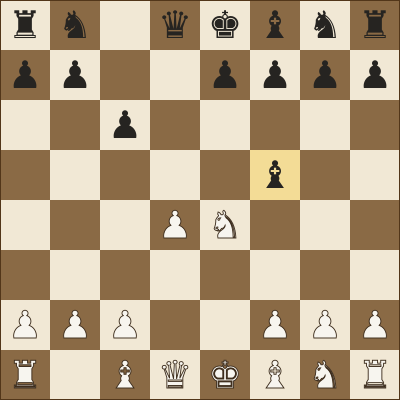
The Classical Caro-Kann: 3...dxe4 4.Nxe4 Bf5
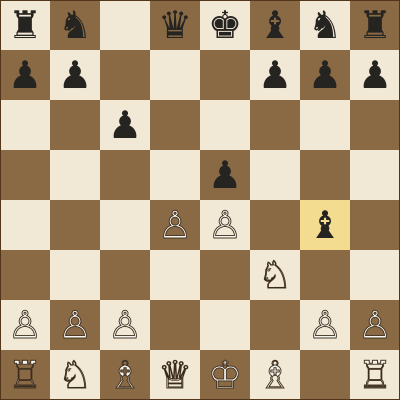
The Classical is the most principled and popular Caro-Kann variation. After White's standard 3.Nc3, Black captures with 3...dxe4, forcing White to recapture. The key move is 4...Bf5 — Black's c8-bishop escapes before the pawn chain can lock it in. This is the Caro-Kann's defining achievement: the bishop that is the "bad bishop" in the French Defense becomes actively placed in the Classical Caro-Kann.
After 1.e4 c6 2.d4 d5 3.Nc3 dxe4 4.Nxe4 Bf5 — the Classical Caro-Kann. Black's bishop on f5 (highlighted) is the hallmark of the Classical: it escaped the pawn chain and is now actively placed, controlling key diagonal squares.
After 5.Ng3 Bg6, White forces the bishop to retreat — but the bishop is still active on g6. Then 6.h4 h6 7.Nf3 (or 7.h5) continues the battle. Karpov's handling of the Classical Caro-Kann was masterful — he repeatedly demonstrated that Black's solid setup, combined with the active bishop, gives excellent practical results.
Spassky/Bronstein Variation (6.h4)
White immediately plays 6.h4, threatening h5 to trap the bishop. Black responds 6...h6, preventing h5 and creating a target for later attacks. After 7.Nf3 Nd7 8.h5 Bh7, the bishop is tucked away but secure. White then attacks with e3-Bd3-Nf5 or continues naturally.
Karpov Variation (4...Nd7)
Instead of 4...Bf5, Black plays 4...Nd7, keeping ...Ngf6 available. After 5.Bc4 Ngf6, Black develops naturally. The bishop doesn't escape via f5 but Black avoids the h4-h5 push that targets the bishop. Karpov made this flexible approach a cornerstone of his repertoire — the line is also known as the Smyslov Variation. (The true Bronstein-Larsen is 4...Nf6 5.Nxf6 gxf6, accepting doubled pawns for the open g-file.)
The Panov-Botvinnik Attack (3.exd5 cxd5 4.c4)
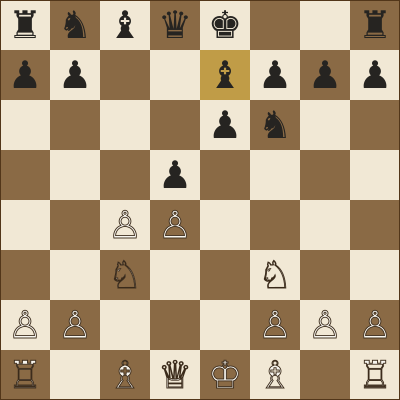
The Panov-Botvinnik transforms the Caro-Kann into an IQP (Isolated Queen's Pawn) position after 3.exd5 cxd5 4.c4 Nf6 5.Nc3 e6 6.Nf3. White accepts an isolated pawn on d4 in exchange for active piece play; Black blockades d5 with a knight, develops solidly, and aims to trade down against the isolani. The structure resembles the QGD after the exchange on d5.
The IQP position is one of chess's most instructive structures. White's plan: use active piece play, open lines for the bishop pair, advance e4 or d5 at the right moment. Black's plan: blockade the d4-pawn with a knight on d5, trade off pieces to expose the weakness, win the endgame by attacking the isolated pawn.
White's IQP Weapons
- d4-d5 pawn advance to create passed pawn
- Bishop pair activity on b3 and c1-h6
- Ne5 outpost — permanent center knight
- Rook lift Rd1-d3-g3 to kingside attack
- f4-f5 pawn advance opening g-file
Black's IQP Defense
- Nd5 blockade of the isolated pawn
- Piece trades to reach the endgame
- ...Nb4 or ...Nxe4 tactical counterplay
- ...b5-b4 queenside expansion
- ...Qb6 pressuring b2 and d4
The Two Knights Attack (2.Nc3 d5 3.Nf3)
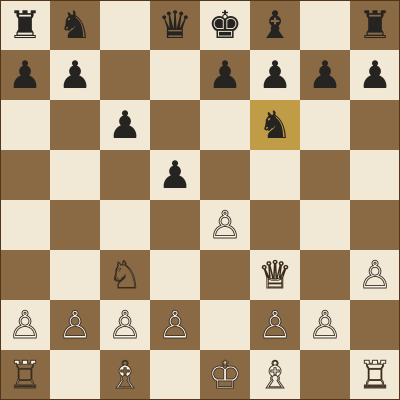
White develops both knights early, bypassing the mainline theory of 2.d4. After 2.Nc3 d5 3.Nf3, Black typically plays 3...Bg4 to pin the knight, or 3...dxe4 transposing into different territory. The Two Knights creates immediate pressure and rewards concrete play.
Bobby Fischer was the system's most famous practitioner, using it regularly in the late 1950s and 1960s to steer opponents out of mainline theory. After 3...Bg4 4.h3 Bxf3 5.Qxf3, White has the bishop pair and attacking potential; Black has solid development and the ability to play ...e6-...Nf6 normally.
The Fantasy Variation (3.f3)
The Fantasy Variation (3.f3) is White's most aggressive option against the Caro-Kann. Rather than recapturing normally, White builds a massive pawn center with d4-e4-f3. If Black takes on e4, White recaptures with the f-pawn, gaining tempo and space. The resulting positions are sharp and uncharted.
After 3...dxe4 4.fxe4 e5 5.Nf3, Black strikes the center before White consolidates. The game enters highly tactical territory. Mikhail Tal used the Fantasy Variation to create complications in critical games — perfectly suited to his attacking style. At club level, the Fantasy is dangerous because few players have studied it carefully.
Rather than capturing on e4, Black plays solidly with 3...e6, treating the position like a French/Caro-Kann hybrid. White's f3 pawn looks aggressive but can become a long-term weakness. After 4.Nc3 Bb4, Black creates a Nimzo-style pin and aims for good counterplay.
Champions of the Caro-Kann
Anatoly Karpov
Karpov made the Caro-Kann his signature defense and played it throughout his career at the highest level. His handling of the Classical variation was particularly instructive — he would maneuver into favorable endgames, exploiting his superior technique. Many of chess's greatest Caro-Kann games have Karpov's name attached to them.
Tigran Petrosian
The legendary positional player used the Caro-Kann's solidity to perfection. Petrosian's defensive mastery was complemented by the Caro-Kann's strategic nature. He used the defense to frustrate tactically superior opponents by denying them the sharp positions they craved, steering into endgames where positional understanding dominated.
Viswanathan Anand
Anand used the Caro-Kann in major world championship preparation, particularly against Topalov in 2010. His handling of both the Advance and Classical lines demonstrated the opening's versatility. Anand's preparation consistently found new ideas in established Caro-Kann positions, keeping opponents guessing about theoretical improvements.
Frequently Asked Questions
The Classical (3.Nc3 dxe4 4.Nxe4 Bf5) allows Black's c8-bishop to escape the pawn chain — the great advantage over the French Defense. Once on f5, the bishop is actively placed, supporting Black's queenside and controlling key squares. This piece is so important that entire variations are defined by White's attempts to chase it away with h4-h5.
After 3.exd5 cxd5 4.c4, White creates an IQP (Isolated Queen's Pawn) position. White gets active piece play and attacking chances; Black blockades the d4 pawn with a knight and aims for the endgame. The Panov structure is one of chess's most instructive — learning to handle it correctly transfers to many other openings.
White plays 2.Nc3 d5 3.Nf3, developing quickly and avoiding mainline theory. Black's most principled responses are 3...Bg4 (pinning the Nf3) or 3...dxe4. The Two Knights creates immediate tactical pressure and rewards concrete calculation. Bobby Fischer used it regularly in his early career.
After 4.Nxe4, Black plays 4...Nd7 instead of 4...Bf5. This keeps the bishop options open — it can go to f5, e6, or b4 depending on White's continuation. After 5.Bc4 Ngf6, Black develops naturally. Karpov and Smyslov used this flexible system to maintain solidity while avoiding the bishop being targeted by h4-h5.
Both are fully sound — the choice is stylistic. The Classical (4...Bf5) produces open, piece-active positions where the escaped bishop dominates. The Advance (3.e5 Bf5) creates a closed French-like structure where Black must break with ...c5. Karpov dominated with the Classical; Petrosian and Anand used the Advance. Both approaches work at all levels.
Key themes: the Ne4-d6+ fork winning material after Black misplaces the queen in the Classical; the Bxh7+ sacrifice when Black's kingside is weakened; the h4-h5-h6 pawn storm to trap the Bg6; in the Panov, the d4-d5 pawn advance to create a passed pawn; and in the Advance, the ...c5 counter-strike to challenge White's center pawn chain.
Further Reading & Sources
Books
- Houska, Play the Caro-Kann
- Schandorff, Playing the Caro-Kann
- Karpov & Podgaets, Caro-Kann Defense
Online Resources
- Lichess.org — Caro-Kann opening explorer
- Chess.com lessons — Caro-Kann Defense
- ChessBase database — filter B10-B19
Model Games
- Karpov – Various, 1974-2005 (Classical)
- Shirov – Opponents (Two Knights)
- Anand – Topalov, 2010 WCh (Advance)
ECO classifications from ECO. Strategic concepts from grandmaster commentaries and opening theory literature.