The Classical Caro-Kann
The heart of the Caro-Kann — 3.Nc3 dxe4 4.Nxe4 Bf5. Black's light-squared bishop escapes to f5 before the pawn chain can trap it, the one luxury the French Defense never enjoys. Karpov's favourite for a decade.
Main line: B18–B19
Karpov 4...Nd7: B17
Bronstein-Larsen: B16
The bishop develops
outside the chain —
then ...e6 is safe.
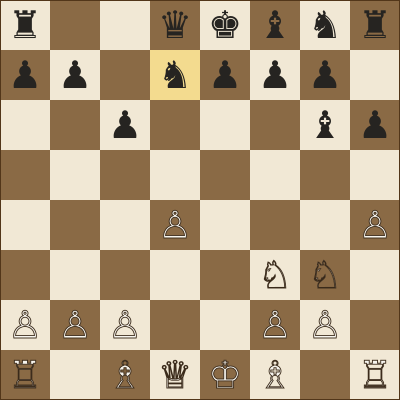
The Caro-Kann and the French both answer 1.e4 by supporting ...d5 — but with a crucial difference. In the French (1...e6), the light-squared bishop is locked behind its own pawns from move one. In the Caro-Kann (1...c6), Black keeps the option to develop that bishop first, and the Classical Variation does exactly that: 4...Bf5 puts the bishop on an active diagonal before ...e6 closes the position. This single idea — solving the 'bad bishop' before it becomes bad — is why Karpov, Petrosian, and Capablanca trusted the Classical Caro-Kann for their most important games.
The Main Line: 5.Ng3 Bg6 6.h4
The great Caro-Kann tabiya. White gains kingside space with h4-h5 (harassing the g6-bishop), and Black responds with the prophylactic ...h6 and solid development: ...Nd7, ...Ngf6, ...e6, ...Bd6, ...Qc7, ...0-0-0 or ...0-0. The resulting middlegames are strategically rich and famously resilient — Black's structure is sound, and the endgames often favour the side with the better pawns. This is positional chess at its purest.
The Karpov Variation: 4...Nd7
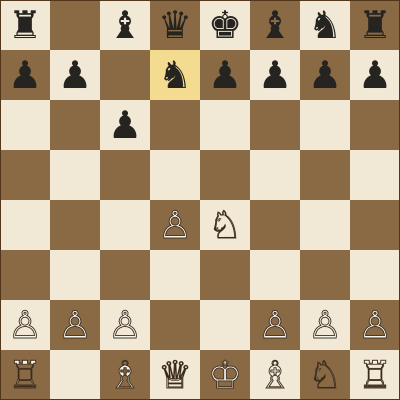
Anatoly Karpov's pet line (also associated with Smyslov). Black develops the knight to d7 first, preparing ...Ngf6 without allowing the doubled pawns of the Bronstein-Larsen. It is even more solid than the main 4...Bf5 — the ultimate "nothing can go wrong" setup. Black quietly completes development and relies on the Caro-Kann's structural soundness, a style that suited Karpov's python-like squeeze perfectly.
The Bronstein-Larsen: 4...Nf6 5.Nxf6 gxf6
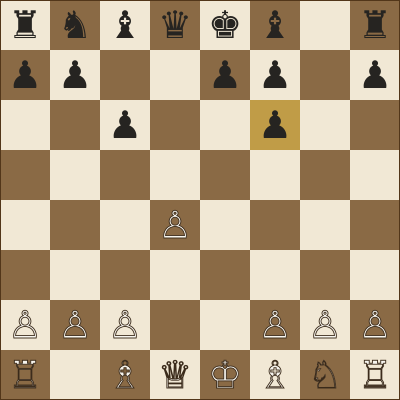
The fighting choice: Black recaptures with the g-pawn, accepting doubled f-pawns in exchange for the half-open g-file, the bishop pair, and a dynamic, unbalanced position. Bronstein and Larsen — two of the great creative attackers — used this to turn the solid Caro-Kann into a double-edged battleground. It is the anti-Karpov: risk and imbalance instead of pure solidity.
Frequently Asked Questions
The Classical Caro-Kann arises after 1.e4 c6 2.d4 d5 3.Nc3 (or 3.Nd2) dxe4 4.Nxe4 Bf5. Black develops the light-squared bishop to f5 — outside the pawn chain — before playing ...e6. This solves the Caro-Kann's only structural question and leads to a solid, endgame-friendly game. It is the main line and the choice of many World Champions.
Because it develops Black's traditionally 'problem' bishop actively before ...e6 locks it in. In the closely related French Defense, that bishop is stuck for the whole game. The Caro-Kann's 4...Bf5 is the whole point of choosing 1...c6 over 1...e6 — active development plus a sound structure.
The Karpov Variation is 3.Nc3 dxe4 4.Nxe4 Nd7 — Black develops the knight first, preparing ...Ngf6 without allowing the doubled pawns of the Bronstein-Larsen. It is extremely solid and was Anatoly Karpov's favourite, suiting his patient, positional style.
The Bronstein-Larsen is 4...Nf6 5.Nxf6 gxf6 — Black recaptures toward the centre with the g-pawn, accepting doubled f-pawns for the bishop pair, the open g-file, and a dynamic position. It transforms the solid Caro-Kann into a fighting, unbalanced game.
Yes. It teaches sound structure, piece development, and endgame technique — the fundamentals of good chess — without the sharpest memorization. Its reputation as the 'grandmaster's defense' comes precisely from how principled and low-risk it is.