
The Orion Nebula
M42 is the brightest nebula in the winter sky — a stellar nursery 1,344 light-years away where stars are forming right now, lit from inside by four young hot stars called the Trapezium.
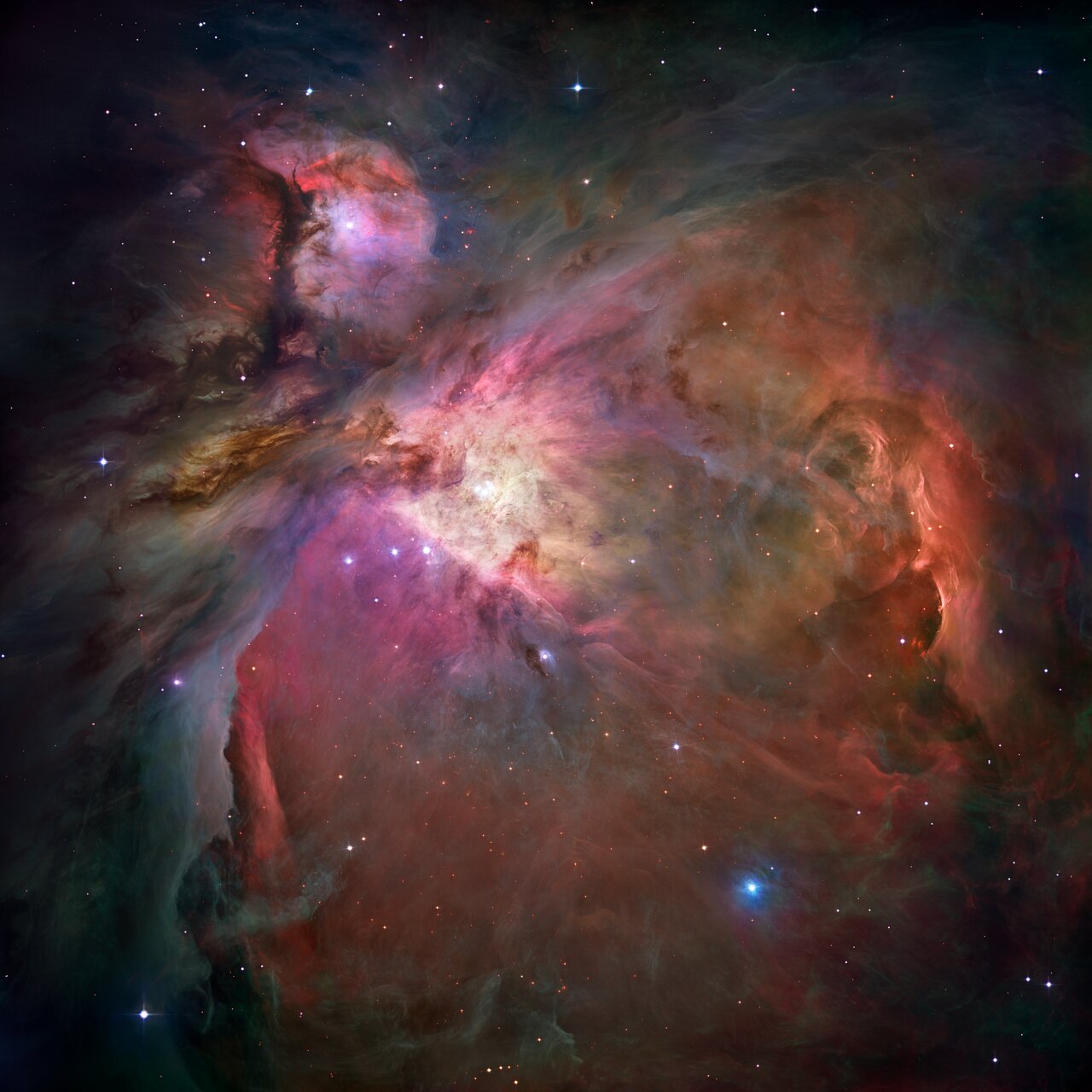
Image credit: NASA, ESA, M. Robberto (Space Telescope Science Institute/ESA) and the Hubble Space Telescope Orion Treasury Project Team. This mosaic of 520 Hubble exposures shows more than 3,000 young stars in various stages of formation across the Orion Nebula.
Also Known As
M42, Messier 42, NGC 1976
Constellation
Orion
Object Type
Emission nebula / stellar nursery
Best Viewing
Winter in the Northern Hemisphere
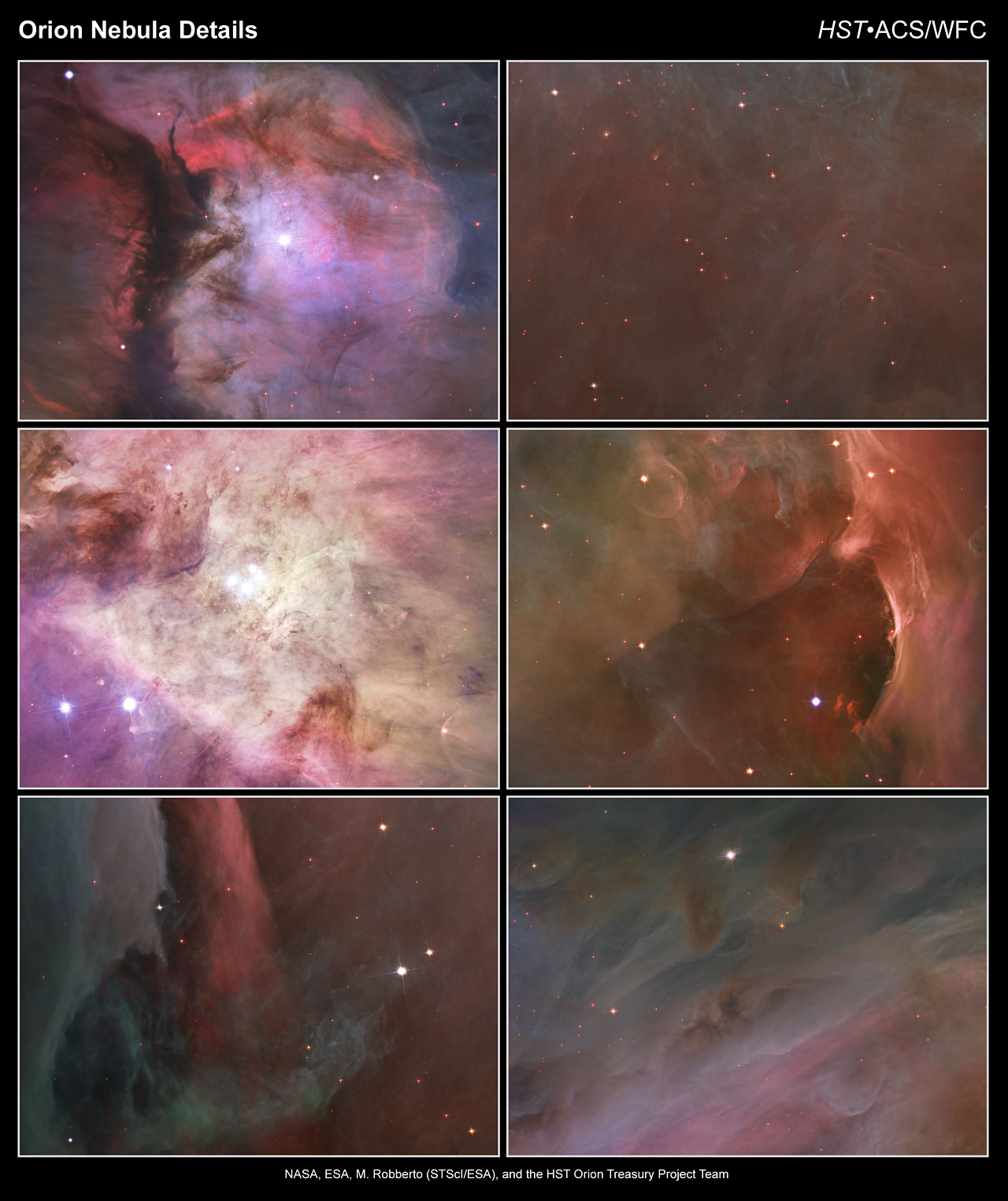
A stellar nursery lit from within
The Orion Nebula is an emission nebula — a cloud of gas and dust where energy from nearby young stars causes the gas to glow. At the heart of M42 sit four extraordinarily hot, massive young stars — the brightest of them a true O-type — known as the Trapezium cluster. Their ultraviolet radiation is so intense it is slowly eroding the gas around them, illuminating the nebula from inside and sculpting it into the dramatic shapes visible in telescope images.
What you are really looking at is active star formation. The cloud of gas and dust that makes up the Orion Molecular Cloud — of which M42 is the bright, glowing face — contains enough material to form thousands of stars. Some are already born and hidden inside the cloud; others are still condensing into protostars. The Orion Nebula is not a relic. It is ongoing.
Three views of M42
Hubble Mosaic
Assembled from 520 individual Hubble exposures, this image resolves more than 3,000 stars in various stages of formation and shows the dramatic gas structures in extraordinary detail.

ESO Wide-Field (VISTA)
A wide infrared view from ESO's VISTA telescope showing M42 in the context of the larger Orion Molecular Cloud complex. The bright core is only a small, glowing window into a much larger dark cloud.
Hubble Trapezium Detail
The Trapezium cluster — four hot, massive young stars — sits at the heart of the nebula. Their fierce UV radiation is the power source behind M42's glow and is sculpting the surrounding gas.
Seen for centuries, photographed for 150 years
The Orion Nebula was first recorded in detail by French astronomer Nicolas-Claude Fabri de Peiresc in 1610 — the same year Galileo was rewriting astronomy with his telescope. Christiaan Huygens made the first published drawing in 1659 that clearly showed the nebula's structure, and Charles Messier added it to his catalog as M42 in 1769.
The nebula's position — just south of Orion's belt, hanging from the three stars that form Orion's sword — makes it one of the easiest deep-sky objects to locate. It is also, unusually, faintly visible to the naked eye from a dark sky: the middle "star" in the sword region looks slightly fuzzy compared to the others, and that fuzziness is a 24-light-year-wide cloud of glowing gas.
Henry Draper took the first photograph of the Orion Nebula in 1880, and detailed imaging of the region has continued ever since. The Hubble mosaic from 2006, assembled from 520 individual exposures, remains one of the most detailed images ever taken of a stellar nursery.
New to stargazing? See how to observe the night sky, and if you're choosing gear, the no-hype telescope buying guide.
The showpiece of the winter sky
The Orion Nebula is one of those rare objects where almost any telescope improves the view. At low power, the green-gray glow of the nebula is immediately striking. Increase magnification and the four points of the Trapezium emerge from the glow at the center. With a larger aperture and dark skies, darker patches, brighter wisps, and the subtle curving structure of the nebula's wings begin to show.
Unlike most deep-sky objects, which are best left at low power, M42 actually rewards pushing the magnification a bit to see the Trapezium. Use averted vision to bring out faint outer extensions. Colors in photographs are assigned from telescope filters; visually, most observers see gray-green with the faintest touch of pink-red in very dark skies. Photography is a different experience entirely.
Finder trick
Find Orion's belt (three stars in a diagonal line), then look for the three stars hanging below as a "sword." The middle of those three is not a star — it is M42.
Trapezium
At 100× or more, the four stars of the Trapezium cluster emerge from the bright core. They are the power source behind the entire nebula's glow.
Best scope
Any telescope works well. A 6–8 inch scope on a dark night is enough to see the nebula's wing structure and the Trapezium clearly separated.
A star factory with some unexpected residents
Hubble images of the Orion Nebula revealed protoplanetary disks — called proplyds — surrounding young stars in the nebula. These are dense, dusty disks of material that are in the process of forming planetary systems. Because the Trapezium stars are blasting them with ultraviolet radiation, the proplyds are slowly being eroded, their outer material boiled away in a process called photoevaporation. Some of these forming planetary systems may be destroyed before they finish forming.
In 2022, the James Webb Space Telescope surveyed the Orion Nebula in unprecedented infrared detail. Among the findings were dozens of Jupiter-Mass Binary Objects — JuMBOs — pairs of planet-mass objects (roughly 0.6 to 13 Jupiter masses) drifting freely through the nebula unattached to any star. These were unexpected. Current star-formation theory does not easily explain how objects this small could form in isolation and then pair up. They remain an open question in stellar physics.
The Trapezium itself is a tight group of four extraordinarily massive and luminous young stars, led by the O-type star Theta-1 Orionis C. Each one emits more ultraviolet radiation in a day than the Sun emits in millions of years. Their presence is the dominant factor shaping the local environment: they light the nebula, erode the proplyds, and are slowly clearing out the surrounding gas cavity.
Finding the Orion Nebula in the winter sky
From November through March, Orion is the dominant constellation of the night sky. Find the three evenly spaced stars of the belt, then look slightly below them for three fainter stars arranged in a small line — Orion's sword. The middle star in the sword is M42. At low power it looks like a bright, fuzzy patch; a little more magnification reveals the Trapezium and the nebula's shape.
Best setup
Any telescope at 40–80× shows the Trapezium and nebula structure beautifully. A narrowband or UHC filter can improve contrast, but M42 is bright enough to be dramatic without one.
Best season
December and January are ideal for Orion from Minnesota and most Northern Hemisphere mid-latitudes. The constellation rises in the east in autumn and is well up by 9 PM in midwinter.
Primary sources: ESA/Hubble Orion Nebula mosaic, ESO VISTA Orion Nebula wide-field image, NASA Messier 42 guide, and ESA Webb Orion Nebula NIRCam release.
The Orion Nebula is a cradle lit from within — a place where new suns are still igniting, and a reminder that the most familiar glow of the winter sky is also one of its most alive.
Stories in the stars
The Orion Nebula hangs in the Sword of Orion the hunter. See the full constellation and its myth, and the wider tapestry, on the Greek mythology hub.
Orion Constellation · Greek Myths Hub · Betelgeuse · Pleiades
More astronomy notes
Continue through the astronomy section for beginner-friendly notes, image credits, viewing tips, history, and the stories behind the night sky.
Astronomy · Betelgeuse · Andromeda Galaxy · Ring Nebula · Interests