
Neutron Stars & Pulsars
Take the mass of the Sun and crush it into a ball the size of a city. That is a neutron star — the collapsed heart of an exploded star, and the densest object you can actually see. Some of them spin dozens of times a second and sweep beams of radiation across the cosmos like a lighthouse. We call those pulsars, and they were one of the great surprises of modern astronomy.
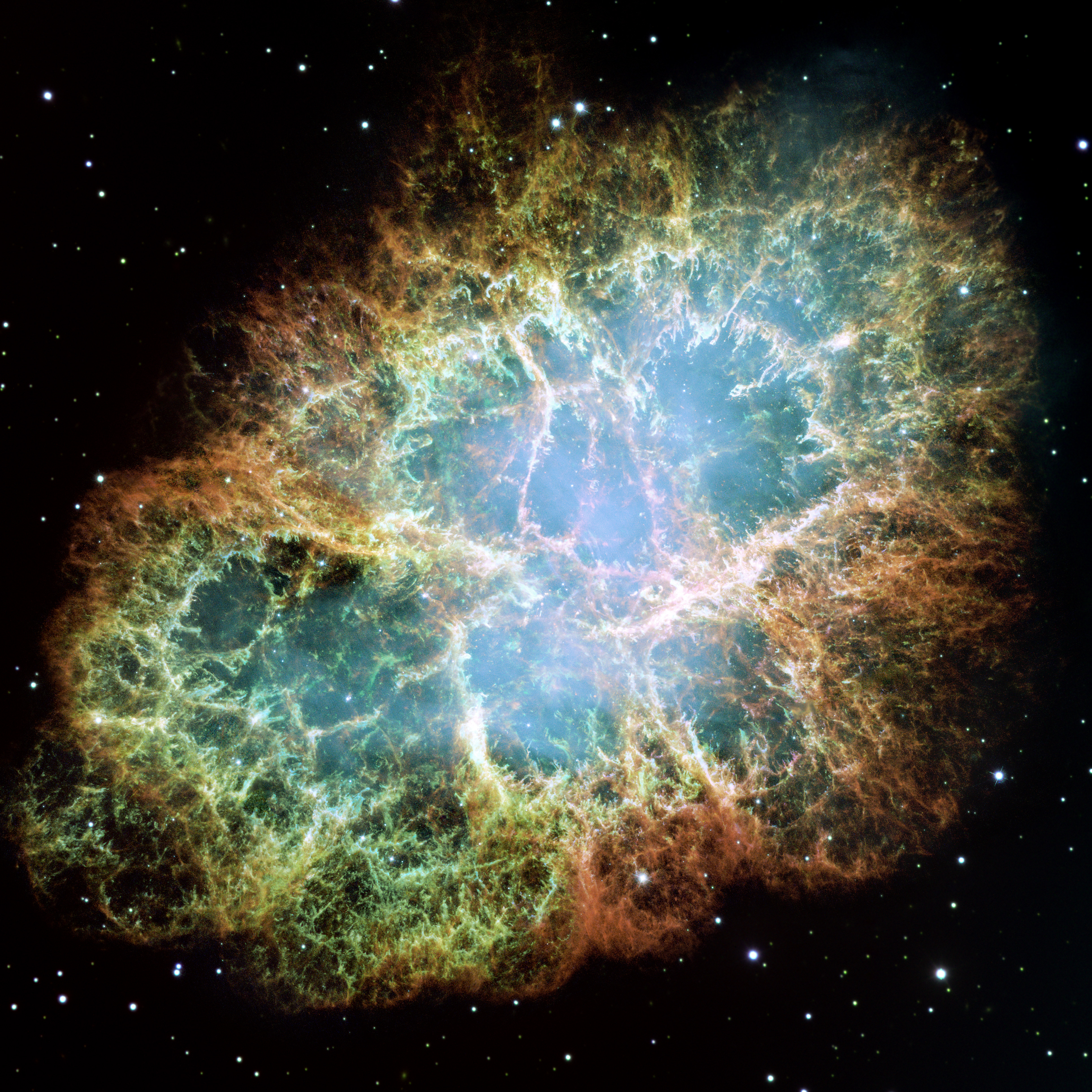
Image: NASA, ESA and Allison Loll/Jeff Hester (Arizona State University). The Crab Nebula is more than a pretty wreck — at its center spins the Crab Pulsar, the neutron-star core of the star that exploded in 1054, turning about 30 times every second and powering the entire glowing cloud around it.
When atoms are crushed to neutrons
When a massive star's core collapses in a supernova, gravity crushes it so hard that electrons and protons are jammed together into neutrons. The entire core — more mass than the Sun — is compacted into a sphere only about 12 miles across, roughly the size of a city. The density is almost impossible to state meaningfully: a single sugar-cube of neutron-star material would weigh about as much as all of humanity, or a mountain. It is matter squeezed to the very edge of what physics allows before it becomes a black hole.
What holds a neutron star up is neutron degeneracy pressure — the same quantum stubbornness that supports a white dwarf, but with neutrons instead of electrons, resisting a far greater crush. Push a neutron star past roughly two to three times the Sun's mass, though, and even that fails: nothing remains to stop the collapse, and a black hole is born. Neutron stars sit right at the frontier between the visible universe and the invisible.
Pulsars — and "little green men"
A collapsing core doesn't just shrink — it spins up, like a figure skater pulling in their arms, until a neutron star can rotate many times per second. It also concentrates the dead star's magnetic field into something almost unimaginably strong. Charged particles caught in that field fire beams of radiation out of the magnetic poles. If a beam happens to sweep past Earth, we see a pulse — on, off, on, off — with clockwork regularity. This is a pulsar: a spinning neutron star we catch in the act of blinking.
Diagram by Michael Paycer. When Jocelyn Bell Burnell found the first pulsar in 1967, its signal was so precise that the source was half-jokingly catalogued "LGM-1" — for "Little Green Men," before a natural explanation was confirmed.
"We did not really believe that we had picked up signals from another civilisation, but obviously the idea had crossed our minds and we had no proof that it was an entirely natural radio emission."
— Jocelyn Bell Burnell, on discovering the first pulsar
Magnetars, and the collision that made gold
The most extreme neutron stars are magnetars, with magnetic fields trillions of times stronger than Earth's — the most powerful magnets in the universe, capable of unleashing flares that, from across the galaxy, can disturb instruments on Earth. But the most consequential neutron-star event we've witnessed was a collision. In 2017, detectors caught two neutron stars spiraling together and merging, an event called GW170817 — seen both as a ripple in spacetime (gravitational waves) and as a burst of light. That smash-up flung out a cloud of freshly forged heavy elements, confirming that neutron-star collisions are a major cosmic source of gold, platinum, and other precious metals. Some of the gold on Earth was very likely minted in a crash like that, billions of years ago.
Straightening out the corpse
"A pulsar is a different object from a neutron star." — A pulsar is a neutron star; we just call it that when its beam happens to sweep past us. "The pulsing is the star flashing on and off." — The star shines steadily; the pulse is its beam rotating past our line of sight, like a lighthouse. "Neutron stars are the densest things possible." — Nearly, but not quite: push one over the mass limit and it collapses into a black hole, which is denser still. "They're just curiosities." — Far from it: pulsars are among the most precise natural clocks known and were used to confirm gravitational waves, and neutron-star collisions forge the heavy elements — including the gold in your jewelry. And "a beam always points at us" — no; we only see pulsars whose beams happen to cross Earth, so most neutron stars pulse unseen.
Black Holes · Supernovae · White Dwarfs · Stellar Black Holes · Stars Hub · Glossary
Return to Michael Paycer
Explore Michael Paycer's professional SQL Server, cloud, ETL, API, automation, and consulting pages, or continue browsing the personal interests section.