
Black Holes
A black hole is the one place in the universe where gravity wins completely — where matter is packed so tightly that not even light can climb back out. For decades they were a mathematical rumor. Now we have photographed two of them. This is a plain-English tour of what they are, how we know, and just how large the largest can grow.
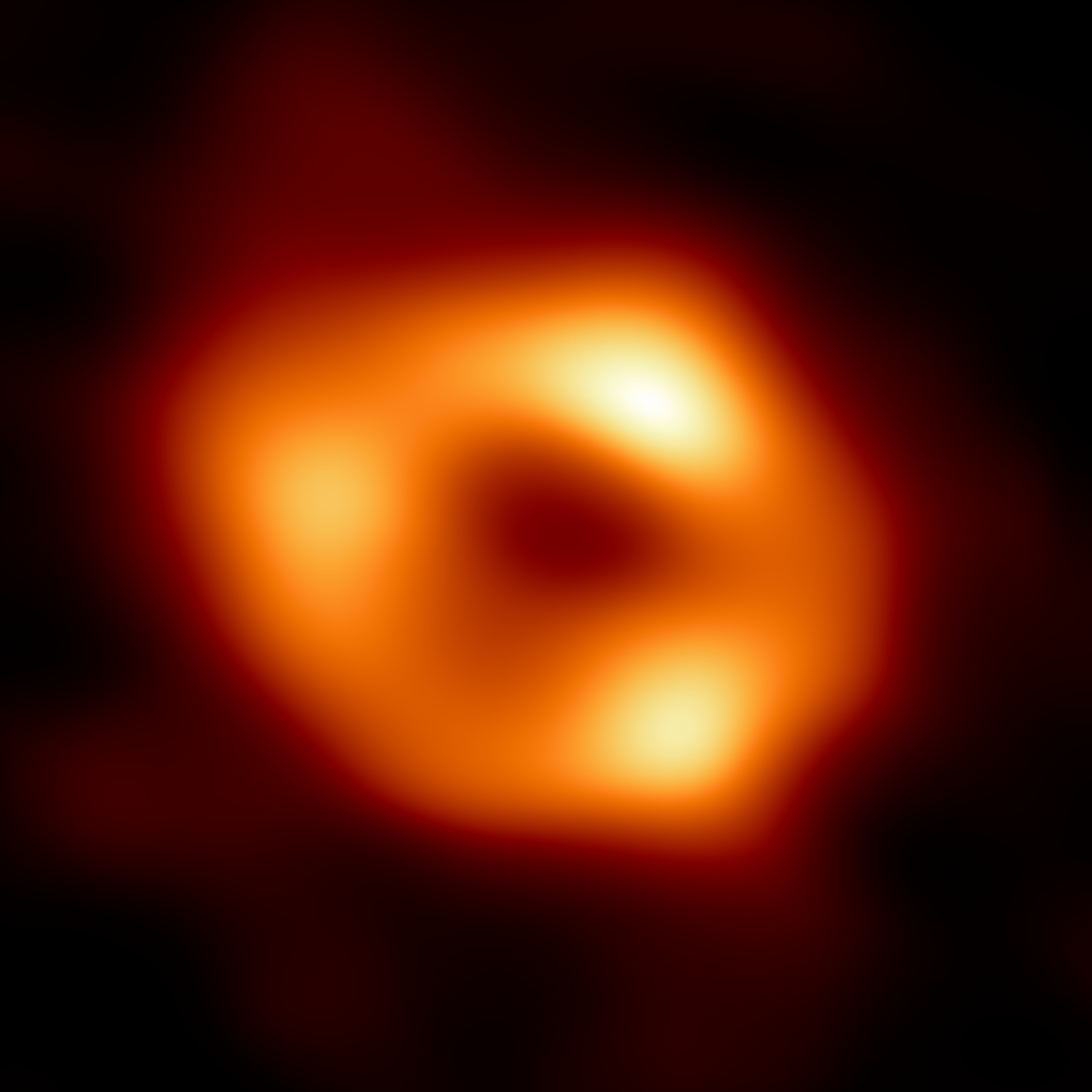
Image: EHT Collaboration. This is Sagittarius A*, the four-million-solar-mass black hole at the heart of our own galaxy — the bright ring is hot gas bent around a dark central "shadow." Released in 2022, it is one of only two black holes ever directly imaged.
Gravity with no way out
Every object has an escape velocity — the speed you'd need to leave it for good. For Earth it's about 25,000 mph. Pile up enough mass in a small enough space and that escape velocity climbs until it reaches the ultimate speed limit, the speed of light. Past that point, nothing can leave, because nothing travels faster than light. That's a black hole: a region where the escape velocity exceeds light speed, wrapped in a one-way boundary called the event horizon.
The black hole itself emits no light — that's why it's black. What we photograph is the glowing, superheated gas swirling just outside, silhouetting the darkness within. A black hole isn't a cosmic vacuum cleaner that roams the galaxy sucking things in; from a safe distance its gravity behaves exactly like any other object of the same mass. Swap the Sun for a black hole of equal mass and Earth's orbit wouldn't change at all — it would just get very cold and dark.
The four questions this section answers
What Is a Black Hole?
The event horizon, the singularity, escape velocity, and what "spaghettification" really means — the anatomy of the strangest object in physics, with a diagram.
Stellar Black Holes
The common kind, born when a massive star dies and collapses. Cygnus X-1, the first one found, and how colliding black holes ring the universe like a bell.
Supermassive Black Holes
The millions- to billions-of-suns giants at the centers of galaxies — including our own Sagittarius A* and the famous first-photographed M87.
TON 618 — The Titan
One of the most massive black holes known: an ultramassive monster of tens of billions of suns, so large its numbers stop feeling real.
From a dead star to a galactic titan
Black holes come in wildly different weights. The stellar kind are a few to a few dozen times the Sun's mass. The supermassive kind at galaxy centers run from millions to billions of suns. And a rare few — the "ultramassive" giants like TON 618 — reach tens of billions. The ladder below is roughly to scale in the exponents, though the real jumps are so vast no single picture can honestly show them.
Diagram by Michael Paycer (symbols not to physical scale; M☉ = solar masses). The gaps between rungs are factors of millions — a stellar black hole is to Sagittarius A* as a marble is to a mountain.
Photographing the invisible
You cannot see a black hole directly — it gives off no light by definition. So for most of the 20th century they were inferred, never observed: predicted by Einstein's relativity, doubted even by Einstein himself, and detected only by their gravitational grip on nearby stars and gas. We found the first strong candidate, Cygnus X-1, by watching a visible star orbit something massive and unseen.
That changed twice. In 2015, detectors on Earth caught gravitational waves — ripples in spacetime — from two black holes colliding a billion light-years away. Then in 2019 the Event Horizon Telescope, a planet-sized virtual telescope, produced the first actual image of a black hole's shadow, in the galaxy M87. In 2022 it imaged our own galaxy's black hole. We have gone, in a single lifetime, from "they might not be real" to "here is its picture."
What black holes are not
"Black holes suck everything in." — No; they're not cosmic vacuum cleaners. Their gravity only dominates very close in — orbit one at a safe distance and you'd circle it as calmly as a planet circles a star. "The Sun could turn into one and swallow us." — It can't; the Sun is far too small ever to become a black hole. "A black hole is a hole." — It's the opposite: an object, a concentration of mass, not an empty tunnel. And "they're just science fiction" — we have now photographed two and heard dozens more collide. The reality outruns the fiction: an object that stops time at its edge, that bends light into a ring, that may hold the deepest unsolved puzzle in physics at its core. Where the physics of the singularity gives out, the questions turn genuinely philosophical — about information, determinism, and the limits of what can be known.
What Is a Black Hole? · Stellar Black Holes · Supermassive · TON 618 · M87 · Astronomy · Glossary
Return to Michael Paycer
Explore Michael Paycer's professional SQL Server, cloud, ETL, API, automation, and consulting pages, or continue browsing the personal interests section.