
Nebulae: The Honest Observer's Guide
Nebulae are the clouds of the cosmos — glowing sheets of gas and dust where stars are born, and the shrouds they cast off when they die. They are the most beautiful things a telescope can show you, and also the most over-promised: the Hubble images are stunning, but they are not what you'll see through the eyepiece. This guide covers the five kinds, the stories behind them, and — honestly — what they look like to your own eyes.
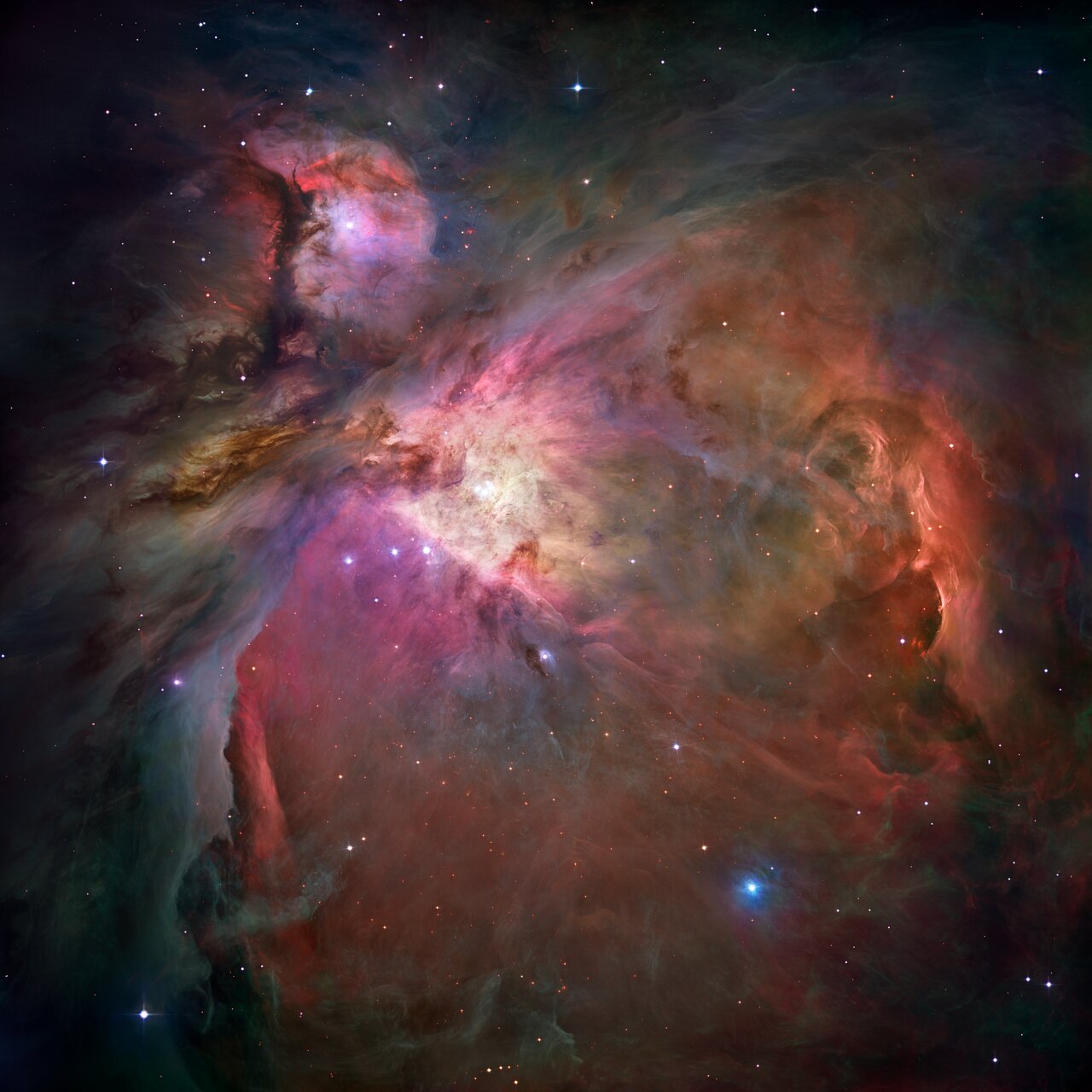
Image: NASA, ESA, M. Robberto (STScI/ESA) & the Hubble Orion Treasury Project Team. The Orion Nebula — the closest great star-forming cloud, and the one nebula that genuinely rewards a backyard telescope. Most nebulae are far fainter to the eye than this; that gap between photo and reality is the honest heart of this guide.
Clouds between the stars
The word nebula is Latin for "cloud," and that's exactly what these are: enormous clouds of gas (mostly hydrogen) and fine dust, drifting in the space between the stars. Some glow with their own excited light, some shine by reflecting starlight, some blot out the light behind them, and some are the wreckage of a star that died. What unites them is that they are the raw material and the recycled remains of stars — the interstellar medium made visible.
It helps to see nebulae as chapters in the life and death of stars. A star is born inside a nebula; a Sun-like star dies by gently shedding a nebula; a massive star dies by blasting one out in a supernova. The same word covers the cradle and the grave. This section is the visual field guide to those clouds; for the physics of how each one forms, the Stars cluster is the companion.
Every nebula is one of these
Astronomers sort nebulae into five families by how they shine and where they come from. Each has its own gallery page, its own showpieces, and its own honest verdict on what you'll actually see.
Emission Nebulae
Star-forming clouds glowing their own pink-red light, energized by hot young stars within. The nurseries — Orion, the Lagoon, the Eagle and its Pillars.
Planetary Nebulae
The glowing shells a dying Sun-like star breathes out — jewel-like rings and eyes. The Ring, the Helix, the Cat's Eye. (Nothing to do with planets — a famous misnomer.)
Supernova Remnants
The shredded, filamentary wreckage of an exploded massive star. The Crab, the Veil — expanding debris still glowing centuries later.
Dark Nebulae
Cold, dense dust clouds that block the light behind them — silhouettes on the sky. The Horsehead, the Coalsack, the Bok globules where stars quietly form.
Reflection Nebulae
Dust clouds that glow blue by scattering the light of nearby stars, like fog around a streetlamp. The Pleiades' haze, the Iris, the Witch Head.
Pillars of Creation
The most famous nebula image ever made — towering columns in the Eagle Nebula, seen by both Hubble and Webb. A featured deep-dive.
Hubble's eyes are not your eyes
Here is the thing almost no one tells a beginner. Those glorious, saturated nebula photos are made with hours of exposure through giant telescopes, and their colors are usually assigned — mapped from wavelengths your eye can't even see. Your eye, at the eyepiece, works in real time and can barely register color in faint light. So the Ring Nebula that blazes emerald and ruby in the photo is, through a backyard telescope, a small pale-grey smoke ring. The Horsehead, an icon of astrophotography, is essentially invisible to most amateurs. This isn't a disappointment to hide — it's the honest truth that makes the hobby rewarding when you learn to see faint things well. Every gallery page here tells you plainly what a given nebula looks like through real equipment, and links to the telescope guide and how to observe so you can actually find them.
The catalog of cosmic nuisances
Many of the finest nebulae carry an "M" number — M1, M42, M57 — and there's a charming reason. In the 1700s, the French astronomer Charles Messier was a devoted comet hunter, and faint fuzzy blobs in his telescope kept fooling him into thinking he'd found a new comet. Annoyed, he began writing them down — not to celebrate them, but as a list of things to ignore, so he wouldn't be tricked twice. That catalog of 110 nuisances became the Messier catalog, and today it's the beloved to-do list of every amateur astronomer. The Crab Nebula is M1, the very first entry — logged in 1758 while Messier was watching for the return of Halley's Comet. The most treasured objects in the sky were catalogued as annoyances.
"Somewhere, something incredible is waiting to be known."
— attributed to Carl Sagan
The naming quirks run deep in this field. The term "planetary nebula" was coined by William Herschel around 1785 because the little round glows looked planet-like in his telescope — a mistake baked permanently into the language. Learning the nebulae means learning their history, and the history is half the pleasure.
Emission · Planetary · Supernova Remnants · Dark · Reflection · Pillars of Creation · Helix · Stars · Astronomy · Glossary
Return to Michael Paycer
Explore Michael Paycer's professional SQL Server, cloud, ETL, API, automation, and consulting pages, or continue browsing the personal interests section.