
The Pillars of Creation
They are probably the most famous photograph in the history of astronomy: three vast columns of gas and dust, light-years tall, standing in the Eagle Nebula while newborn stars burn at their tips. Two great space telescopes have photographed them, 27 years apart, and the pair of images together tells you almost everything about how we really see the cosmos.
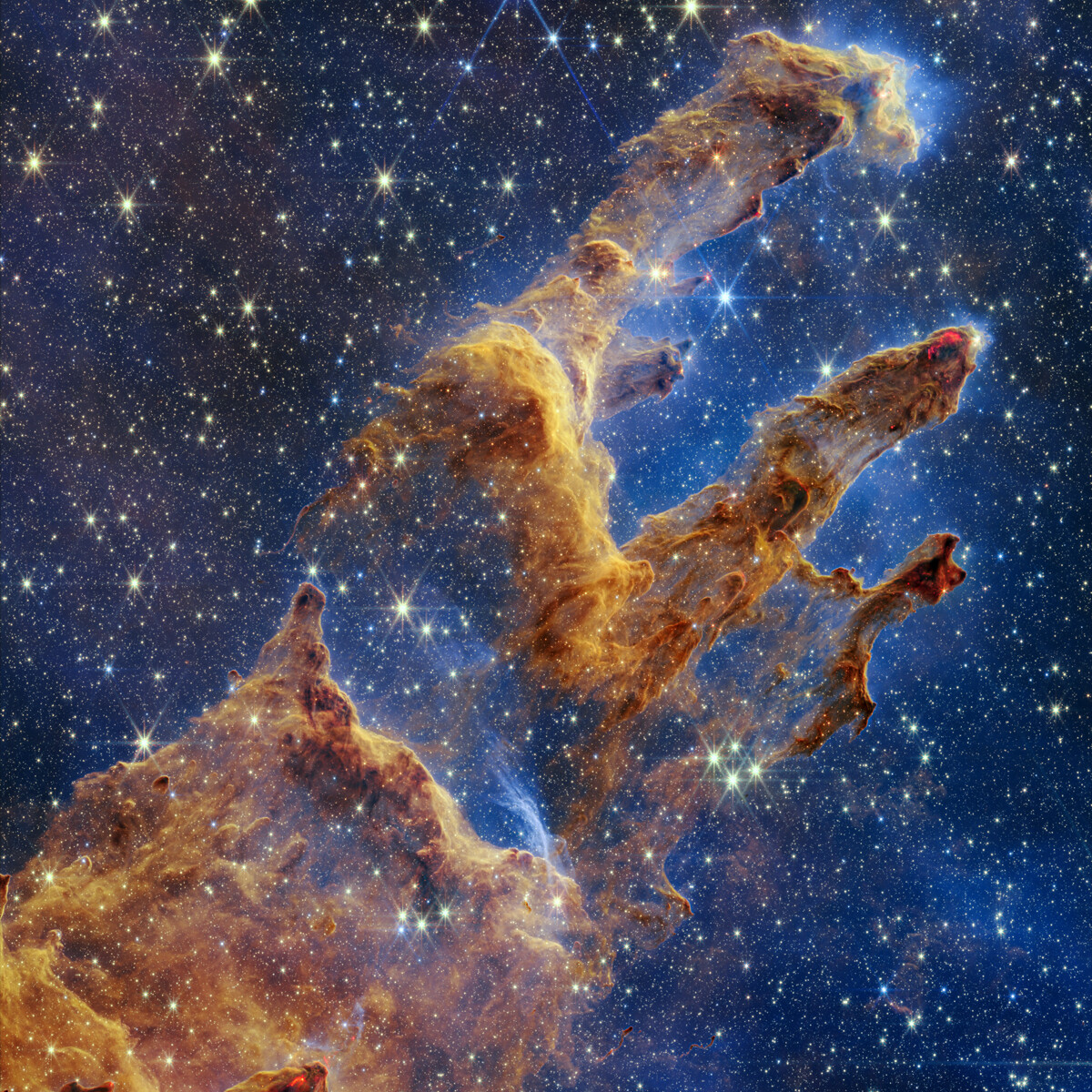
Image: NASA, ESA, CSA, STScI; J. DePasquale, A. Koekemoer, A. Pagan (STScI). The James Webb Space Telescope's 2022 near-infrared view of the Pillars — part of the Eagle Nebula (M16), about 6,500 light-years away in Serpens.
Columns being sculpted and destroyed at once
The Pillars are dense fingers of cold gas and dust within a much larger emission nebula, the Eagle. Just off the top of the frame sits a cluster of brilliant, massive young stars. Their intense ultraviolet radiation and fierce stellar winds are eroding the surrounding cloud — but the densest clumps resist, and the cloud downstream of them is shielded, leaving these towering columns pointing back toward the stars like wind-carved desert rock. At the same time, deep inside the pillars, gravity is pulling knots of gas together into new stars. So the Pillars are a single frame showing both ends of star formation: creation and destruction happening together, the columns being whittled away even as they give birth.
The little bright red-gold blobs at the pillar tips in the Webb image are exactly that — protostars, stars in the act of switching on. The "lava"-like edges are jets of material shot out by these newborns. This is a nursery caught mid-delivery.
Why Hubble and Webb see them differently
This is the object that best teaches how telescopes actually work — because we have two spectacular images of the same pillars, taken in different kinds of light.
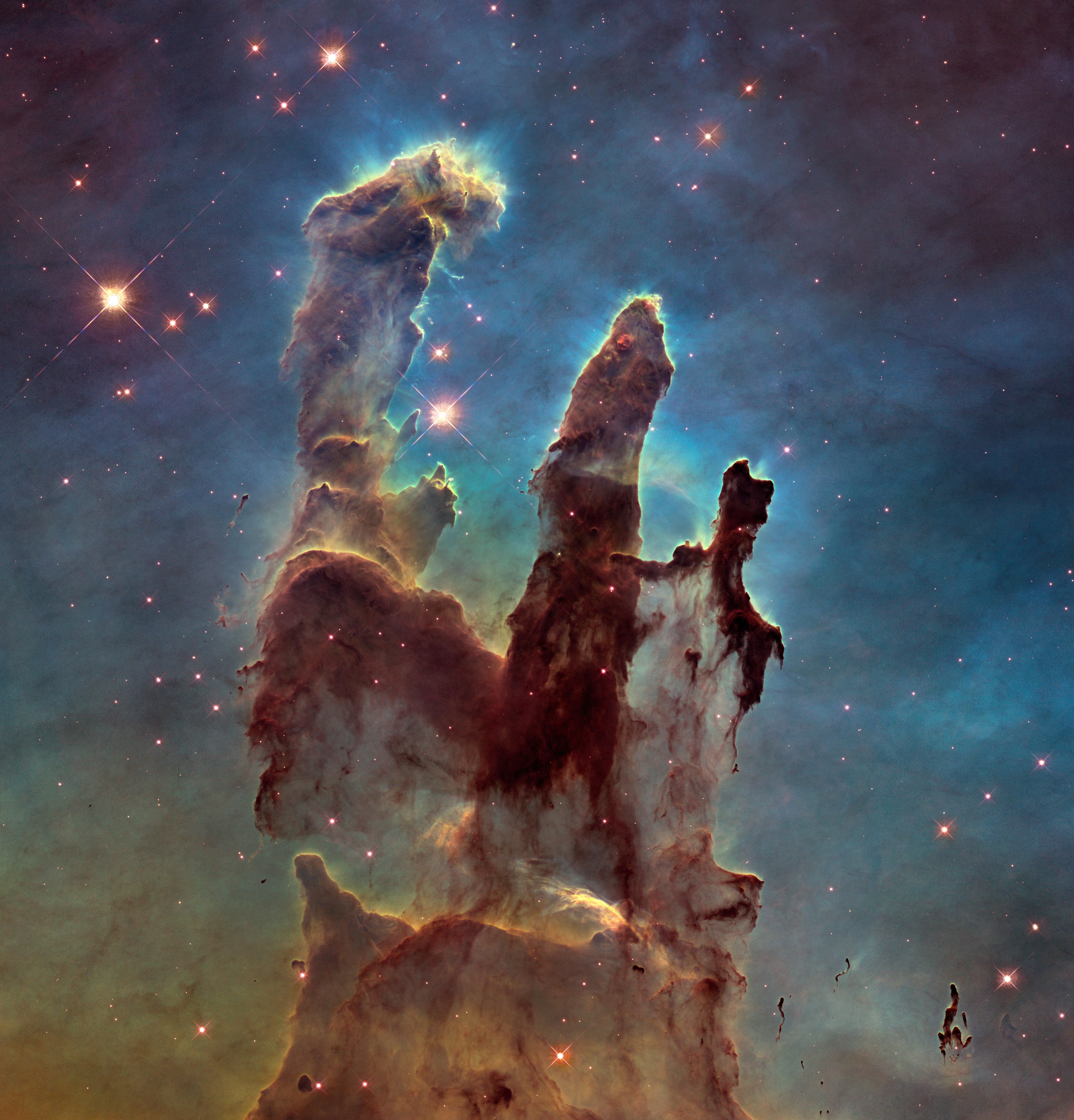
Hubble — visible light (2015)
In the wavelengths your eye uses, the pillars are solid, opaque, and brooding — dark towers rimmed with glowing gas. This is essentially how they'd look if you could stand nearby: dense, dusty, and dramatic.
Webb — infrared light (2022)
Infrared light slips through much of the dust, so the same pillars turn translucent and fill with stars that were hidden before — including the newborns buried at their tips. Same object, but Webb sees into it.
Images: NASA, ESA/Hubble & the Hubble Heritage Team (heic1501a); NASA, ESA, CSA, STScI (weic2216a). Neither image is "the real color" — both are built from specific wavelengths and mapped to visible hues. The difference between them is the whole reason astronomers build telescopes for light beyond what our eyes can see: each wavelength reveals something the others hide.
The honest truth: you cannot see the Pillars
Here's the part every gallery skips. Point a backyard telescope at M16 and you will not see the Pillars of Creation. They are far too small, faint, and dust-shrouded for any amateur instrument — they exist, visually, only in the long exposures of the world's greatest space telescopes. What you can see in a modest scope is the surrounding Eagle Nebula: a faint glow and, more clearly, the young star cluster (NGC 6611) embedded in it. Under dark skies with a nebula filter, the broader nebulosity emerges. But the Pillars themselves are a Hubble-and-Webb sight, full stop. That's not a knock on your gear — it's a reminder that some of the universe's most famous sights were never visible to human eyes at all until we built machines to see them. See the telescope guide for what M16 will show you.
The image that changed how we see space — and a lingering mystery
The Eagle Nebula was discovered in the 1740s and catalogued by Charles Messier as M16. But the Pillars became famous on April 1, 1995, when astronomers Jeff Hester and Paul Scowen released a Hubble image that instantly became one of the most reproduced photographs ever made — printed on postage stamps, album covers, and countless classroom walls. It made "the Pillars of Creation" a household phrase and helped define what the Hubble Space Telescope meant to the public.
There's a haunting footnote, though. In 2007, based on infrared data from the Spitzer telescope, some astronomers suggested that a nearby star may have already exploded as a supernova roughly 6,000 years ago, and that the blast wave might have destroyed the Pillars — meaning that because they're 6,500 light-years away, we could be seeing the light of structures that no longer exist. It's a debated and unconfirmed idea, not settled fact. But it's a genuinely poetic uncertainty: we may be gazing at a ghost, the last light of towers already gone.
"For small creatures such as we the vastness is bearable only through love."
— Carl Sagan, Contact (1985)
Emission Nebulae · Star Formation · Helix Nebula · Nebulae Hub · Telescopes · How to Observe · Glossary
Return to Michael Paycer
Explore Michael Paycer's professional SQL Server, cloud, ETL, API, automation, and consulting pages, or continue browsing the personal interests section.