
Supernova Remnants
When a massive star explodes, it doesn't vanish — it leaves a corpse and a mess. The mess is a supernova remnant: a vast, expanding cloud of shredded stellar guts, glowing for thousands of years as the blast wave plows through space. These are the most violent nebulae, and the most generous — they seed the galaxy with the heavy elements that build new worlds.
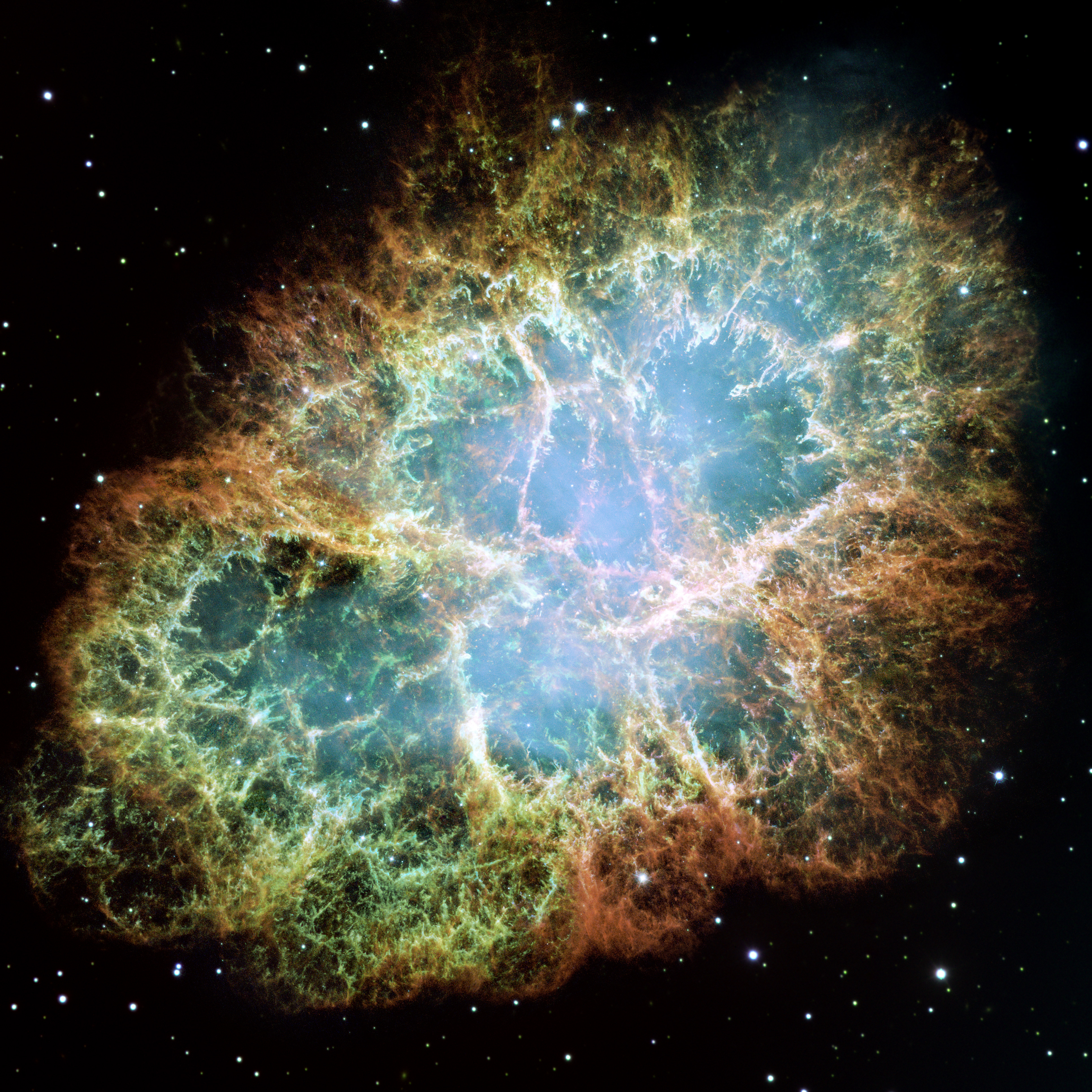
Image: NASA, ESA and Allison Loll/Jeff Hester (Arizona State University). The Crab Nebula — debris from a star seen to explode in 1054, still expanding at over 1,000 km per second nearly a thousand years later, lit from within by the neutron star at its heart.
A star turned inside out
A supernova remnant is the aftermath of the death of a massive star. When the star's core collapses and the outer layers are blasted away in a supernova, that debris rushes outward at thousands of kilometers per second, slamming into and sweeping up the surrounding interstellar gas. The collision heats everything and makes it glow — in twisted filaments, delicate wisps, and expanding bubbles that can grow for tens of thousands of years before finally fading and merging back into the interstellar medium.
These remnants matter far beyond their beauty: they are how the universe distributes the elements. The oxygen, silicon, iron, and heavier atoms forged in the star and its explosion are scattered here into space, enriching the clouds that will form the next generation of stars and planets. Often a neutron star or black hole — the collapsed core — sits at the center. For the explosion itself, see supernovae.
The great wrecks
The Crab Nebula (M1)
The most famous remnant, in Taurus, from a star seen to explode in 1054. It was the very first entry in the Messier catalog, and at its heart spins the Crab Pulsar, a neutron star rotating 30 times a second. About 6,500 light-years away and still visibly expanding.
The Veil Nebula
The most beautiful remnant for observers, in Cygnus — the delicate, rope-like wreckage of a star that exploded 10,000–20,000 years ago. So large it spans six full Moons of sky, wrapped in impossibly fine filaments.
Cassiopeia A
One of the youngest known remnants in our galaxy (only radio-discovered G1.9+0.3 is younger) — light from its explosion reached Earth only about 340 years ago. Barely visible optically but blazing in X-rays and radio, it's the expanding shell of a star that died almost within recorded history, yet went strangely unremarked at the time.
The Cygnus Loop & others
The Veil is one bright arc of the larger Cygnus Loop bubble. Other famous remnants — the Jellyfish (IC 443), the Spaghetti Nebula — are photographic targets, faint sprawls of filament that reward long exposures and dark skies.
What you'll really see
Be honest with yourself here: supernova remnants are among the hardest nebulae to see well, because their light is spread thin across large areas. The Crab, despite its fame, is a small, faint grey smudge in a backyard scope — you'll see an oval haze, and none of the filaments the photos show. The Veil is the great exception, but it comes with a condition: under dark skies and — crucially — with an OIII nebula filter, the Veil transforms from nearly invisible into a genuinely jaw-dropping tangle of glowing threads. Many observers call their first filtered view of the Veil the moment deep-sky observing "clicked." Without the filter and dark skies, most remnants simply won't show. This is the category where gear and sky quality matter most — see the telescope guide and how to observe.
The guest star of 1054
The Crab Nebula's parent explosion is one of the best-documented events in the ancient sky. In the summer of 1054, court astronomers of China's Song dynasty recorded a brilliant new "guest star" in Taurus — bright enough to be seen in daylight for over three weeks, and visible at night for nearly two years. Japanese and Arab observers noted it too, and a painting at Chaco Canyon in New Mexico may record it as well. Then it faded. Seven centuries later, telescopes revealed the expanding wreckage still rushing outward from that exact spot. In the 1840s, Lord Rosse sketched its tangled filaments and thought they looked like a crab's legs — and the name stuck.
"In the first year of the Zhihe reign period, a guest star appeared ... it was visible by day, like Venus."
— Song dynasty court records of the supernova of 1054, whose wreckage is the Crab Nebula
Supernovae · Neutron Stars & Pulsars · Cygnus (Veil) · Black Holes · Nebulae Hub · Telescopes · Glossary
Return to Michael Paycer
Explore Michael Paycer's professional SQL Server, cloud, ETL, API, automation, and consulting pages, or continue browsing the personal interests section.