
Reflection Nebulae
Some clouds don't make their own light and don't block it — they borrow it. When a dust cloud sits near a bright star but not close enough to be set aglow, it simply scatters the starlight toward us, shining a soft, dreamy blue. They are the subtlest nebulae, the same physics as a blue sky or fog around a streetlamp, painted across light-years.
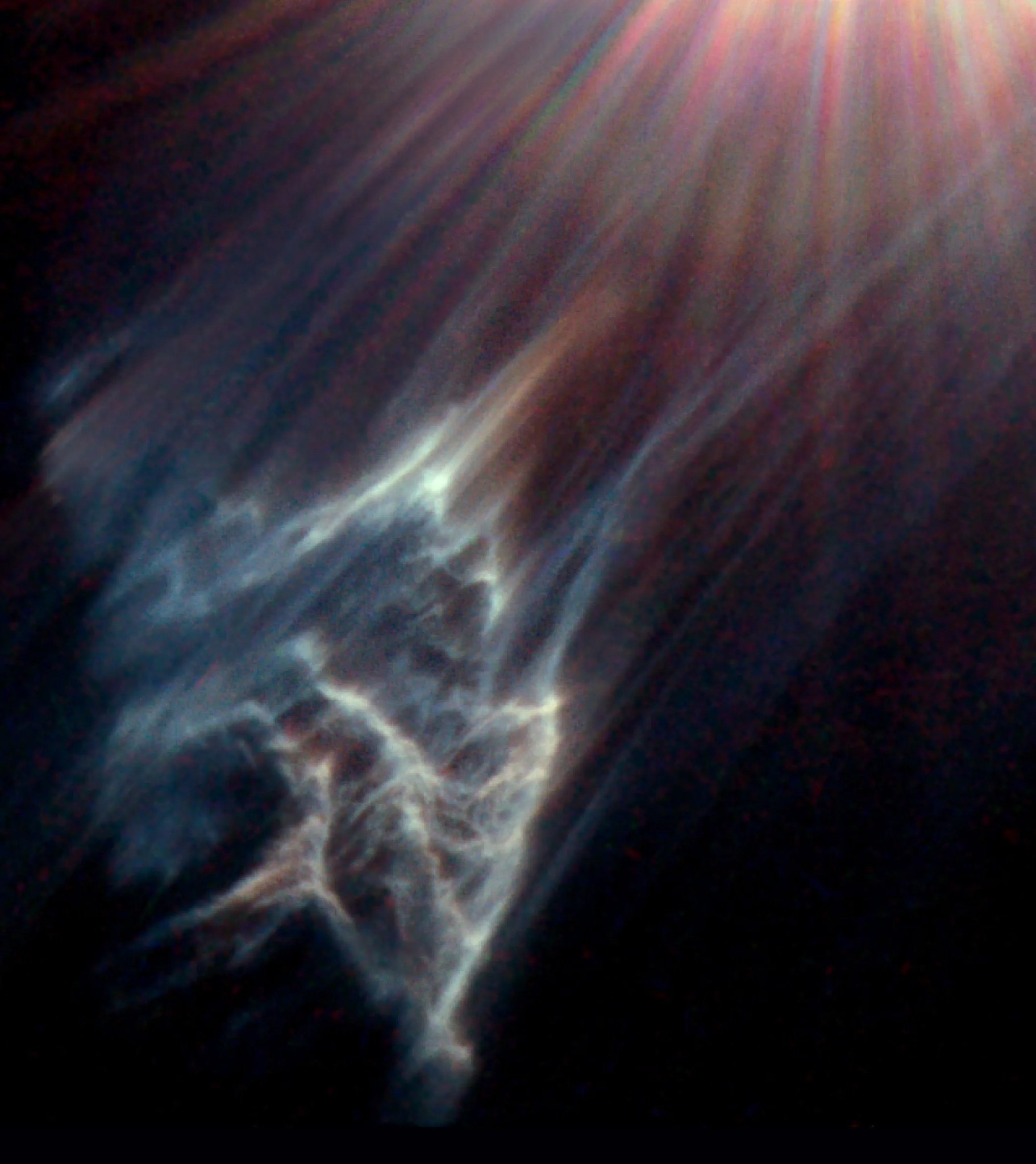
Image: NASA, ESA, AURA/Caltech, Palomar Observatory. Wisps of blue dust around the star Merope in the Pleiades — a reflection nebula. The dust isn't glowing; it's scattering the light of the hot blue stars it happens to be drifting past.
Why they're always blue
A reflection nebula is a cloud of interstellar dust lit indirectly. Unlike an emission nebula, whose gas is energized into glowing on its own, the dust here isn't heated to shine — the nearby star just isn't hot enough for that. Instead the dust grains scatter the star's light toward us, the way particles in the air scatter sunlight. And that's why reflection nebulae are almost always blue: fine dust scatters blue light more efficiently than red, exactly the same effect that makes the daytime sky blue and sunsets red. When you look at a reflection nebula, you are seeing the same physics as an Earth sky, happening around another star.
Reflection nebulae often mark the edges of star-forming regions, where leftover dust drifts near freshly minted stars — so they tend to keep company with the stellar nurseries. The famous blue haze of the Pleiades was once thought to be leftover from the cluster's birth; we now know the cluster is simply drifting through an unrelated dust cloud. Either way, the effect is the same: dust, a nearby star, and a scattered blue glow.
The blue veils
The Pleiades Nebulosity
The best-known reflection nebula, wrapped around the bright blue stars of the Pleiades (M45). In photographs the cluster sits in a gauzy blue mist; the cluster itself is a naked-eye jewel, though the nebulosity is famously hard to see directly.
The Iris Nebula (NGC 7023)
A striking flower-shaped blue reflection nebula in Cepheus, lit by a single hot star at its center. One of the prettiest reflection nebulae for astrophotographers, with intricate dusty petals.
The Witch Head (IC 2118)
An eerie profile of blue dust near the bright star Rigel in Orion, whose light it reflects. Very faint — almost entirely a photographic target — but unforgettable in shape, a ghostly face turned toward the star.
The Trifid's blue lobe (M20)
The Trifid Nebula is a rare three-in-one: a red emission nebula, dark dust lanes, and a separate blue reflection nebula sharing the same field — a single object that shows all three effects at once.
What you'll really see
Reflection nebulae are, honestly, the toughest nebulae to see visually — and the one category where a filter does not help (nebula filters pass the specific glow of emission nebulae, but reflection nebulae shine in ordinary scattered starlight, so a filter just dims them). Their blue color, so vivid in photos, is essentially invisible to the eye at these low light levels. The Pleiades are the move: the star cluster is a genuine naked-eye and binocular showpiece — one of the finest sights in the sky — even though the surrounding nebulosity only whispers under the darkest skies. Enjoy the cluster; treat any hint of the haze as a bonus. The Iris and Witch Head are really rewards for the camera, not the eye. This is a category where dark skies and patience matter more than aperture, and where astrophotography, not visual observing, is the natural path.
The seven sisters, seen for millennia
The Pleiades are the most celebrated star cluster in human history — named and storied by cultures on every inhabited continent, from the Greek "Seven Sisters" fleeing Orion to the Japanese Subaru (yes, the car badge is the cluster) to the Aboriginal Australian and Native American sky-stories. The blue nebulosity around them, though, is a modern discovery: it took long-exposure photography in the late 1800s to reveal that the sisters are wrapped in a faint glowing veil. For most of history, people saw the stars; only the camera saw the cloud. That's fitting for the whole reflection-nebula family — clouds that live at the very edge of what the eye can perceive.
"Many a night I saw the Pleiads, rising thro' the mellow shade, / Glitter like a swarm of fire-flies tangled in a silver braid."
— Alfred, Lord Tennyson, "Locksley Hall" (1842)
The Pleiades · Cepheus (Iris) · Emission Nebulae · Dark Nebulae · Nebulae Hub · How to Observe · Glossary
Return to Michael Paycer
Explore Michael Paycer's professional SQL Server, cloud, ETL, API, automation, and consulting pages, or continue browsing the personal interests section.