
Dark Nebulae
Not every nebula glows. Some are seen only by what they hide — cold, dense clouds of dust so thick they blot out the stars and glowing gas behind them, standing on the sky as black silhouettes. They look like holes in the universe. They are, in fact, the opposite: the densest, most fertile clouds of all, where the next generation of stars is quietly taking shape in the dark.
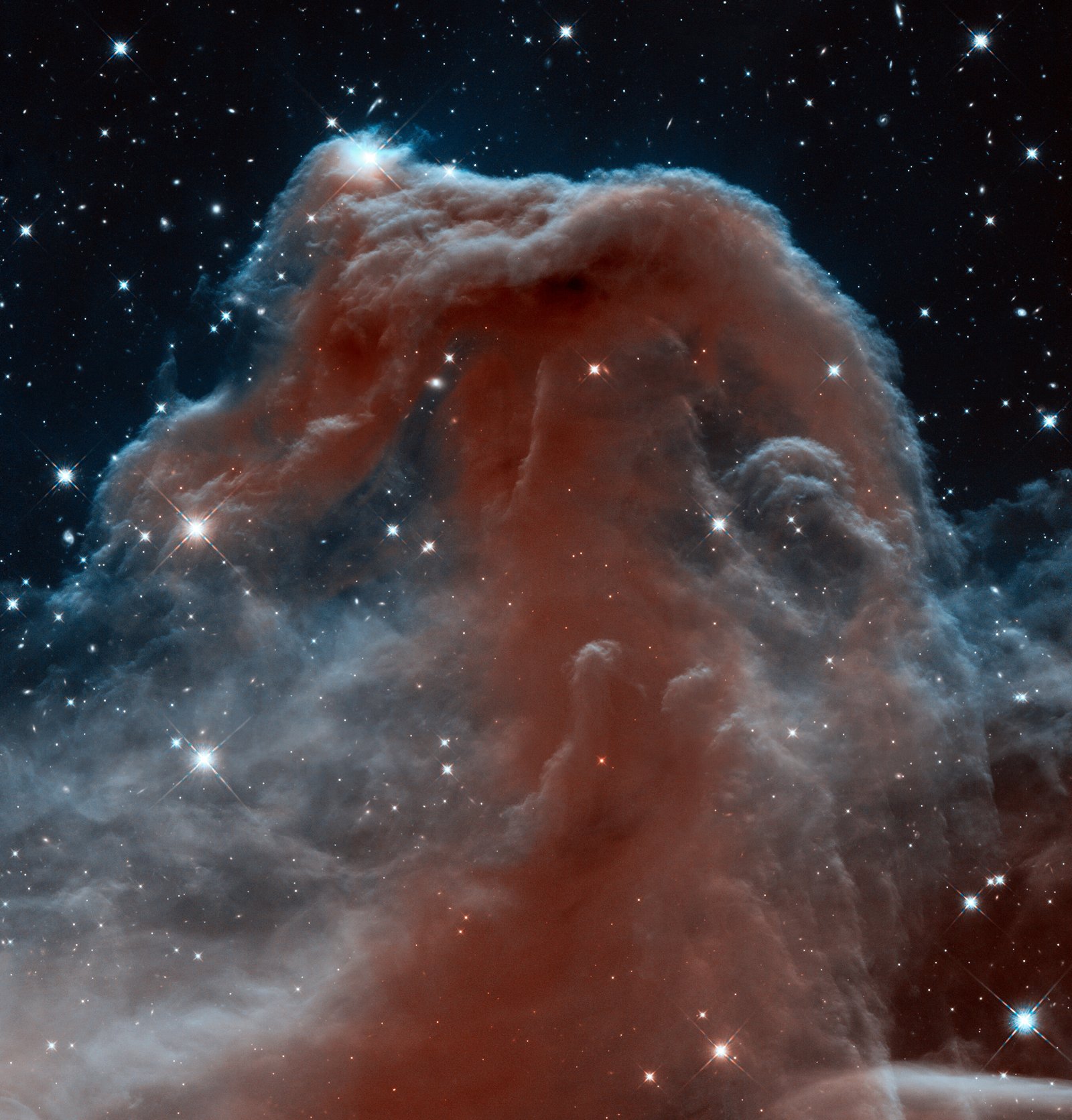
Image: NASA, ESA & the Hubble Heritage Team (STScI/AURA). The Horsehead Nebula in Orion — a dark pillar of dust, shaped like a chess knight, silhouetted against the pink glow of an emission nebula behind it. (This is Hubble's infrared view, which makes the dust translucent; in visible light it is jet black.)
Seen by its shadow
A dark nebula is the same stuff as the bright ones — interstellar gas and dust — but colder, denser, and with no nearby star to light it up. Instead of glowing, it absorbs: the fine dust grains block the light of whatever lies behind, so the cloud appears as a starless void against the richer background of the Milky Way. For a long time astronomers genuinely thought these were empty gaps in the star fields, actual holes. They're the reverse — the thickest concentrations of matter in their region, so opaque that not even starlight gets through.
And that density is the point: dark nebulae are the cradles of star formation. Deep inside their cold, shielded interiors, gas can collapse without being blown apart, and new stars ignite. The small, rounded dark clouds called Bok globules are star nurseries caught in the act. A dark nebula isn't a dead void; it's a womb.
The famous silhouettes
The Horsehead (Barnard 33)
The most famous dark nebula, in Orion, just below the belt star Alnitak — a dust column shaped exactly like a chess knight, set against a glowing red backdrop. Iconic in photographs, and notoriously one of the hardest objects to see with your own eyes.
The Coalsack
A large, naked-eye dark nebula near the Southern Cross — a conspicuous black patch in the bright Milky Way, known to Southern Hemisphere cultures for millennia. Aboriginal Australian astronomy sees it as the head of the "Emu in the Sky."
Barnard 68
A near-perfect small dark globule in Ophiuchus — a Bok globule so clean and round it looks like a hole cut in the star field. A textbook example of a cloud on the verge of collapsing into a new star.
The Pipe & the Great Rift
The dark lanes that split the summer Milky Way down its length are enormous dust clouds — the Great Rift — with the Pipe Nebula a striking dark shape within it. From a truly dark site, these are visible to the naked eye as the "dark constellations."
What you'll really see
Dark nebulae flip the usual observing problem: you're not trying to see a faint glow, you're trying to see a faint absence — and that requires a rich, bright background to silhouette against, which means dark skies are everything here. The Horsehead is the famous heartbreaker: despite being on every beginner's wish list, it is genuinely difficult, needing a large telescope, a specialized "H-beta" filter, and pristine skies — many experienced observers have never seen it, and there's no shame in that. The easy wins are the big naked-eye ones: from a dark site, the Coalsack and the Great Rift are obvious dark shapes woven through the Milky Way, best appreciated with just your eyes or binoculars — no telescope required. This is the one nebula category where the naked eye can outperform the telescope. See how to observe for finding dark skies.
"A hole in the heavens"
The great cataloguer of dark nebulae was the American astronomer Edward Emerson Barnard, who in the early 1900s used the new tool of wide-field photography to map hundreds of these obscuring clouds — which is why so many carry a "B" number, like the Horsehead's Barnard 33. But the most famous line about them is older. Sweeping his telescope across a starless patch in the constellation Ophiuchus, William Herschel is said to have exclaimed that he had found a genuine gap in the star field — "Here truly is a hole in the heavens." He was wrong in the best way: it wasn't a hole at all, but a wall of dust. The darkest patches turned out to be the fullest.
"Here truly is a hole in the heavens."
— attributed to William Herschel, on a dark nebula in Ophiuchus — which is not a hole, but a cloud
Star Formation · Orion (Horsehead) · Emission Nebulae · Reflection Nebulae · Nebulae Hub · How to Observe · Glossary
Return to Michael Paycer
Explore Michael Paycer's professional SQL Server, cloud, ETL, API, automation, and consulting pages, or continue browsing the personal interests section.