
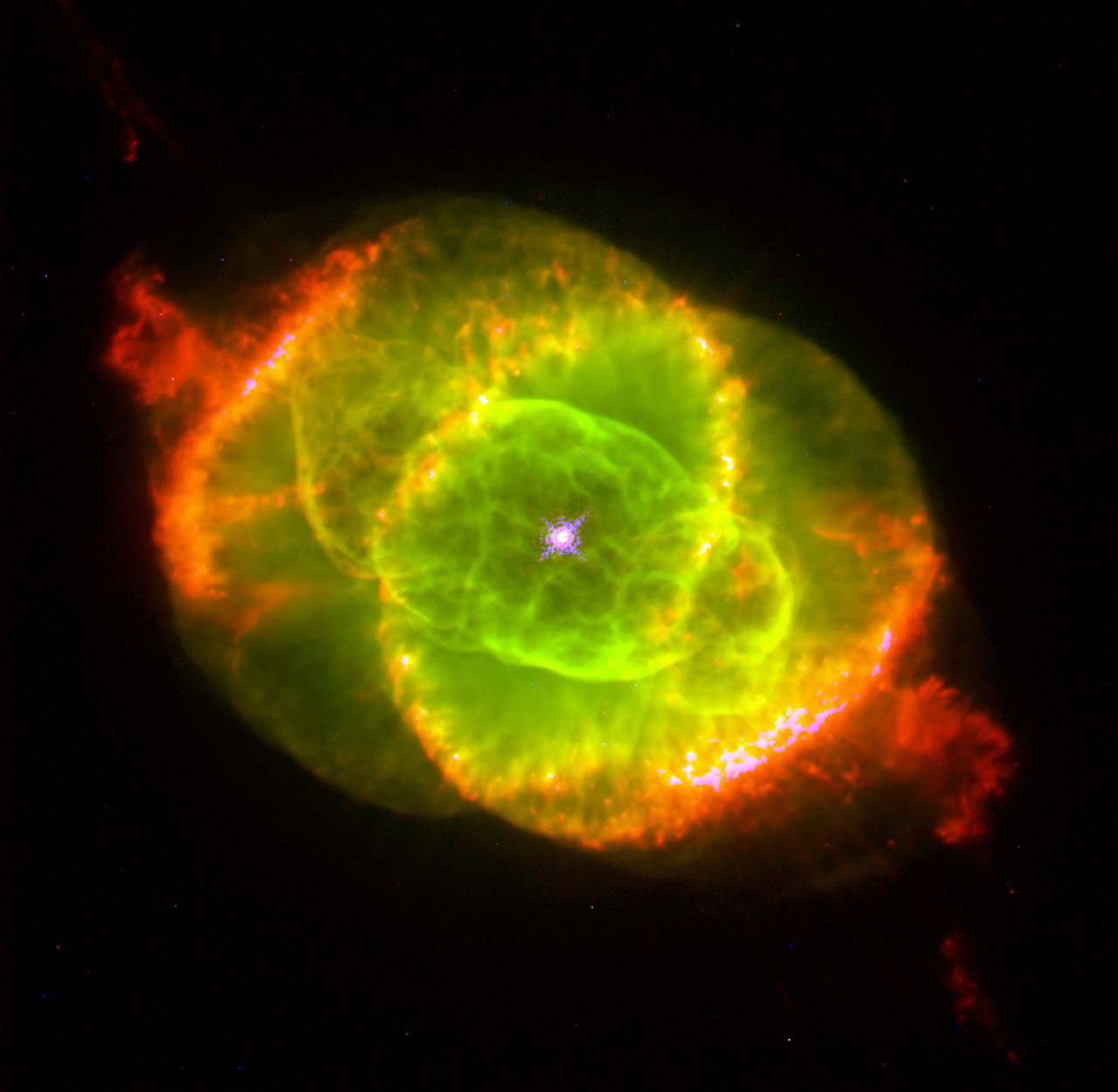
The Cat's Eye Nebula (NGC 6543) in Draco — one of the most structurally complex planetary nebulae known, the glowing shells of gas thrown off by a dying Sun-like star. Image credit: NASA, ESA, HEIC and the Hubble Heritage Team (STScI/AURA).
A constellation that never sets
In Greek mythology, Draco is usually identified as Ladon, the hundred-headed dragon that guarded the golden apples of the Hesperides and was slain by Heracles. In the sky he is rendered as a long, winding chain of modest stars that loops between the Big Dipper and the Little Dipper, curling its tail around Polaris.
Draco is the eighth-largest constellation of the 88, sprawling across more than 1,000 square degrees. From the northern United States it is circumpolar — it never dips below the horizon, so on any clear night of the year you can trace the Dragon overhead. Its stars are faint, but the deep-sky treasures hidden among them are extraordinary.
Draco rewards patience over wow-factor. The pattern is dim and rambling — but once you've followed the Dragon's body from tail to head, the whole northern sky reorganizes around it.
Draco at a glance
Abbreviation
Dra · Genitive: Draconis
Brightest Star
Eltanin (γ Dra), magnitude 2.2
Size
1,083 sq. degrees — 8th largest of 88
Best Visibility
Circumpolar above ~30°N; highest in summer
Key Stars
- γ Dra — Eltanin. Magnitude 2.2, the brightest star in Draco. An orange giant about 154 light-years away in the Dragon's head. Draco is drifting toward us, and in roughly 1.5 million years Eltanin will pass close enough to become the brightest star in Earth's entire sky.
- β Dra — Rastaban. Magnitude 2.8. A yellow supergiant marking the Dragon's head alongside Eltanin. Its name comes from the Arabic for "head of the serpent."
- α Dra — Thuban. Magnitude 3.7 — modest today, but around 3000 BCE it was the North Star. The descending passages of the Egyptian pyramids at Giza are thought to have been aligned to Thuban as it sat near the pole.
- ι Dra — Edasich. An orange giant ~101 light-years away, notable for hosting one of the first planets discovered orbiting a giant star.
- ν Dra — Kuma. A near-equal naked-eye double star — two white stars that split cleanly in binoculars, a favorite easy target in the Dragon's head.
A glimpse of the Sun's distant future
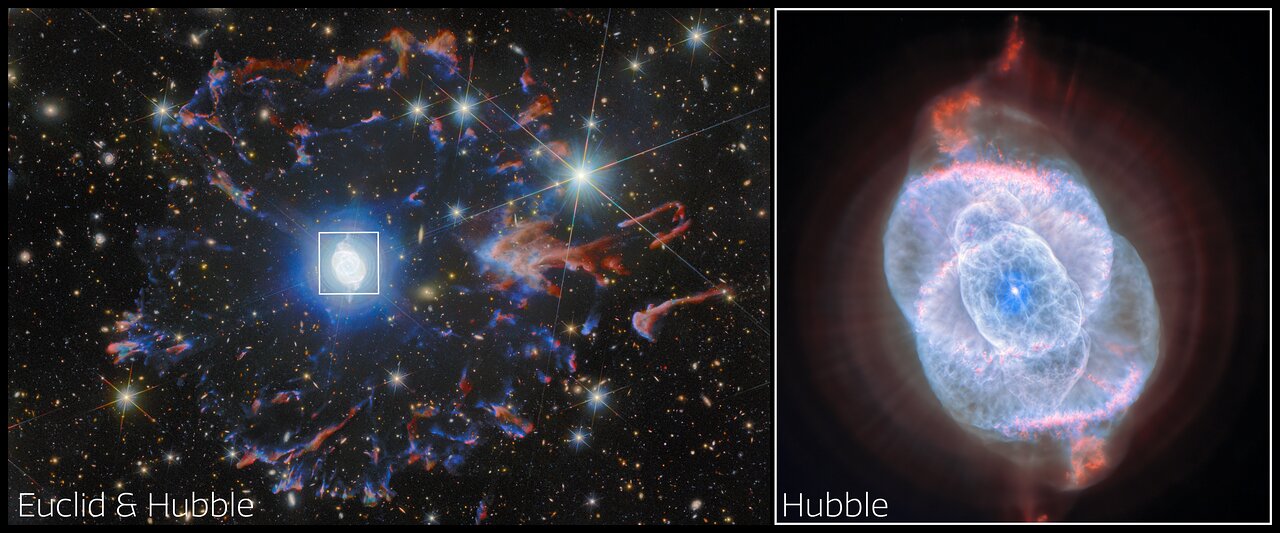
The jewel of Draco is the Cat's Eye Nebula (NGC 6543), about 3,000 light-years away — one of the most intricate planetary nebulae ever imaged. Despite the name, a planetary nebula has nothing to do with planets: it is the gas a Sun-like star sheds as it dies, lit up by the exposed, ultra-hot core left behind.
Hubble revealed at least eleven concentric shells around the Cat's Eye, plus knots, jets, and arcs of glowing gas. Those nested rings are thought to be pulses of material ejected roughly every 1,500 years as the star convulsed in its death throes. In about five billion years, our own Sun will end its life as a planetary nebula not unlike this one.
Three galaxies, three completely different lives
One of the finest sights in the constellation is a chance lineup of three galaxies framed together — the Draco Triplet. What makes it a perfect teaching image is that you are looking at three fundamentally different kinds of galaxy in a single view:
NGC 5985 — Face-on barred spiral
A grand, sweeping pinwheel seen flat-on, with a bar through its center and active Seyfert nucleus. Roughly twice the diameter of the Milky Way.
NGC 5982 — Elliptical
A smooth, featureless football of old stars — a galaxy that long ago finished forming stars. It looks bright simply because it is dense, not because it is large.
NGC 5981 — Edge-on spiral
A spiral seen exactly side-on, a thin needle of light. Same type of galaxy as a face-on spiral — we just happen to view its disk edgewise, like a plate seen along its rim.
Here is the trap, and the lesson: they look like a family standing shoulder to shoulder, but they are not gravitationally bound. All three lie roughly 100–140 million light-years away and only appear adjacent from our line of sight. It is the sky's best reminder that things that look next to each other can be wildly different distances apart — like a class photo where one student stands ten feet behind the rest and only looks like part of the row.
A constellation rich in galaxies
Looking toward Draco, our line of sight points away from the crowded, dusty plane of the Milky Way and out into deep intergalactic space — which is why the Dragon is packed with galaxies rather than nebulae and star clusters.
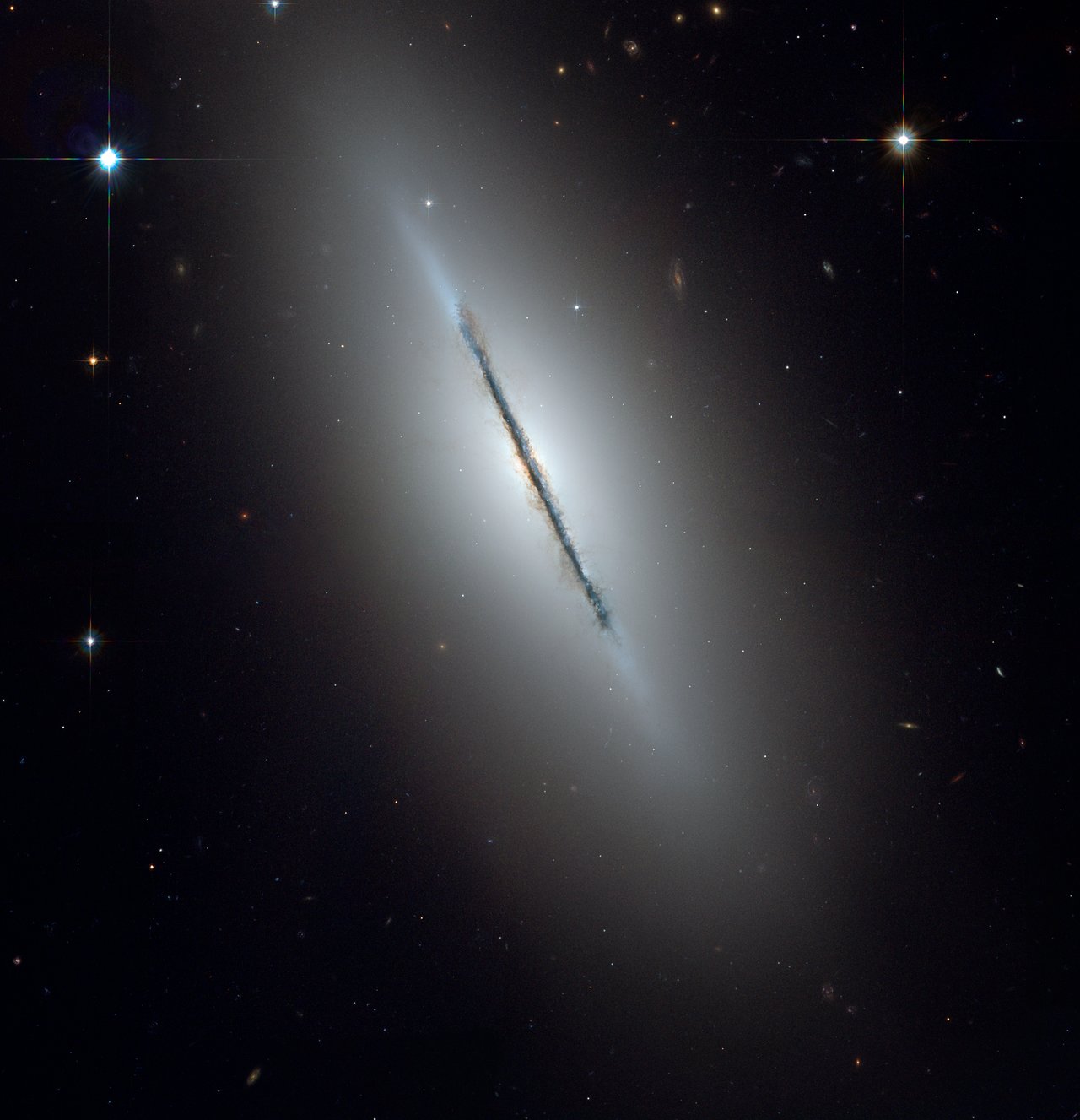
Spindle Galaxy — NGC 5866
An edge-on lenticular galaxy about 44 million light-years away, sliced cleanly in half by a crisp dust lane. Often identified with Messier 102, one of the catalog's long-standing puzzles.
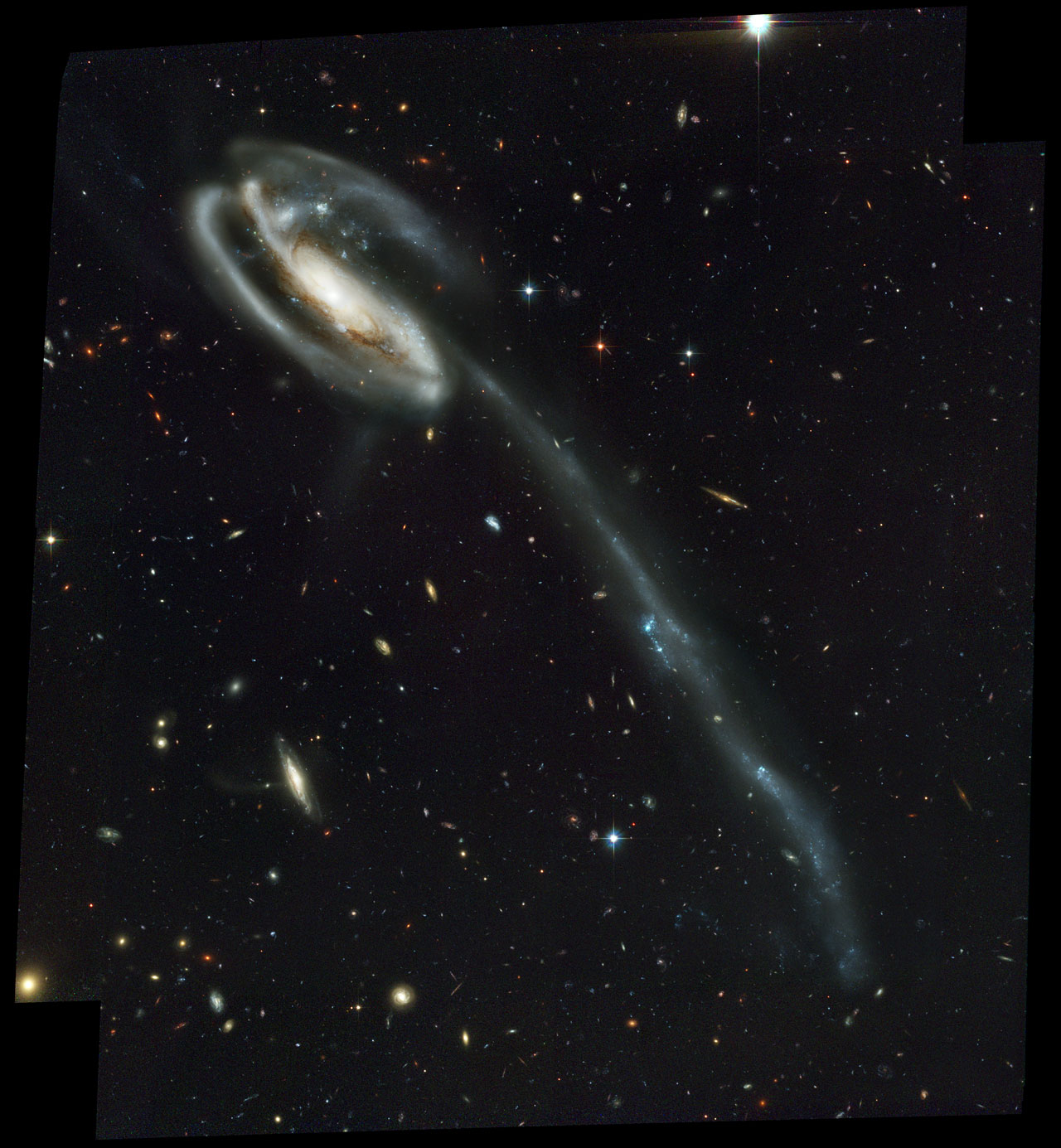
Tadpole Galaxy — Arp 188
A disrupted spiral roughly 420 million light-years away, trailing a spectacular 280,000-light-year tail of stars and gas drawn out by a passing intruder galaxy. The deep Hubble field behind it is dusted with thousands of far more distant galaxies.
Draco deep-sky objects
| Object | Type | Distance | Notes |
|---|---|---|---|
| Cat's Eye Nebula (NGC 6543) | Planetary nebula | ~3,000 ly | Eleven+ concentric shells; preview of the Sun's fate |
| Spindle Galaxy (NGC 5866) | Lenticular galaxy | ~44 million ly | Edge-on; candidate for Messier 102 |
| Tadpole Galaxy (Arp 188) | Disrupted spiral | ~420 million ly | 280,000 ly tidal tail from a galaxy collision |
| NGC 5985 | Barred spiral (Seyfert) | ~100–140 million ly | Face-on member of the Draco Triplet |
| NGC 5982 | Elliptical galaxy | ~100–140 million ly | Central member of the Draco Triplet |
| NGC 5981 | Spiral galaxy | ~100–140 million ly | Edge-on member of the Draco Triplet |
| Draco Dwarf | Dwarf spheroidal | ~260,000 ly | A faint satellite galaxy of the Milky Way |
Finding and observing Draco
Draco is circumpolar for observers north of about 30°N, so from most of the United States it is up every clear night. The trick is to use the two Dippers as bookends:
- Find the Big Dipper and the Little Dipper. Draco's long body threads between them.
- Start at the tail near the Big Dipper's bowl, then follow the faint chain of stars as it curls around the Little Dipper.
- End at the head — a compact quadrilateral of brighter stars (Eltanin and Rastaban among them) near the bright star Vega.
Naked eye: The Dragon's winding pattern; the head's quadrilateral.
50mm binoculars: The double star Nu Draconis (Kuma) splits cleanly.
6-inch telescope: The Cat's Eye Nebula shows as a small blue-green disk; the Spindle Galaxy as an edge-on sliver.
Astrophotography target: The Draco Triplet and the Cat's Eye both reward longer-exposure imaging.
New to stargazing? See how to observe the night sky, and if you're choosing gear, the no-hype telescope buying guide.
Constellation data sheet
| Abbreviation | Dra |
| Genitive | Draconis |
| Right Ascension | 17h 30m (center, approx.) |
| Declination | +65° (center, approx.) |
| Area | 1,083 sq. degrees (8th largest) |
| Brightest star | Eltanin (gamma Dra), mag 2.2 |
| Former pole star | Thuban (alpha Dra), ~3000 BCE |
| Meteor shower | Draconids (October); Quadrantids radiant nearby (January) |
| Bordering constellations | Ursa Major, Ursa Minor, Cepheus, Cygnus, Lyra, Hercules, Boötes, Camelopardalis |
| Best visibility | Circumpolar from >30N; highest on summer evenings |
The dragon read a dozen ways
Greek storytellers gave Draco at least two origins. In the better-known version the dragon is Ladon, the hundred-headed serpent that coiled around the tree of golden apples in the garden of the Hesperides. Heracles killed it to seize the apples as his eleventh labour, and Hera set the dragon among the stars to thank it for its service. In the older account the dragon fought the Olympians during their war with the Titans, until Athena caught it and flung it, still twisting, onto the cold pole of the sky, where it froze into the constellation.
The northern peoples who charted the same stars later read their own creatures into them. Persian and Arab astronomers saw serpents and a pair of hyenas; over three thousand years the figure has been drawn as a dragon, a snake, and a crocodile. The constant is the shape. A long, sinuous body that no bright star anchors threads the narrow gap between the two Dippers, and once you trace it from tail to head you never lose it again.
Sources & Image Credits
Hubble Space Telescope and ESA/Euclid images used under open science and education licenses:
Draco is the slow dragon of the pole — faint enough to overlook, ancient enough that it once pointed travelers north, and deep enough that its quiet stars frame galaxies tens of millions of light-years away. A constellation that asks you to look longer, and rewards you for it.
Stories in the stars
Draco's dragon Ladon is one thread in a wider tapestry of constellation myths. Explore them all on the Greek mythology hub.
Greek Myths Hub · Hercules · Lyra · Cassiopeia · Ursa Major
All Astronomy Notes · Whirlpool Galaxy (M51) · Cassiopeia · Lyra · Summer Triangle · Ring Nebula · Andromeda Galaxy · Polaris