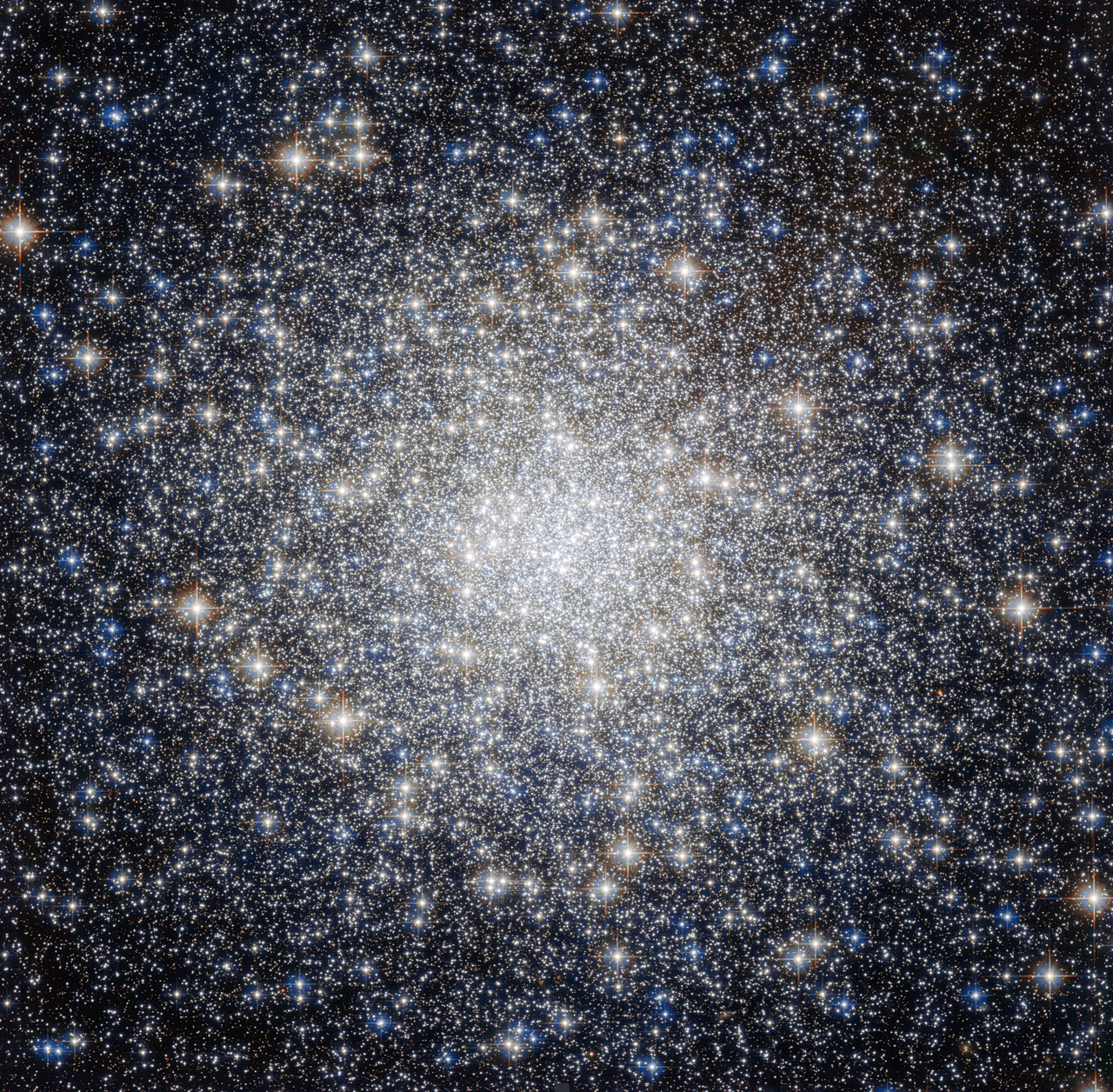
The globular cluster Messier 92 in Hercules, imaged by Hubble. One of the oldest clusters in the Milky Way, roughly 27,000 light-years away and nearly as old as the universe itself. Image credit: ESA/Hubble & NASA.
The strongest man, on one knee
This is Heracles, the Roman Hercules, the greatest hero of Greek myth and a son of Zeus. Driven to madness by the goddess Hera, he killed his own family, and to atone he performed the famous twelve labours: slaying the Nemean lion, the many-headed Hydra, capturing the Erymanthian boar, and more. The Greeks first knew this constellation simply as Engonasin, "the kneeling one," and only later identified the kneeler as Hercules.
In the sky he kneels with one foot planted on the head of Draco, the dragon Ladon that he killed to win the golden apples of the Hesperides. The hero and the dragon he defeated lie locked together near the northern crown, a quiet piece of the larger map of myths overhead.
Hercules at a glance
Abbreviation
Her · Genitive: Herculis
Brightest Star
Kornephoros (β Her), magnitude 2.8
Signpost
The Keystone asterism
Best Visibility
Summer evenings; northern sky
Two great clusters and a monster galaxy
The Keystone, the lopsided square at the hero's torso, is the key to finding everything here. Run down its western edge and you arrive at the constellation's crown jewel.
Messier 13
The Great Hercules Cluster, the finest globular in the northern sky, a sphere of about 300,000 stars and the target of the 1974 Arecibo radio message. It has its own page on this site.
Messier 92
The cluster in the feature image, often overshadowed by M13 but magnificent in its own right, and one of the oldest objects in the galaxy.
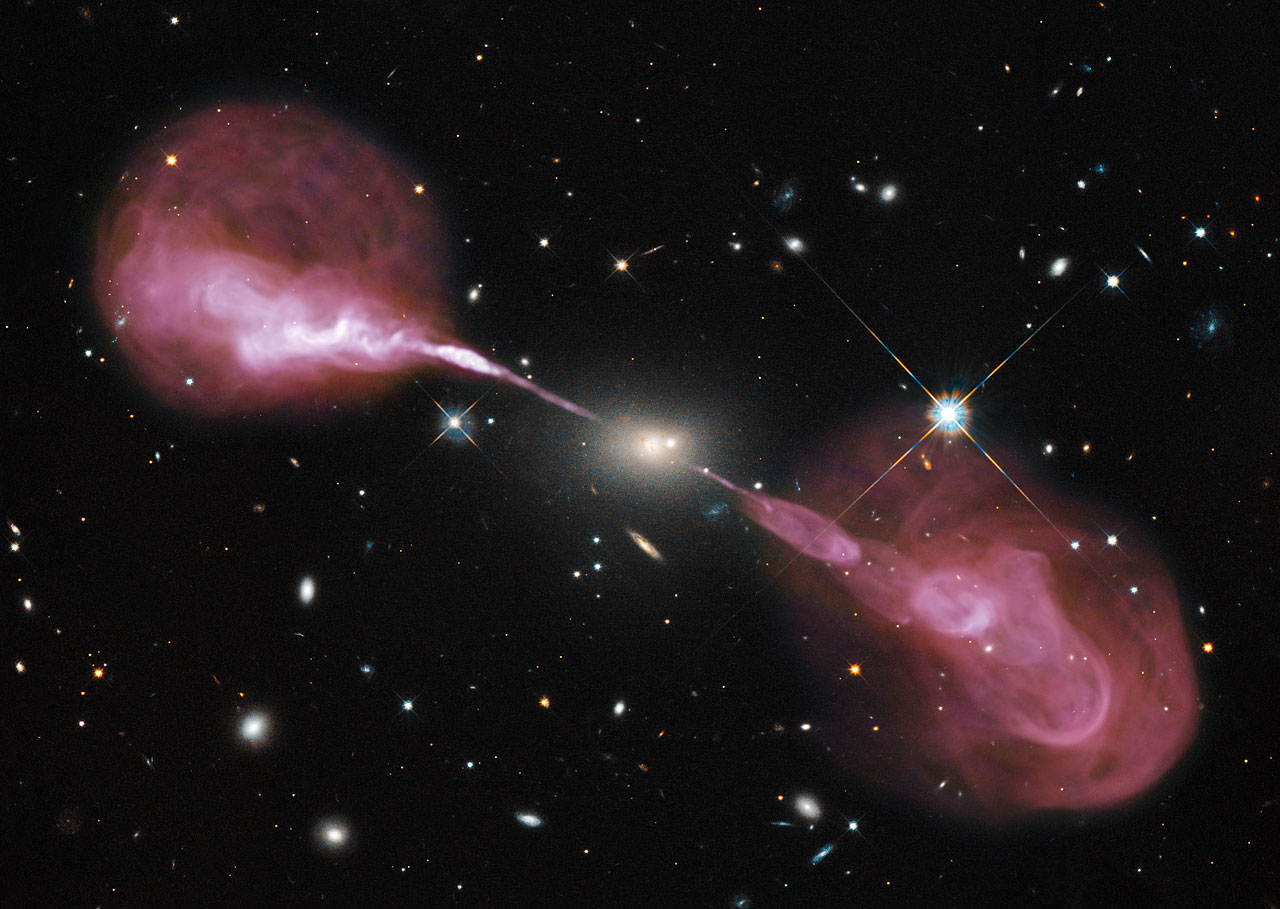
Hercules A
The radio galaxy at right, about 2 billion light-years away. Its supermassive black hole drives twin jets longer than dozens of Milky Ways laid end to end.
Ras Algethi
Alpha Herculis, the "head of the kneeler," a vast red giant and a colourful double star that splits in a small telescope into orange and blue-green components.
Constellation data sheet
| Abbreviation | Her |
| Genitive | Herculis |
| Area | 1,225 sq. degrees (5th largest) |
| Brightest star | Kornephoros (beta Her), mag 2.8 |
| Signature asterism | The Keystone |
| Showpiece objects | M13 and M92 globular clusters |
| Bordering constellations | Draco, Boötes, Corona Borealis, Lyra, Aquila, Ophiuchus, Serpens |
| Best visibility | Summer evenings, northern latitudes |
| Mythology | Heracles, hero of the twelve labours |
Hercules kneels in the summer sky with his foot on a dragon, the strongest of heroes drawn from the faintest of stars. Look closer and his quiet square holds suns older than the Earth and a black hole roaring across two billion light-years. The labours, it turns out, never really ended.
More stories in the stars
Hercules is one of many constellations carrying a Greek myth. Explore the connected sagas and figures on the Greek mythology hub.
Greek Myths Hub · Hercules Cluster (M13) · Draco · Lyra · Perseus · Orion
New to stargazing? See how to observe the night sky, and if you're choosing gear, the no-hype telescope buying guide.
All Astronomy Notes · Hercules Cluster · Draco · Lyra · Greek Mythology in the Night Sky