
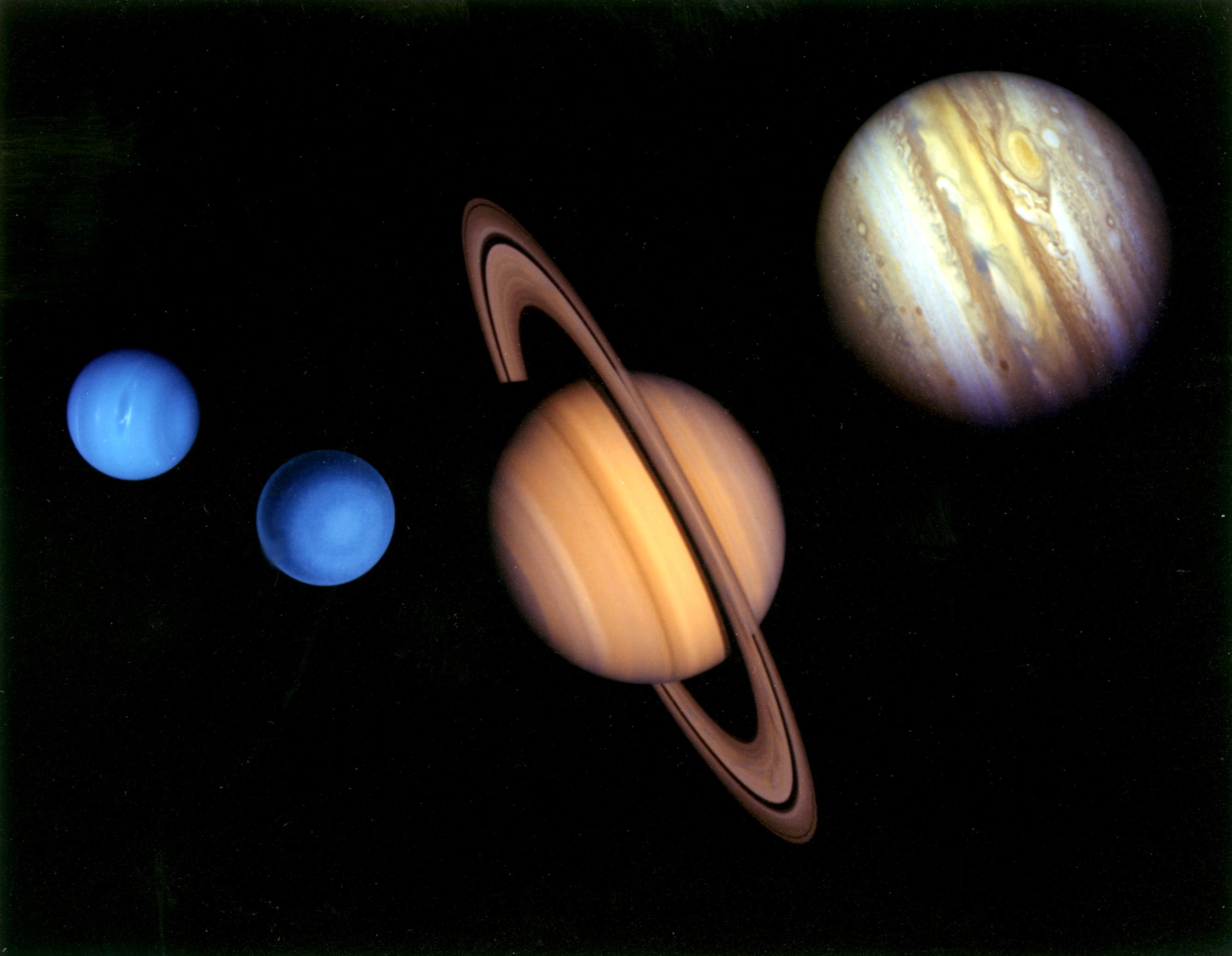
Voyager Tour Montage: Jupiter, Saturn, Uranus, and Neptune as seen by the twin Voyager spacecraft. Voyager 2 visited all four. Credit: NASA/JPL [PIA01483].
Launched first, named second
There is something quietly absurd about the name. Voyager 2 launched sixteen days before Voyager 1 — on August 20, 1977 — yet received the lower number because its slower, more ambitious trajectory meant it would reach Jupiter second. The naming logic made bureaucratic sense. The mission itself made history.
Where Voyager 1 became the first human-made object to leave the solar system, Voyager 2 did something arguably more extraordinary along the way: it visited all four of the solar system's outer planets — Jupiter, Saturn, Uranus, and Neptune. No spacecraft before or since has done this. Nearly five decades after launch, it remains the only emissary humanity has ever sent to Uranus or Neptune — the only close-up photographs we have of two entire worlds.
It is now sailing through interstellar space, more than 12 billion miles from the Sun, still sending data back across the void. Still working.
"Jupiter. Saturn. Uranus. Neptune. No spacecraft before or since has visited all four."
Voyager 2 at a glance
Launch
August 20, 1977 — 16 days before Voyager 1
Planets Visited
Jupiter (1979), Saturn (1981), Uranus (1986), Neptune (1989)
Unique Distinction
Only spacecraft ever to fly past Uranus and Neptune
Interstellar Crossing
November 5, 2018 — second human-made object to enter interstellar space
The physics of the slingshot
The mission that became Voyager took shape in the late 1960s when a young aerospace engineer named Gary Flandro noticed something remarkable: the outer planets were about to align in a configuration that occurs roughly once every 176 years. A spacecraft launched on the right trajectory could use each planet's gravity as a slingshot — gaining speed, bending direction, and arriving at the next target without burning a drop of additional fuel. Scientists called it the Grand Tour. Miss the window, and no one alive in 1977 would see another.
The physics is elegant. As a spacecraft falls toward a massive planet, the planet's gravity accelerates it; if the geometry is right, the spacecraft swings around and departs in a new direction, carrying away extra velocity it "stole" from the planet's orbital momentum. The planet slows by an immeasurable amount; the spacecraft speeds up by thousands of miles per hour. Each gravity assist is essentially a free rocket burn. NASA built two spacecraft to take advantage of it — Voyager 1 on a faster route optimized for Jupiter and Saturn, and Voyager 2 on the longer road, designed from the outset to keep going.
Confirming Io's volcanoes, then pressing onward
When Voyager 2 swept past Jupiter in July 1979, it arrived knowing what to look for. Voyager 1 had passed four months earlier and discovered active volcanoes on Io. Voyager 2 confirmed and extended that discovery, imaging Io's constantly churning surface — which had already changed measurably in the months between encounters. It also returned tantalizing early evidence that Europa might hide a liquid water ocean beneath its cracked, frozen surface, and discovered a new Jovian moon, Adrastea — Thebe and Metis were found in Voyager 1's images the same year.
Voyager 1 had already studied Saturn in November 1980. Voyager 2 arrived in August 1981 with a different mandate: do not let Saturn's gravity capture you. Its trajectory was deliberately designed to skip the close Titan approach so the spacecraft could carry enough momentum to continue onward to Uranus — a 4.5-year journey away. The Saturn flyby still yielded refined measurements of the ring structure and magnetic field. But the real prize lay ahead.
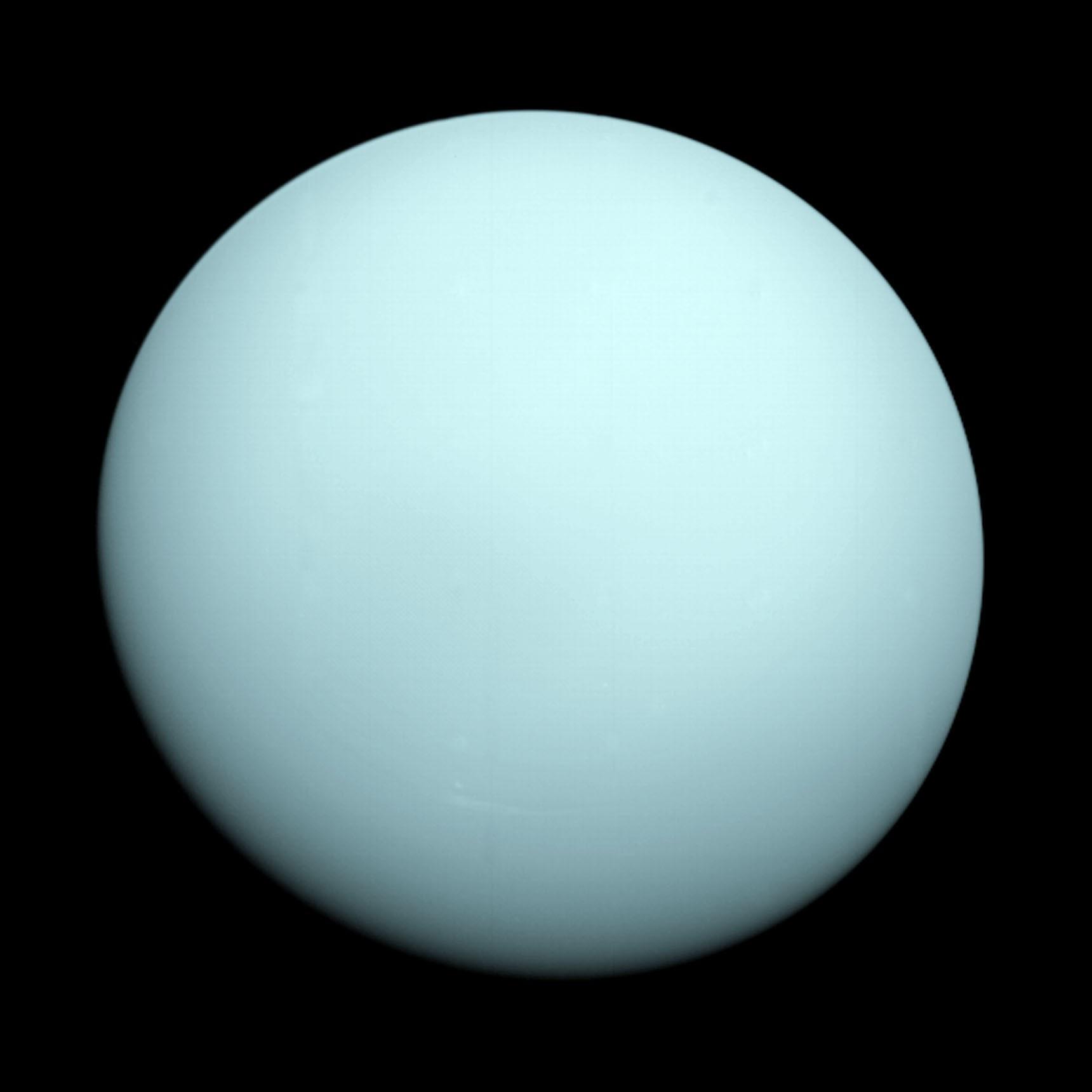
A planet tipped on its side
On January 24, 1986, Voyager 2 made the closest approach to Uranus in the history of human spaceflight — coming within 81,500 kilometers of the cloud tops. It remains the only close encounter with Uranus ever conducted.
What it found was unlike anything else in the solar system. Uranus is tilted so severely on its axis — roughly 98 degrees — that it essentially rolls around the Sun on its side. The leading theory for this extreme tilt is a catastrophic collision early in the solar system's history. The magnetic field is also deeply strange — tilted 59 degrees from the rotation axis and offset far from the planet's center.
Voyager 2 discovered ten previously unknown moons and two new rings. And then there was Miranda — the most geologically extreme surface ever photographed on any world in the solar system. Towering cliffs (Verona Rupes is estimated at 20 kilometers tall, the highest known cliff face in the solar system) sit alongside chaotically jumbled terrain and grooved ridges that seem to belong to completely different geological eras. The leading interpretation is that Miranda was shattered by an ancient collision and re-assembled from its own fragments.
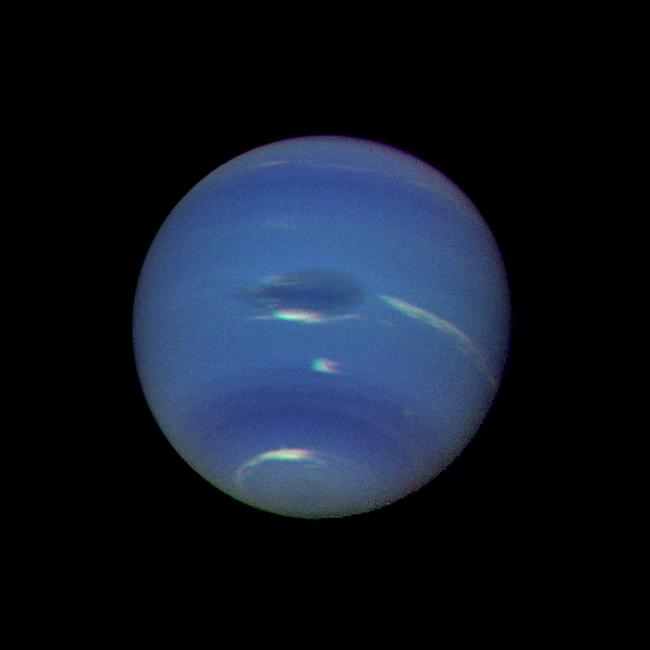
The windiest world — and a storm that vanished
Three and a half years later, on August 25, 1989, Voyager 2 arrived at Neptune. Again: the only close encounter ever. Neptune's most prominent feature was an enormous anticyclonic storm in the southern hemisphere — the Great Dark Spot, roughly the size of Earth. It drew immediate comparisons to Jupiter's Great Red Spot, but proved transient: when the Hubble Space Telescope looked in 1994, it had vanished entirely, replaced by a new dark spot in the northern hemisphere.
The planet also proved to be the windiest in the solar system, with jet streams exceeding 2,000 kilometers per hour — the fastest sustained atmospheric winds anywhere we have measured. Voyager 2 confirmed that Neptune has five faint rings, one of which (Adams) contains three distinct arcs of denser material that puzzled scientists.
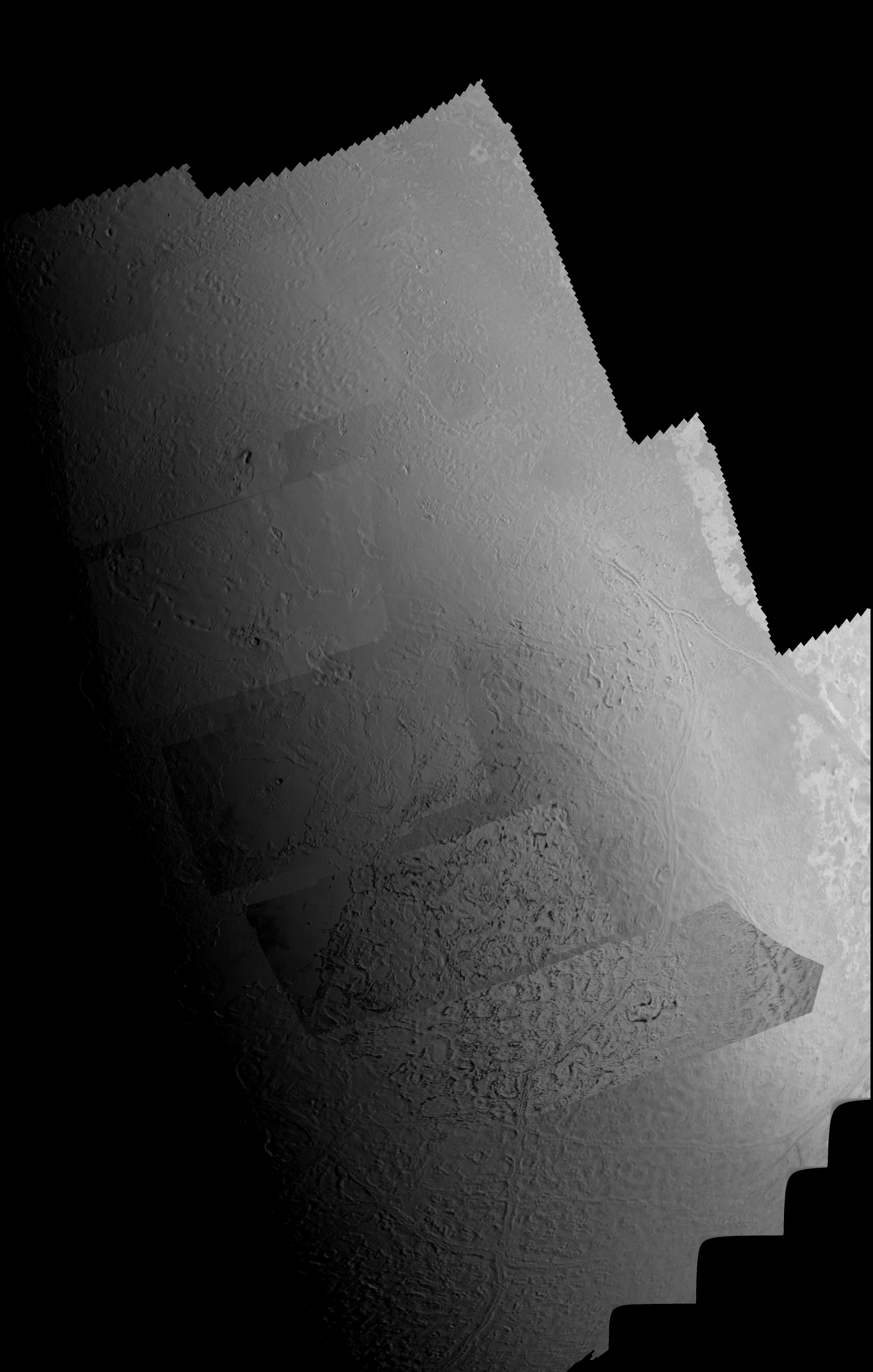
Geysers on one of the coldest worlds ever measured
Neptune's largest moon is one of the most geologically and dynamically bizarre objects in the solar system. It orbits Neptune backwards — opposite to the planet's rotation — a nearly certain sign that Triton did not form alongside Neptune but was captured from the Kuiper Belt billions of years ago. Its surface temperature is −235°C, making it one of the coldest places ever measured.
And yet, against all intuition, it has geysers: dark nitrogen plumes erupting from the surface and rising eight kilometers high before being swept downwind into dark streaks across the frozen plains. A world so cold it makes Pluto look temperate, actively venting material into space. Everything detailed science knows about Neptune and Triton was learned during that single afternoon in August 1989.
Worlds seen only once
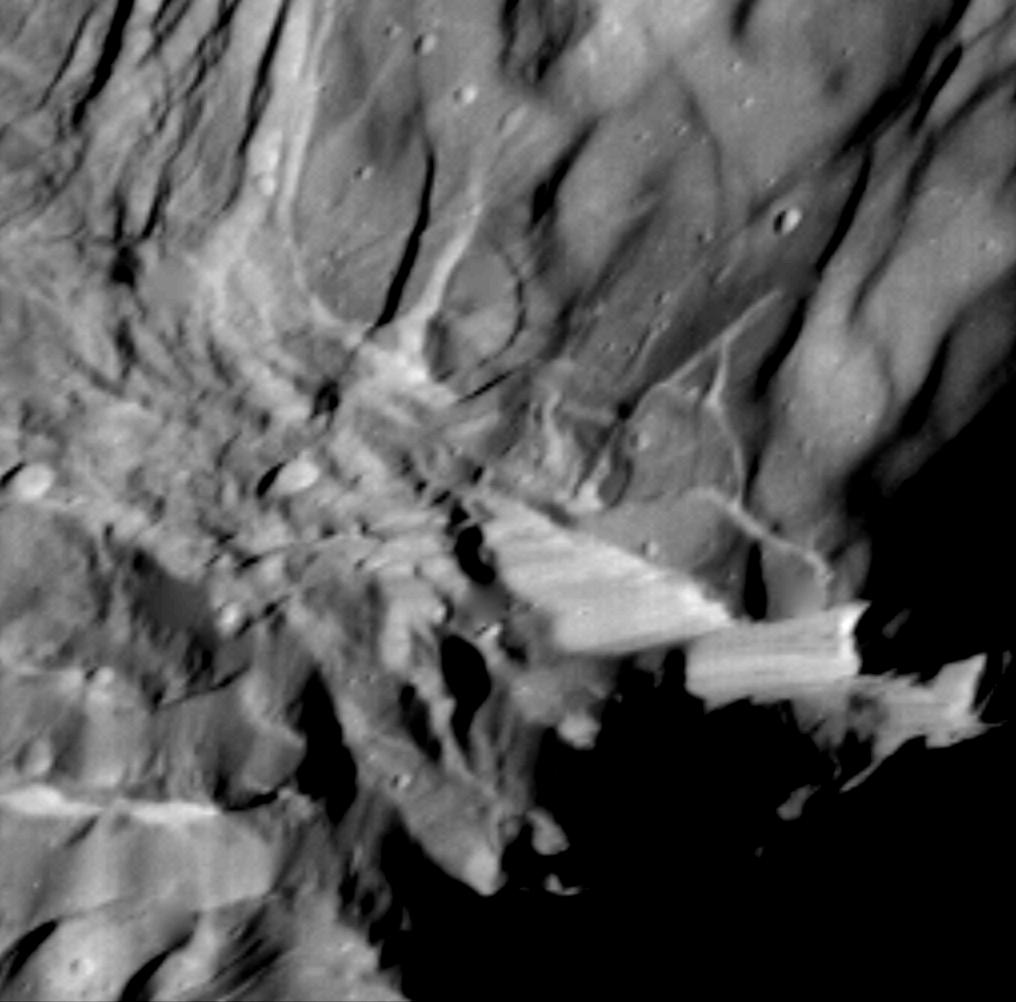
Miranda
Uranus's moon Miranda — the most geologically extreme surface ever photographed, with Verona Rupes, a cliff face estimated at 20 km tall, the highest known in the solar system.
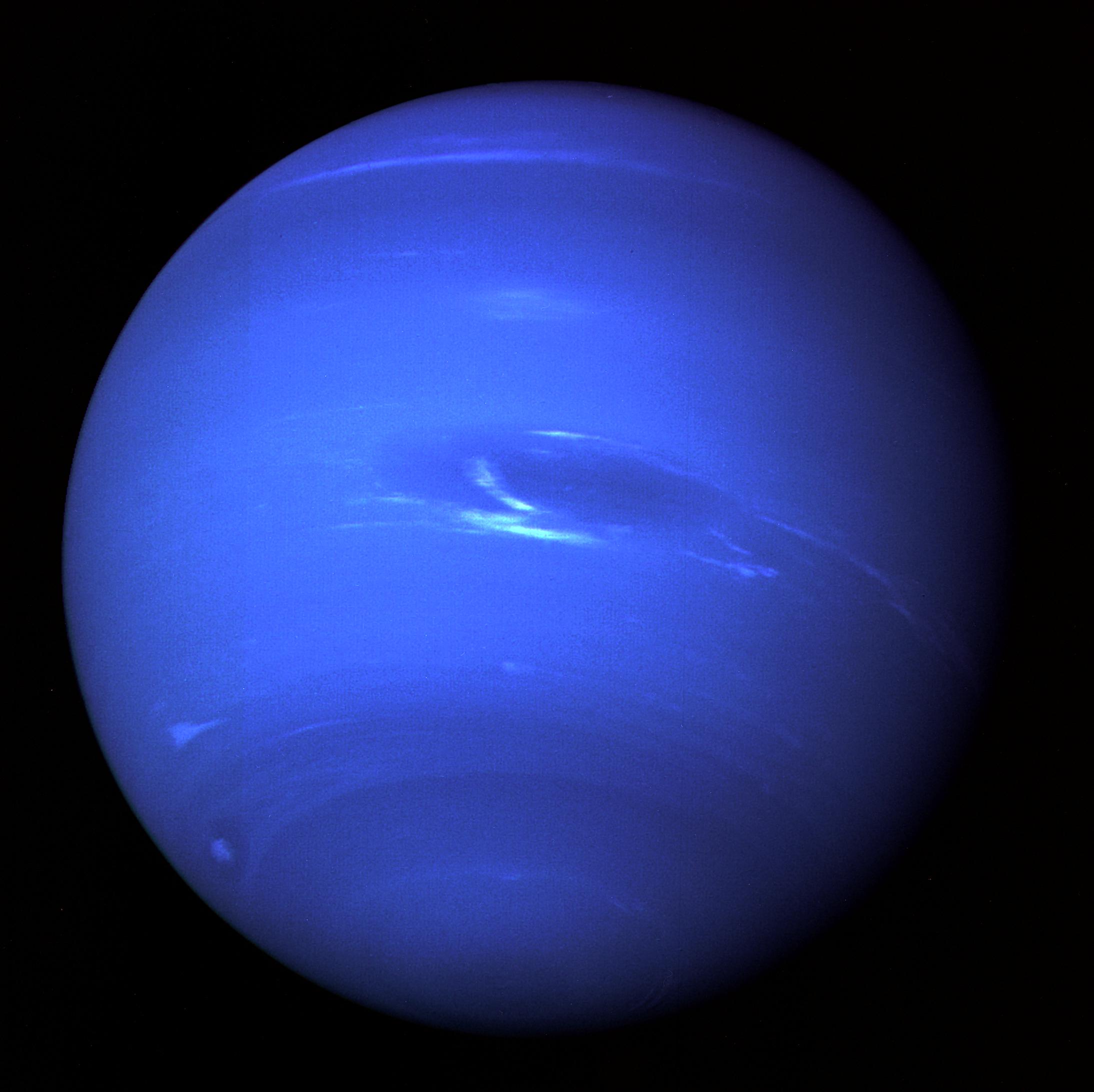
Neptune
The deep blue disk of Neptune — the windiest planet in the solar system, with jet streams exceeding 2,000 km/h, seen up close for the only time in 1989.
Triton
Neptune's largest moon, orbiting backwards and venting nitrogen geysers at −235°C — one of the coldest and strangest worlds Voyager 2 encountered.
A two-point measurement of the solar system's edge
On November 5, 2018, Voyager 2 crossed the heliopause — the boundary where the Sun's solar wind gives way to the interstellar medium — and became the second human-made object to enter interstellar space, roughly 18 billion kilometers from the Sun. NASA announced the crossing that December. Voyager 1 had crossed in 2012, but at a different location and angle.
That difference matters enormously. Having two spacecraft cross at separate locations gave scientists their first two-point measurement of the heliosphere's boundary, revealing that the outer edge of the Sun's influence is not uniform — it is thinner and sharper than models had predicted. And Voyager 2 brings something Voyager 1 cannot: its Plasma Science instrument is still functional, making it the only spacecraft ever to carry a working plasma instrument into interstellar space, directly measuring the density and temperature of the medium between the stars.
Aboard Voyager 2, as on its twin, is a 12-inch gold-plated copper disk — the Golden Record. It contains 115 images of Earth and its life, greetings in 55 languages, natural sounds, and 90 minutes of music spanning Beethoven, Chuck Berry, and folk songs from across the world. If any civilization ever intercepts and plays it, they will hear, among other things, a human heartbeat and the sounds of surf.
No successor on the way
As of 2026, Voyager 2 remains operational — one of only two human-made objects transmitting from interstellar space. Its signals take more than 18 hours to reach Earth, where the Deep Space Network's largest antennas strain to detect a transmission weaker than a digital watch battery. Power from its RTGs declines by roughly four watts per year, and NASA has been selectively shutting down instruments to keep the most valuable ones running. Engineers expect to lose contact sometime in the late 2020s.
What makes that approaching silence particularly poignant is that no successor is on the way. No spacecraft has returned to Uranus or Neptune since Voyager 2's flybys more than three decades ago. NASA's 2022 planetary science decadal survey designated a Uranus orbiter and probe as the highest-priority flagship mission for the 2030s, but any launch is unlikely before the mid-2030s, with arrival not before the 2040s. For the foreseeable future, the data Voyager 2 gathered in 1986 and 1989 remains the best — and only — close-up science humanity has from two entire planets.
After contact is lost, Voyager 2 will drift through the galaxy indefinitely. In approximately 296,000 years, it will pass within 4.3 light-years of Sirius, the brightest star in Earth's night sky. No one will be listening. But the Golden Record will still be there.
Sources & Image Credits
All photographs in this article are NASA/JPL-Caltech public-domain works from the Voyager program, sourced from NASA's image library.
Voyager 2 remains the only craft ever to touch all four giant worlds — one improbable journey that turned distant points of light into real places, and sails on now, forever, beyond the last edge of the Sun's domain.
All Astronomy Notes · Voyager 1 · Pale Blue Dot · Earthrise · Cassiopeia · Andromeda Galaxy · Orion Nebula · Betelgeuse · Polaris