
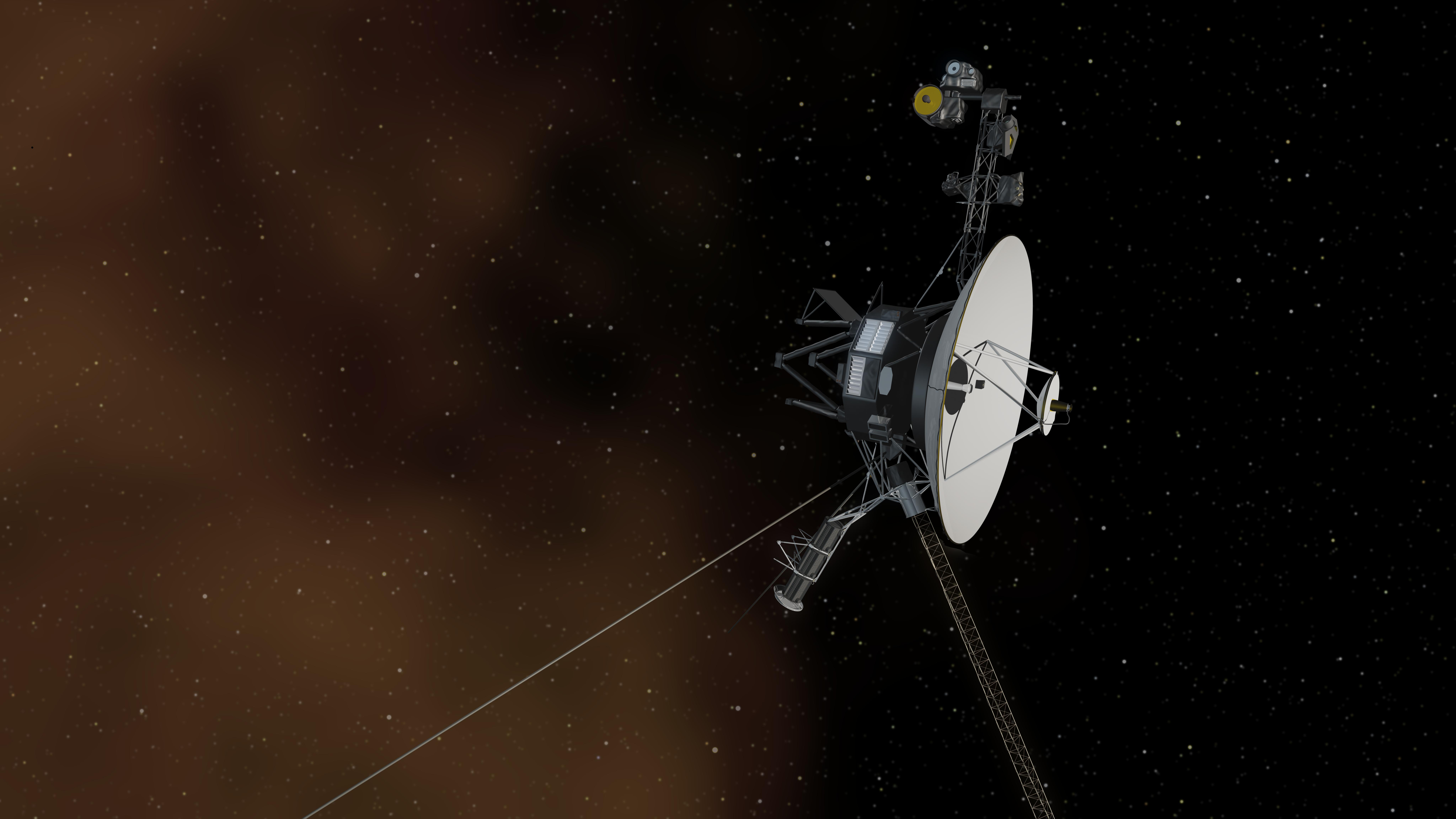
Artist's concept of Voyager 1 entering interstellar space. Launched September 5, 1977, it crossed into the space between the stars in August 2012. Credit: NASA/JPL-Caltech.
Still sending data from beyond the solar system
Voyager 1 is a NASA space probe that has achieved something no human-made object has ever done before: it has left the solar system entirely and is now sailing through interstellar space — the vast, cold void between the stars. Launched on September 5, 1977, it was built for a mission expected to last perhaps five years. Nearly five decades later, it is still operational, still sending data home from a distance of nearly 26 billion kilometers (about 173 astronomical units). And on November 18, 2026, it crosses a threshold no human-made object has ever reached: one full light-day from Earth — a "good morning" radioed to Voyager on Monday won't be answered until Wednesday.
It is one of two spacecraft in NASA's Voyager program. Its twin, Voyager 2 — launched 16 days earlier, though on a slower trajectory — followed a different path through the outer solar system, visiting Uranus and Neptune, and has since also crossed into interstellar space. Together, these two probes represent one of the greatest engineering and scientific achievements in human history.
"It was built for a five-year mission. Nearly fifty years later, from almost 26 billion kilometers away, it is still talking."
Voyager 1 at a glance
Launch
September 5, 1977, Cape Canaveral — Titan IIIE/Centaur rocket
Mass & Power
722 kg; powered by radioisotope thermoelectric generators (plutonium-238), not solar panels
Interstellar Crossing
August 2012 — first human-made object to cross the heliopause
Distance & Signal
~25 billion km (168 AU); one-way light time about 23 hours
A once-in-176-years alignment
Voyager 1 lifted off from Cape Canaveral on a Titan IIIE/Centaur rocket during a rare planetary alignment that occurs only once every 176 years. This alignment allowed a single spacecraft to use the gravity of each outer planet as a slingshot to the next — a trajectory called the "Grand Tour." Mission planners at NASA's Jet Propulsion Laboratory (JPL) seized the opportunity.
The spacecraft itself is a marvel of its era: a 722-kilogram probe built around a 10-sided aluminum bus, with a large 3.7-meter high-gain dish antenna pointed permanently toward Earth and a set of radioisotope thermoelectric generators (RTGs) that convert heat from decaying plutonium-238 into electricity. No solar panels — at the distances Voyager would travel, sunlight is too faint to be useful.
Onboard, Voyager 1 carried eleven scientific instruments, each targeting a different layer of the universe it would pass through — from the imaging cameras that captured the iconic photographs to the Plasma Wave Subsystem, one of the few instruments still operating today, which measures the density of the medium Voyager is traveling through. Taken together, these instruments were designed not just to photograph planets but to probe the invisible architecture of the outer solar system — and eventually, the space beyond.
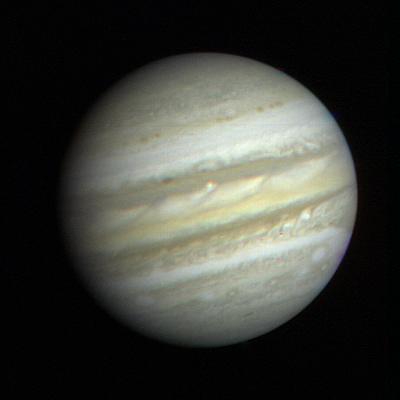
A world revealed — and active volcanoes on Io
Eighteen months after launch, Voyager 1 made its closest approach to Jupiter on March 5, 1979, swinging within 349,000 kilometers of the giant planet, measured from Jupiter's center. Jupiter's atmosphere churned with storms of startling complexity, and the Great Red Spot proved to be a centuries-old anticyclonic hurricane larger than Earth itself.
But the most breathtaking discovery came from Io, one of Jupiter's four large moons. On March 9, 1979, flight engineer Linda Morabito was processing a navigational image of Io when she noticed a vast umbrella-shaped plume rising nearly 300 kilometers above the surface. Voyager 1 had discovered active volcanoes on another world — the first ever seen beyond Earth. The energy source is tidal: Jupiter's colossal gravity, amplified by the orbital resonances of neighboring moons, continuously kneads Io's interior. Io remains the most volcanically active world we know of.
Voyager 1 also transformed our understanding of Jupiter's moon system. Europa's smooth, cracked surface hinted at a liquid water ocean buried beneath the ice — a discovery that would later make Europa one of the most compelling candidates for extraterrestrial life. The probe also confirmed a thin, dark dust ring around Jupiter, entirely invisible from Earth.
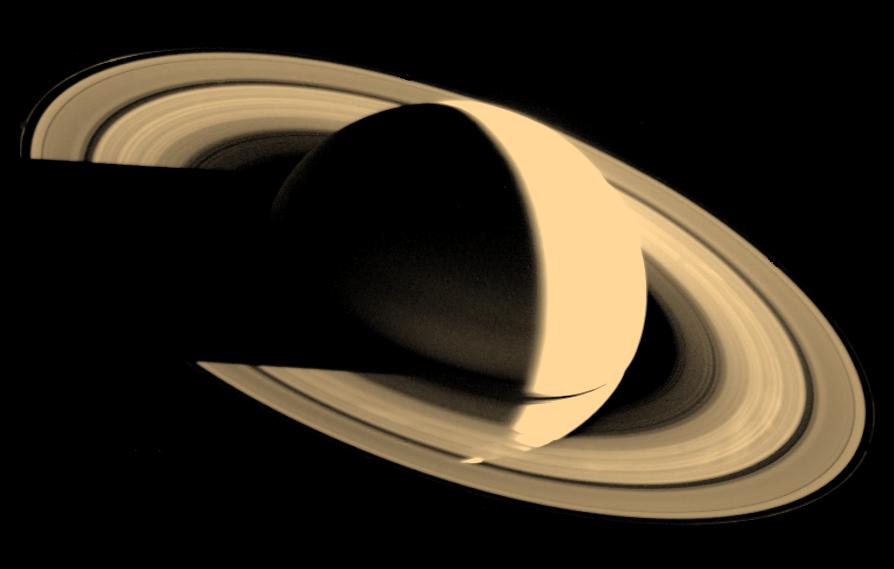
A ringed masterpiece and the choice that sent it to the stars
Using Jupiter's gravity as a slingshot, Voyager 1 raced on toward Saturn, reaching closest approach on November 12, 1980, at just 124,000 kilometers from the cloud tops. Saturn's ring system, resolved in extraordinary detail for the first time, proved far more complex than anyone had imagined — thousands of individual ringlets, gaps, and waves, with the braided F ring shepherded by two small moons. Most mysterious of all were the "spokes": radial, ghostlike features in the B ring that rotated with the planet's magnetic field rather than following normal orbital dynamics.
But the most scientifically consequential stop was Titan, the only moon in the solar system known to have a substantial atmosphere. Voyager confirmed that Titan's atmosphere is predominantly nitrogen — like Earth's — with a surface pressure roughly 1.5 times greater than our own, blanketed by layers of orange organic haze.
The Titan flyby was prioritized deliberately. The gravity assist needed to fly close to Titan flung Voyager 1 sharply out of the ecliptic plane, permanently ending any possibility of continuing to Uranus and Neptune. From Saturn onward, Voyager 1 was bound for the stars.
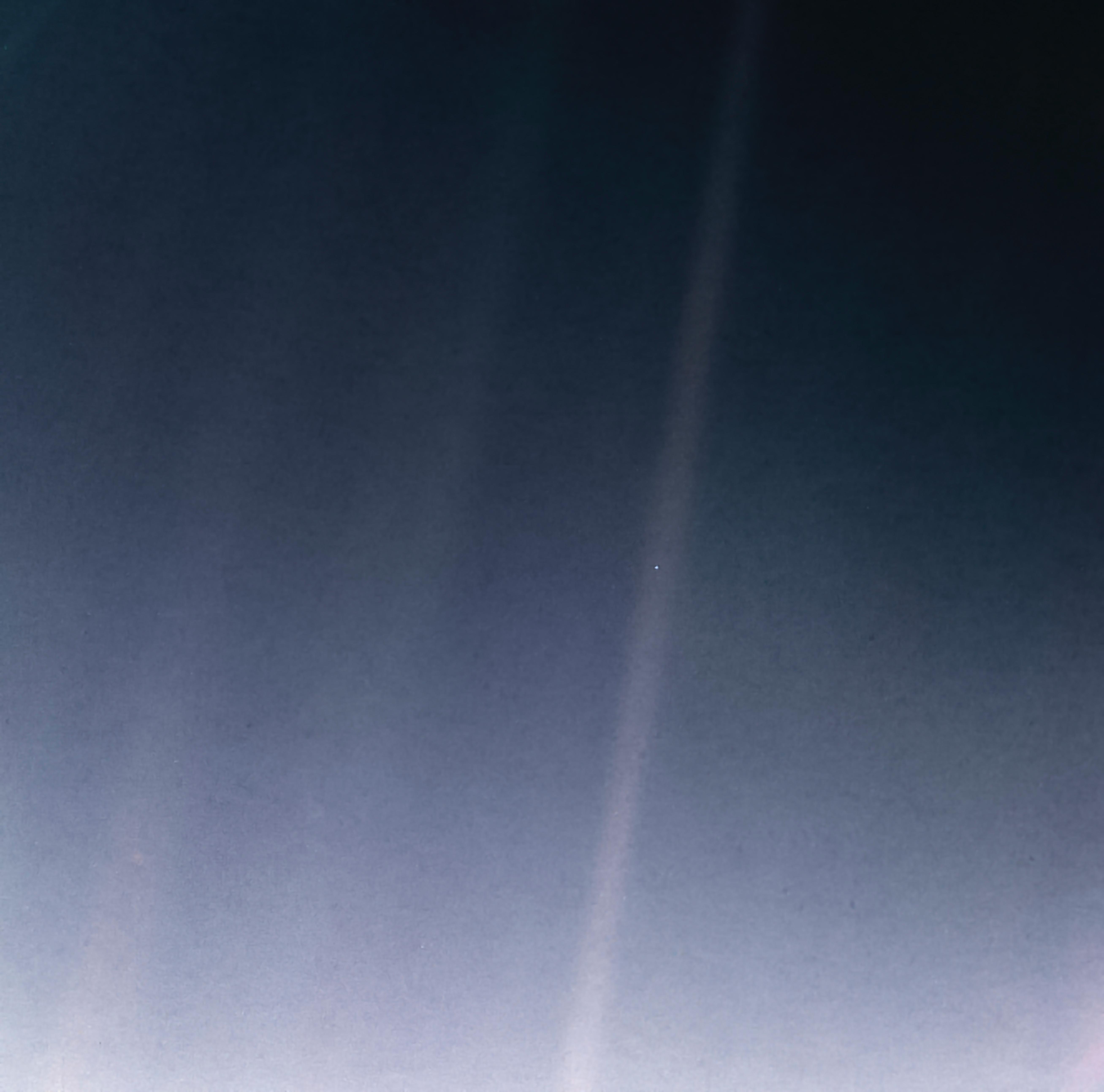
A mote of dust suspended in a sunbeam
On Valentine's Day 1990, at the urging of astronomer Carl Sagan, Voyager 1 turned its camera back toward the inner solar system one final time and photographed the planets. The sequence of 60 images — NASA's "Family Portrait of the Solar System" — captured six worlds, but one image became iconic beyond all others. Earth appears as a pale blue mote, less than a single pixel, suspended in a scattered sunbeam 6 billion kilometers from home.
Sagan's reflection on the image remains one of the most profound passages ever written about our place in the cosmos: "Look again at that dot. That's here. That's home. That's us. … a mote of dust suspended in a sunbeam." Shortly after the portrait was complete, Voyager 1's cameras were shut off forever to conserve power — leaving us with a photograph that permanently reframed humanity's sense of its own significance.
More from the mission
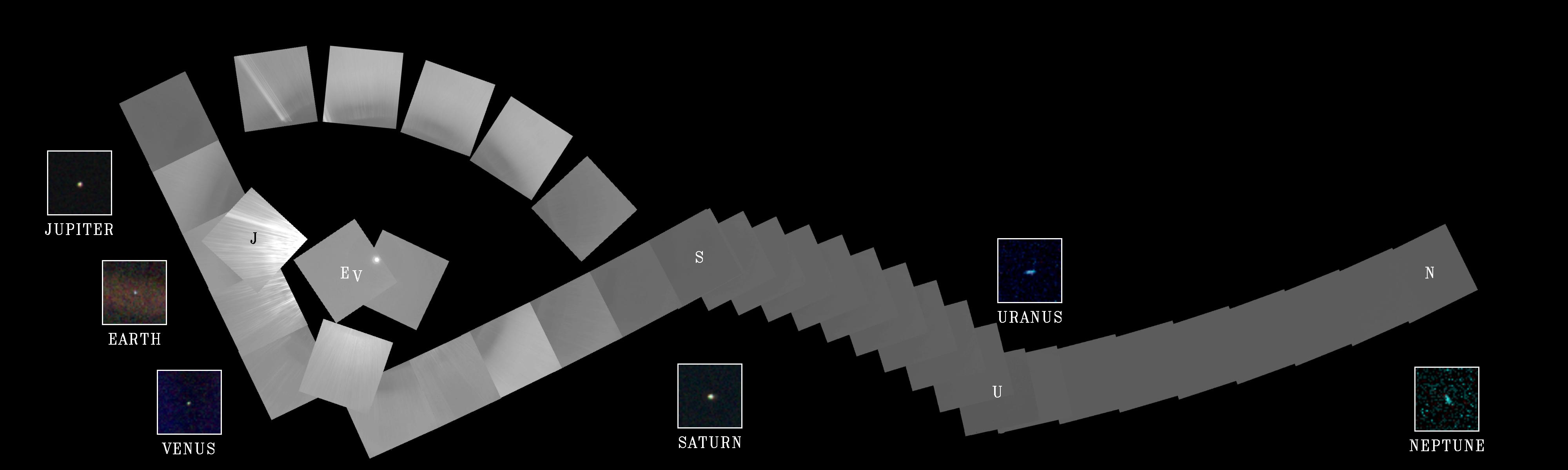
The Family Portrait
Before its cameras were switched off, Voyager 1 turned around and photographed six planets in a single mosaic — the only "family portrait" of the solar system ever taken from the outside.
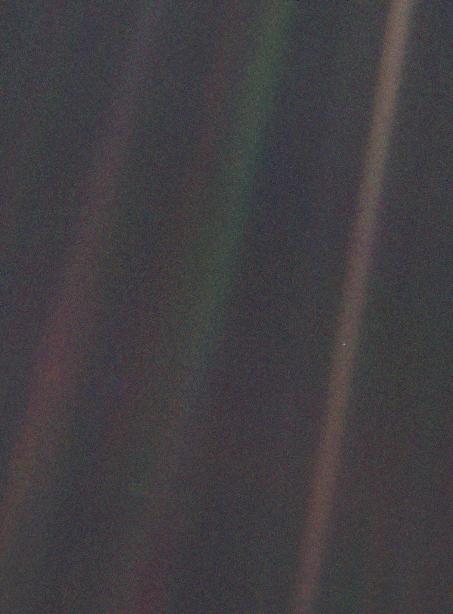
Pale Blue Dot (1990 Original)
The original 1990 frame: Earth as a single bright point caught in a scattered ray of sunlight. See the full Pale Blue Dot note.
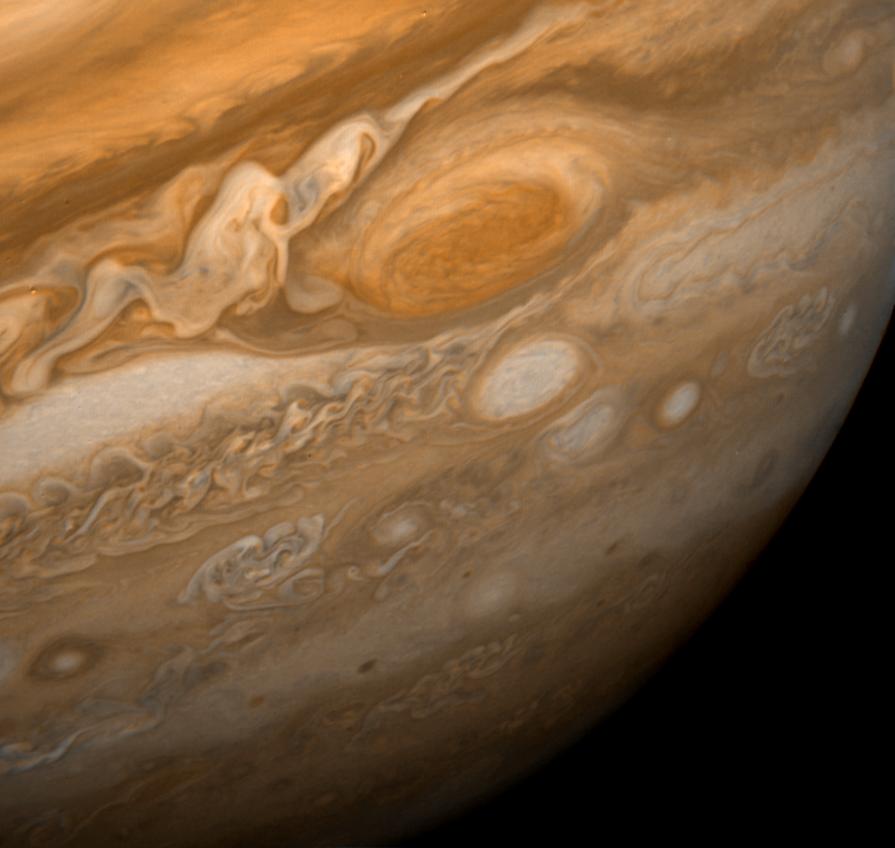
Jupiter's Great Red Spot
A Voyager 1 close-up of the Great Red Spot — a centuries-old anticyclone larger than Earth, surrounded by intricate ribbons of turbulent cloud.
Listening to the space between the stars
For decades after Saturn, Voyager 1 streaked outward through the heliosphere — the vast bubble of solar wind and magnetic field that surrounds our sun. In August 2012, the spacecraft crossed the heliopause, the boundary where the sun's outward-blowing solar wind is finally halted by the pressure of the interstellar medium, becoming the first human-made object ever to enter interstellar space. The confirmation came from a sudden, dramatic change in the plasma environment: solar wind particles dropped to nearly nothing while galactic cosmic rays surged fourfold.
The data Voyager 1 sends home today is unlike anything gathered by any earlier mission — because no probe has ever been here before. Its Plasma Wave Subsystem detects oscillations in the surrounding plasma, letting scientists calculate its density directly; the measurements confirm that interstellar plasma is substantially denser than the solar wind. The Cosmic Ray System has measured the full, unshielded flux of galactic cosmic radiation for the first time — telling us how much protection the heliosphere provides to life on Earth, and how much radiation future interstellar travelers would face.
Both Voyager spacecraft carry a 12-inch gold-plated copper disk — the Golden Record. Designed by a committee chaired by Carl Sagan, it holds 115 images of Earth, greetings in 55 languages, natural sounds, and music from Bach and Beethoven to Chuck Berry's "Johnny B. Goode." The cover is etched with instructions, in the universal language of pulsars and hydrogen, for how to play it. It is expected to survive at least one billion years — likely outlasting every other artifact of human civilization.
The 24-billion-kilometer rescue
In November 2023, Voyager 1 began transmitting a repeating pattern of meaningless binary data — the same nonsense sequence, over and over — instead of science and engineering telemetry. The spacecraft was still alive, its carrier signal strong, but its computers were no longer sending coherent information. The source was traced to the Flight Data System (FDS): a single memory cell had physically degraded and corrupted the code responsible for formatting outgoing data.
The engineering challenge was almost incomprehensible. Commands sent to Voyager 1 take 22.5 hours to arrive; responses take another 22.5 hours to return — a 45-hour round trip for every diagnostic attempt. The team had to work from documentation written in the 1970s, some of it on paper, for a computer architecture no living engineer had designed.
The solution was elegant: since the corrupted memory could not be repaired, engineers identified the scrambled sections, broke them apart, and redistributed the code across other still-functional regions of memory, then rewrote the pointers so the computer could find its own instructions. On April 20, 2024, Voyager 1 returned engineering data for the first time in five months; by May 2024, science data followed. It was one of the most extraordinary feats of remote engineering ever accomplished.
Power remains the mission's inexorable constraint. Voyager 1's RTGs shed roughly four watts of output per year, and instruments are being switched off one by one. Sometime between 2025 and 2030, the last science instrument will go dark, and eventually the transmitter itself will fall silent.
A ghost ship for the ages
Even after its transmitter falls silent, Voyager 1 will not stop. It will drift through the interstellar medium for millions — billions — of years, carrying humanity's message into the dark. In approximately 40,000 years, it will pass within 1.6 light-years of AC+79 3888, a dim star in the constellation Camelopardalis. It will never reach that star, and it will never be retrieved.
Long after the Earth is gone, Voyager 1 will still be out there, moving at roughly 17 kilometers per second through the dark, carrying a gold record etched with music and voices and the sounds of a living world — and the accumulated wonder of a species that once looked up at the stars and, against all reason and all odds, decided to go.
Sources & Image Credits
All photographs in this article are NASA/JPL-Caltech public-domain works from the Voyager program, sourced from NASA's image library.
Voyager 1 carries a golden record and a fragment of 1977 into the dark between the stars — humanity's farthest reach, still faintly whispering home long after the hands that built it have gone still.
All Astronomy Notes · Voyager 2 · Pale Blue Dot · Earthrise · Cassiopeia · Andromeda Galaxy · Orion Nebula · Betelgeuse · Polaris