
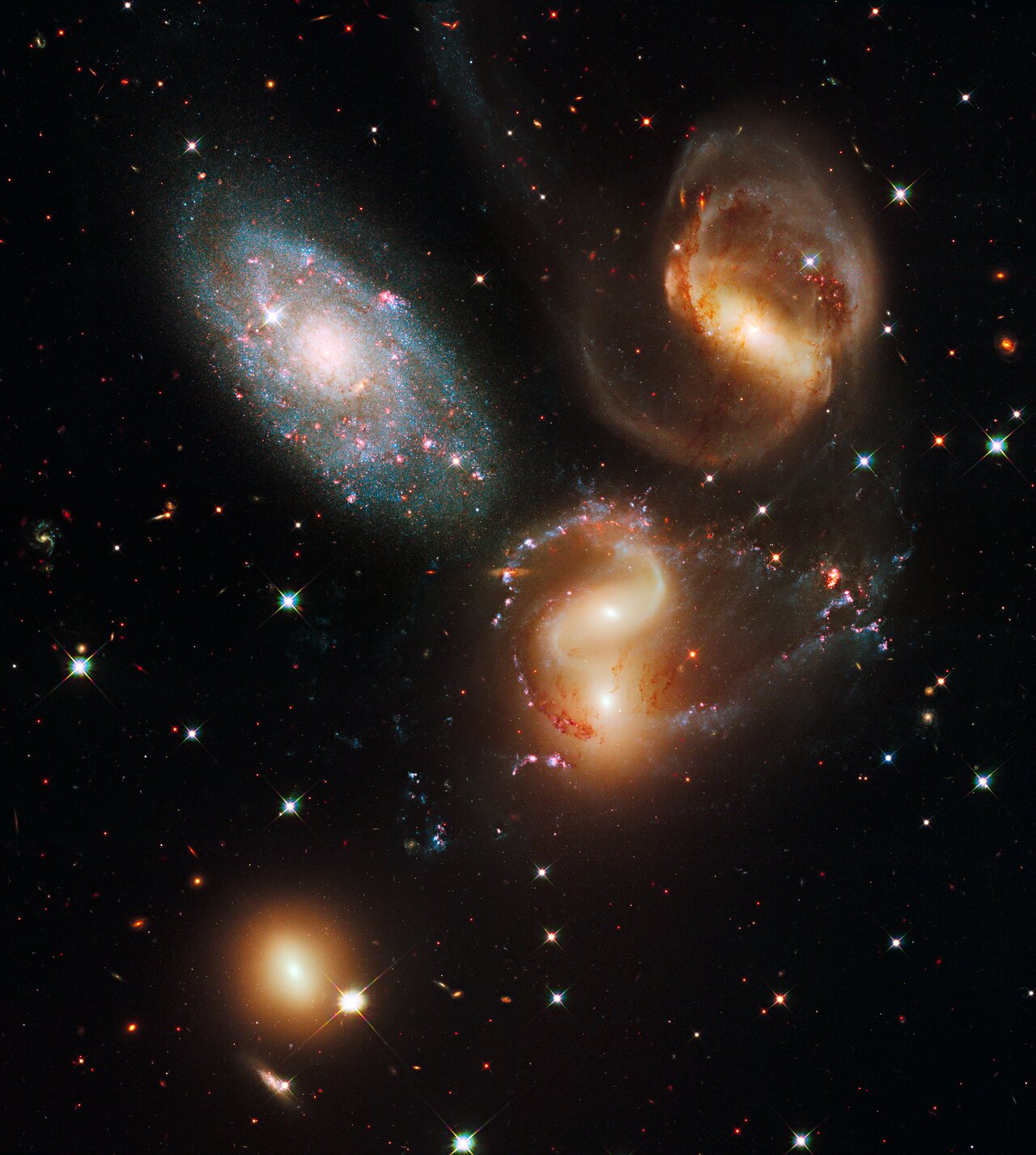
Stephan's Quintet in Pegasus, a compact group of galaxies about 290 million light-years away, several locked in a slow gravitational collision. It opened the James Webb Space Telescope's first image release in 2022. Image credit: NASA, ESA and the Hubble SM4 ERO Team.
Born from a Gorgon, tamed by a hero
When Perseus beheaded Medusa, the winged horse Pegasus sprang from her blood. The hero Bellerophon later tamed him with a golden bridle given by Athena and rode him into battle against the fire-breathing Chimera. Drunk on success, Bellerophon tried to fly Pegasus all the way to Olympus to join the gods. Zeus sent a single gadfly; it stung the horse, Bellerophon was thrown, and Pegasus flew on alone to the heavens, where he carried Zeus's thunderbolts and earned a place among the stars.
In the sky the horse is drawn upside-down and incomplete, just the head, neck, and forequarters. His body is the Great Square of Pegasus, four stars marking a large, nearly empty box that dominates the autumn sky. One corner of that square, Alpheratz, is officially the head of Andromeda, a shared star that literally links the horse to the princess.
Pegasus at a glance
Abbreviation
Peg · Genitive: Pegasi
Brightest Star
Enif (ε Peg), magnitude 2.4
Signpost
The Great Square of Pegasus
Best Visibility
Autumn evenings; northern and southern skies
The star that opened the age of exoplanets
In 1995 the Swiss astronomers Michel Mayor and Didier Queloz pointed their instruments at 51 Pegasi, an ordinary sun-like star about 50 light-years away inside the Great Square. They detected a tiny wobble in its motion, the gravitational tug of an unseen planet. It was the first planet ever confirmed orbiting a normal star like our Sun.
The planet, later named Dimidium, stunned everyone: a world about half the mass of Jupiter whipping around its star every four days, far closer than Mercury orbits the Sun. Nobody had predicted "hot Jupiters," and the discovery rewrote the textbooks overnight. It launched the search that has now found thousands of worlds, and in 2019 it earned Mayor and Queloz the Nobel Prize in Physics. Every exoplanet headline since traces back to this one star in the horse.
An ancient cluster and a famous collision
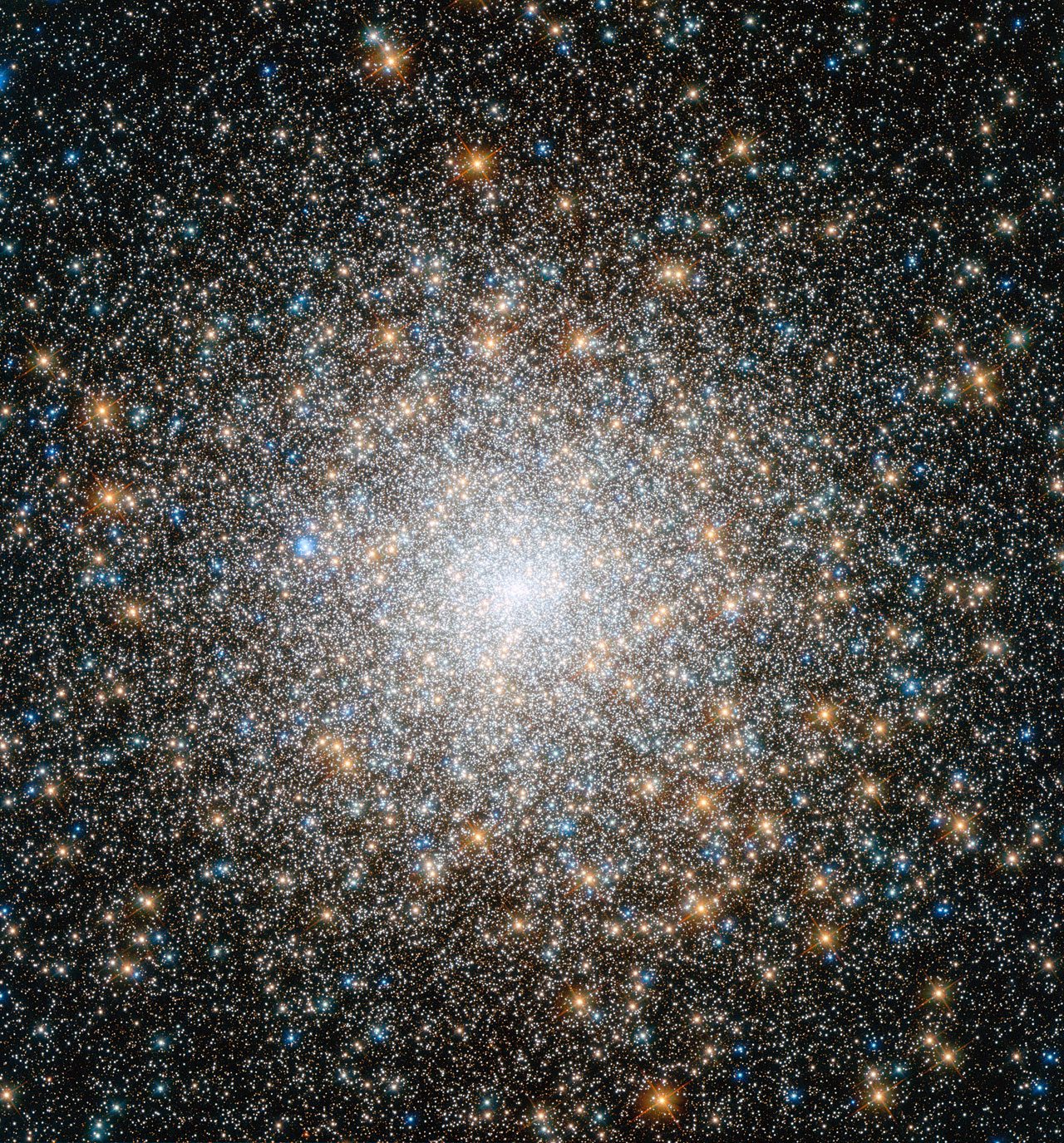
Messier 15
The Great Pegasus Cluster, a sphere of hundreds of thousands of stars roughly 12 billion years old and one of the densest known. Its core has collapsed inward, and it hides a planetary nebula and possibly a black hole. Easy to find in binoculars near the nose of the horse.
Stephan's Quintet
The famous galaxy group in the feature image. Four of its five galaxies are tangled in a slow-motion gravitational wreck. It appeared in the film It's a Wonderful Life and headlined the first science images from the James Webb Space Telescope.
NGC 7331
A bright spiral galaxy often called a twin of the Milky Way, about 40 million light-years away. It sits in the same field as the more distant Stephan's Quintet, a striking depth-of-field illusion.
The Great Square itself
Count the stars you can see inside the box on a given night and you have a quick gauge of how dark and clear your sky is. A handful means excellent conditions.
Constellation data sheet
| Abbreviation | Peg |
| Genitive | Pegasi |
| Area | 1,121 sq. degrees (7th largest) |
| Brightest star | Enif (epsilon Peg), mag 2.4 |
| Signature asterism | The Great Square of Pegasus |
| Landmark planet | 51 Pegasi b — first exoplanet around a sun-like star (1995) |
| Shared star | Alpheratz, a corner of the Square and the head of Andromeda |
| Bordering constellations | Andromeda, Pisces, Aquarius, Equuleus, Delphinus, Cygnus, Lacerta |
| Best visibility | Autumn evenings, worldwide |
Pegasus carries two kinds of flight at once: the old myth of a horse rising to Olympus, and the modern moment a wobbling star told us, for the first time, that other suns have worlds. The autumn sky has always been a place for leaving the ground.
Part of the Royal Family
Pegasus belongs to the connected autumn saga of the Royal Family, mapped on the Greek mythology hub.
Cassiopeia · Cepheus · Andromeda · Perseus · Pegasus · Cetus
New to stargazing? See how to observe the night sky, and if you're choosing gear, the no-hype telescope buying guide.
All Astronomy Notes · Greek Mythology in the Night Sky · Andromeda Galaxy · Perseus · Hercules Cluster · Whirlpool Galaxy