
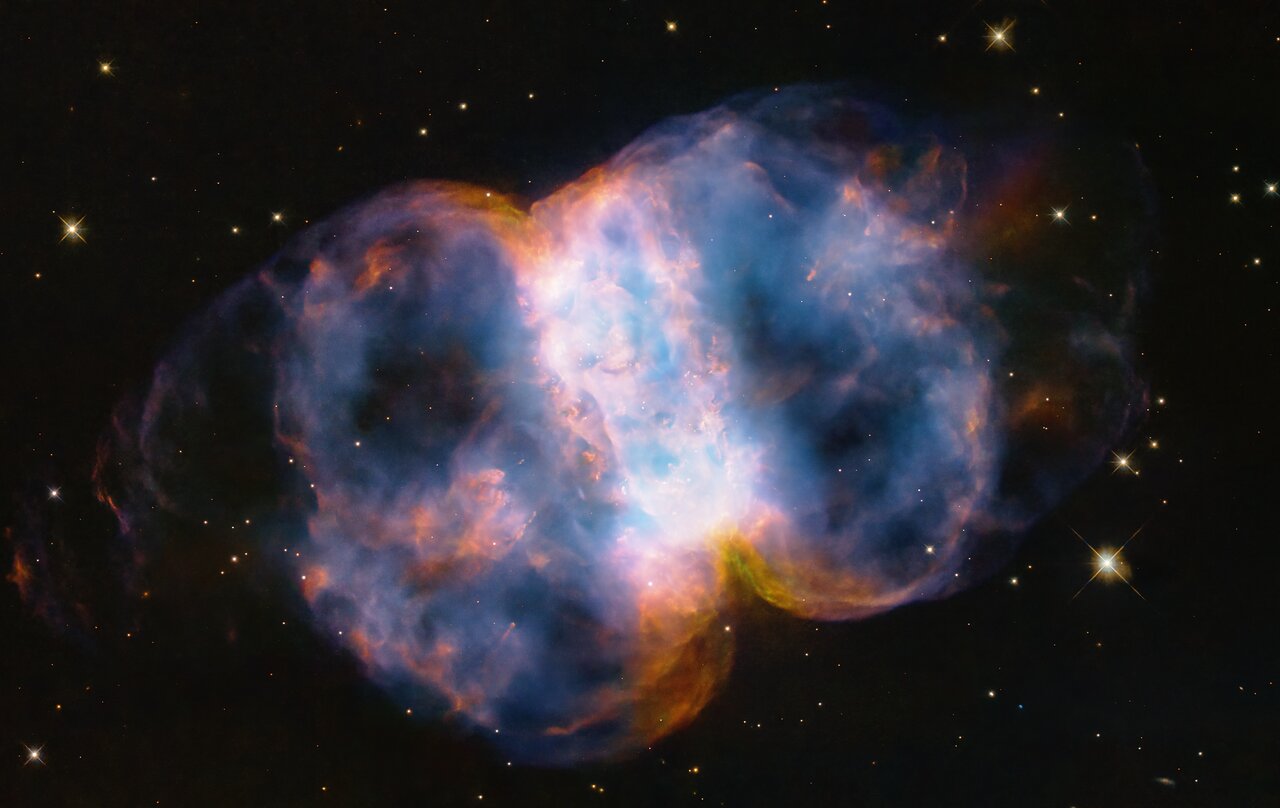
The Little Dumbbell Nebula (Messier 76) in Perseus, imaged by Hubble for its 34th anniversary in 2024. It is the shed outer shell of a dying star about 3,400 light-years away. Image credit: NASA, ESA, STScI.
The rescuer of the Royal Family
Perseus is the action figure of Greek myth and the hinge of the whole autumn-sky saga. Son of Zeus and the mortal princess Danaë, he was sent by a scheming king to fetch the head of Medusa, the Gorgon whose gaze turned the living to stone. Armed with a mirrored shield from Athena and winged sandals from Hermes, he beheaded her by looking only at her reflection. From the blood of her neck sprang the winged horse Pegasus.
Flying home with the head, Perseus passed the coast of Aethiopia and saw Andromeda chained to a rock, left as a sacrifice to the sea monster Cetus. He killed the monster, freed her, and married her. The gods placed the whole cast in the sky together, which is why Perseus stands near the princess he saved and the horse born of his greatest deed.
For the full hero — Danaë and the shower of gold, the Gorgon, Andromeda, and the prophecy he could not outrun — see the Perseus myth page.
Perseus rides the Milky Way between Cassiopeia and the bright star Capella. Find Cassiopeia's W, then drift toward Capella, and you are walking straight through the hero.
Perseus at a glance
Abbreviation
Per · Genitive: Persei
Brightest Star
Mirfak (α Per), magnitude 1.79
Famous Star
Algol (β Per), the Demon Star
Best Visibility
Autumn and winter evenings; northern sky
Medusa's eye, winking every three days
The most storied star in Perseus is Algol, Beta Persei, traditionally drawn as the eye in Medusa's severed head. Its name comes from the Arabic Ra's al-Ghul, "the demon's head." Watch it over a few nights and you will see why people across the world tagged it as unlucky: every 2.87 days Algol fades to less than a third of its usual brightness for about ten hours, then recovers.
In 1783 the young English astronomer John Goodricke correctly proposed the reason: Algol is an eclipsing binary, a pair of stars orbiting so tightly that the dimmer one passes in front of the brighter one on each circuit, blocking its light. Algol became the prototype of an entire class of variable stars. Ancient cultures had noticed the winking long before they understood it. Chinese astronomers logged Algol within an asterism called Tseih She, "the piled-up corpses," a grim cousin of the Greek demon's head.
Clusters, a dying star, and the deepest note in the cosmos
Perseus straddles a rich arm of the Milky Way, so it is loaded with star clusters, and it points out toward a giant swarm of galaxies beyond.
The Double Cluster (NGC 869 & 884)
Two open clusters side by side, each holding hundreds of young hot stars about 7,500 light-years away. A naked-eye smudge between Perseus and Cassiopeia, and a showpiece in any binoculars.
Little Dumbbell Nebula (M76)
The two-lobed planetary nebula above, about 3,400 light-years away. One of the faintest objects in Messier's catalogue and a satisfying target for a small telescope.
California Nebula (NGC 1499)
A long ribbon of glowing hydrogen shaped like the state of California, about 1,000 light-years away. Huge but faint, it is an astrophotographer's favourite.
Perseus Cluster (Abell 426)
A cluster of thousands of galaxies about 240 million light-years away. Its central black hole, in NGC 1275, pumps pressure waves through the surrounding gas at a B-flat roughly 57 octaves below middle C, the lowest note ever detected.
The best meteor shower of the year
Every August the Earth plows through the dusty trail left by comet 109P/Swift-Tuttle, and the debris burns up as the Perseid meteor shower. The meteors can appear anywhere in the sky, but their paths all trace back to a single point, the radiant, that sits in Perseus. That is how the shower got its name.
At its peak around August 11 to 13, a dark-sky observer can count 50 to 100 meteors an hour, including bright fireballs. No equipment helps here. A reclining chair, a moonless night, and patience are the whole kit.
Constellation data sheet
| Abbreviation | Per |
| Genitive | Persei |
| Area | 615 sq. degrees (24th largest) |
| Brightest star | Mirfak (alpha Per), mag 1.79 |
| Famous variable | Algol (beta Per), eclipsing binary, period 2.87 days |
| Meteor shower | Perseids, peak ~August 12 (comet Swift-Tuttle) |
| Bordering constellations | Cassiopeia, Andromeda, Triangulum, Aries, Taurus, Auriga, Camelopardalis |
| Best visibility | Autumn and winter evenings, northern latitudes |
| Mythology | The hero who killed Medusa and rescued Andromeda |
Perseus is the rescuer fixed mid-stride across the Milky Way, demon's eye in hand, scattering meteors every August. Proof that the bravest figure in the old story is also one of the busiest corners of the real sky.
Part of the Royal Family
Perseus belongs to the connected autumn saga of the Royal Family, mapped on the Greek mythology hub.
Cassiopeia · Cepheus · Andromeda · Perseus · Pegasus · Cetus
New to stargazing? See how to observe the night sky, and if you're choosing gear, the no-hype telescope buying guide.
All Astronomy Notes · Greek Mythology in the Night Sky · Cassiopeia · Andromeda Galaxy · Draco · Pleiades