
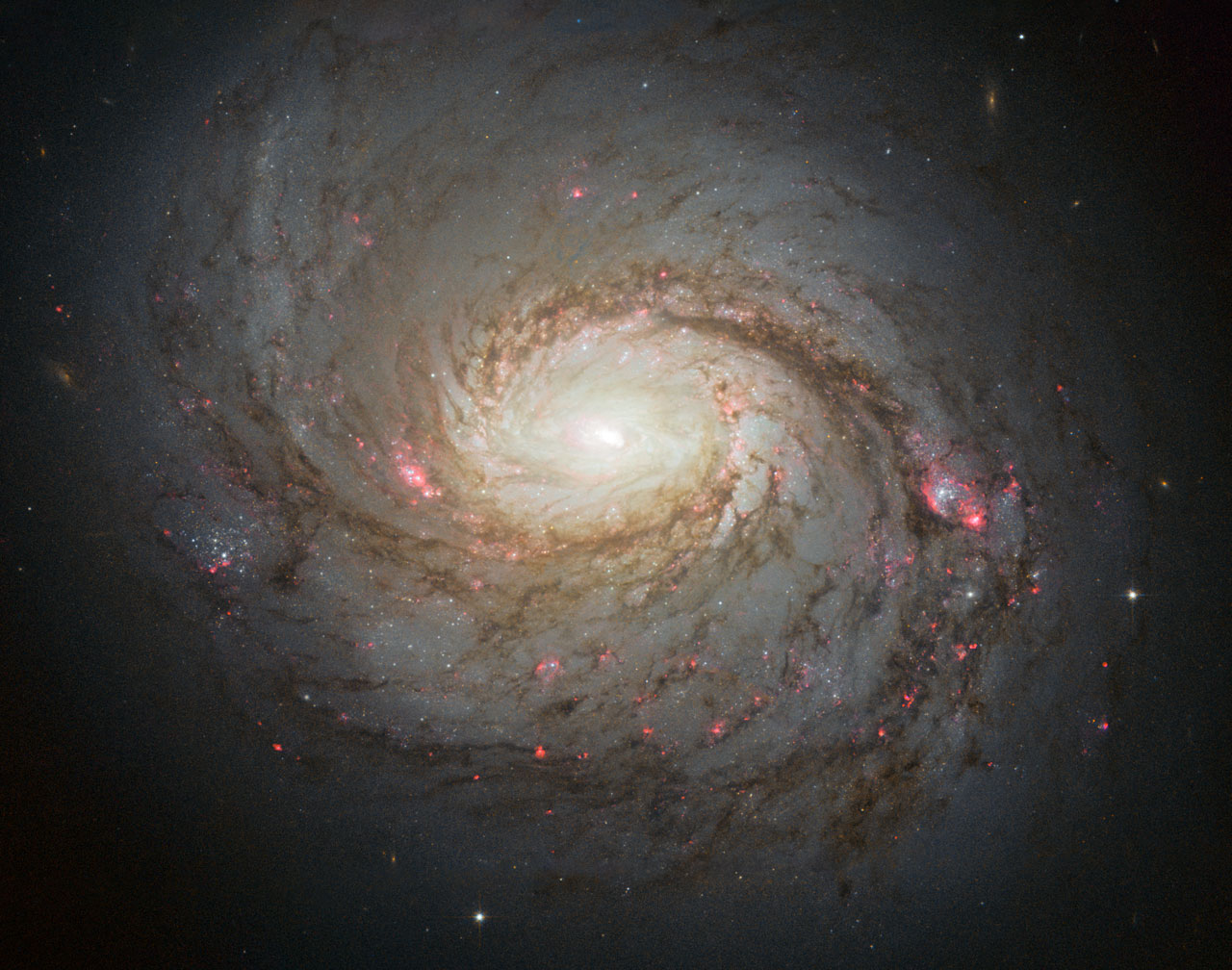
Messier 77 in Cetus, a barred spiral about 47 million light-years away and the nearest bright Seyfert galaxy, with an actively feeding supermassive black hole at its core. Image credit: NASA, ESA & A. van der Hoeven.
The beast Poseidon sent
When Queen Cassiopeia boasted that she outshone the sea nymphs, Poseidon answered by loosing Cetus, a monster of the deep, on the coast of Aethiopia. To appease the god, King Cepheus chained his daughter Andromeda to a rock as the monster's meal. The hero Perseus arrived in time, killed Cetus, and saved her. The monster earned its place in the sky as the loser of the story.
The Greek word ketos meant any huge sea creature, and Cetus is often drawn as a whale. That same root gives us the modern word cetacean for whales and dolphins. The constellation is one of the largest in the sky but made of faint stars, a long, low beast that creeps along the horizon on autumn nights.
Cetus sprawls below Pisces and Aries. Drop a line from the Great Square of Pegasus toward the southern horizon and you fall into the monster's watery domain.
Cetus at a glance
Abbreviation
Cet · Genitive: Ceti
Brightest Star
Diphda / Deneb Kaitos (β Cet), magnitude 2.0
Famous Star
Mira (ο Cet), the first known variable
Best Visibility
Autumn evenings; mostly the southern sky
A star that vanishes and returns
In 1596 the Dutch astronomer David Fabricius noticed a star in Cetus, watched it fade away entirely, and assumed he had seen a nova. Then it came back. Over the following decades observers realized it was rising and fading on a regular cycle of about 332 days, swinging from an easy naked-eye star down to a point that needs a telescope, and back again. They named it Mira, Latin for "the wonderful."
Mira was the first periodic variable star ever recognized, the prototype of the long-period Mira variables, which are dying red giants pulsing as they shed their outer layers. Mira even trails a comet-like tail of cast-off material thirteen light-years long, plowed back as the star races through the galaxy. Centuries before anyone understood why stars change, this one in the sea monster proved that the heavens were not fixed and eternal after all.
Tau Ceti and Messier 77
Tau Ceti — a near twin of the Sun
About 12 light-years away, Tau Ceti is one of the closest single sun-like stars. In 1960 it was a target of Project Ozma, the first modern search for radio signals from other civilizations. It hosts a family of planets and remains a favourite setting in science fiction.
Messier 77
The barred spiral in the feature image, about 47 million light-years away. It is the nearest and brightest Seyfert galaxy, a type with a blazing active core powered by a supermassive black hole devouring surrounding gas.
Diphda and Menkar
The two brightest stars of the monster: Diphda, an orange giant marking the tail, and Menkar, a red giant marking the jaw. Both are easy naked-eye anchors for tracing the faint figure.
A whale across cultures
Read as a whale, a sea monster, or a leviathan in different traditions, Cetus is the sky's reminder that the ancients populated the heavens with the same creatures they feared in the deep.
Constellation data sheet
| Abbreviation | Cet |
| Genitive | Ceti |
| Area | 1,231 sq. degrees (4th largest) |
| Brightest star | Diphda / Deneb Kaitos (beta Cet), mag 2.0 |
| Famous variable | Mira (omicron Cet), first known variable, period ~332 days |
| Nearby star | Tau Ceti, ~12 light-years, sun-like |
| Bordering constellations | Pisces, Aries, Taurus, Eridanus, Aquarius, Sculptor, Fornax |
| Best visibility | Autumn evenings, worldwide; low for northern observers |
| Mythology | The sea monster sent against Andromeda, slain by Perseus |
Cetus is the monster the hero slew, left to sprawl forever across the cold water of the autumn sky. Yet within the beast a star learned to vanish and return, and a quiet sun-like neighbour waits, as if the villain were keeping the most human secrets of all.
Part of the Royal Family
Cetus belongs to the connected autumn saga of the Royal Family, mapped on the Greek mythology hub.
Cassiopeia · Cepheus · Andromeda · Perseus · Pegasus · Cetus
New to stargazing? See how to observe the night sky, and if you're choosing gear, the no-hype telescope buying guide.
All Astronomy Notes · Greek Mythology in the Night Sky · Perseus · Andromeda Galaxy · Betelgeuse · Ring Nebula