
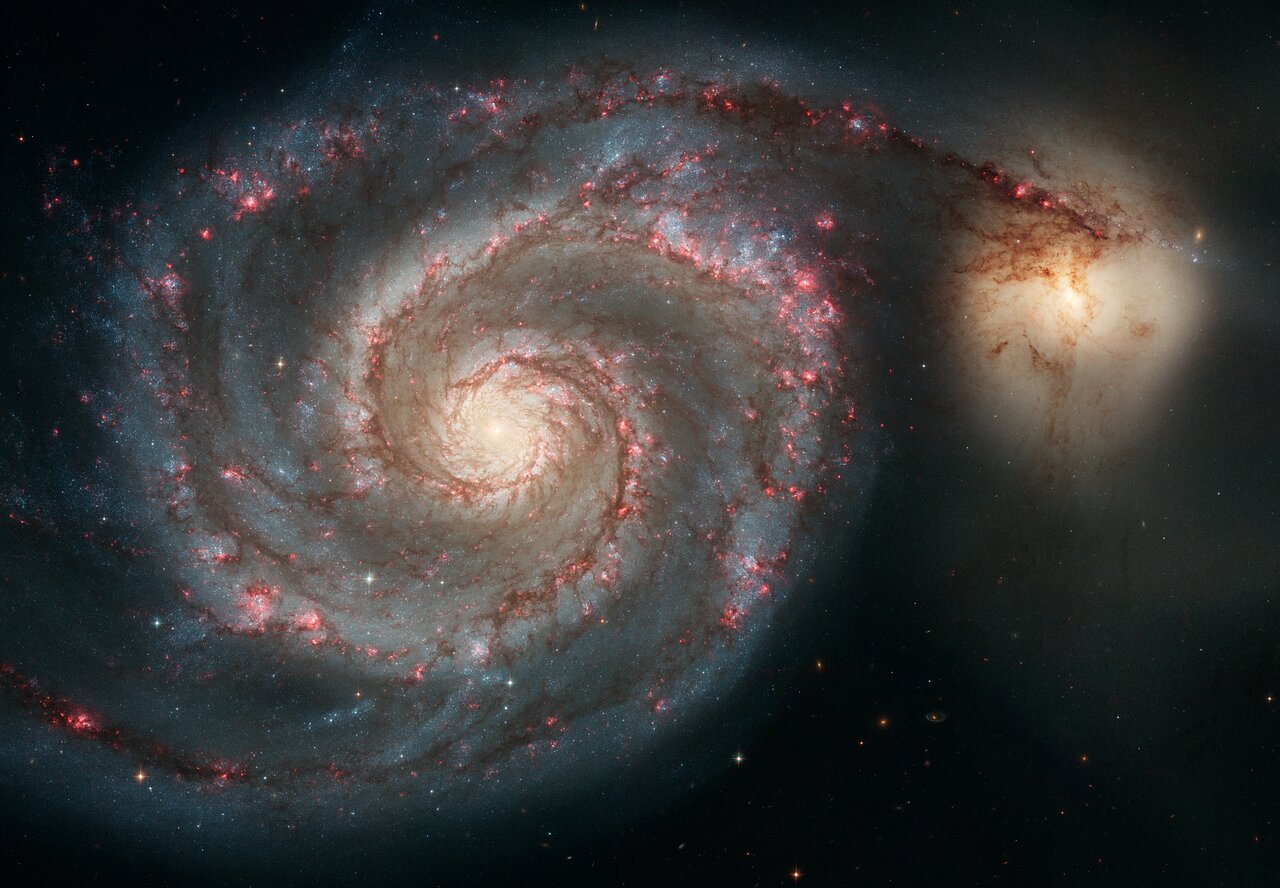
The sharpest view ever taken of M51, captured with Hubble's Advanced Camera for Surveys in January 2005 and released for Hubble's 15th anniversary. The companion galaxy NGC 5195 hangs at the tip of one spiral arm. Image credit: NASA, ESA, S. Beckwith (STScI) and the Hubble Heritage Team (STScI/AURA).
A galaxy you can recognize at a glance
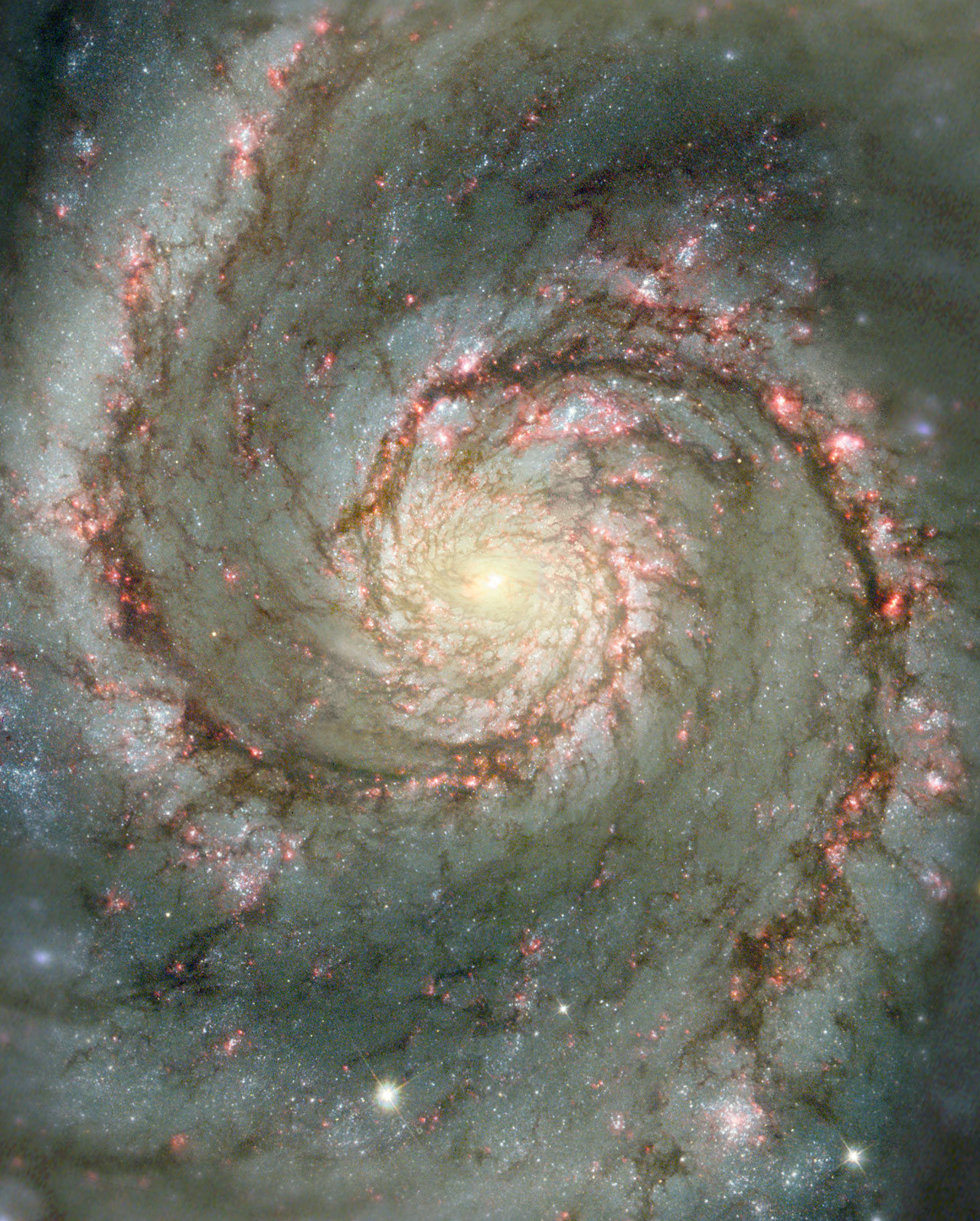
Some galaxies are smudges. M51 is a portrait. Its two sweeping arms wind out from a glowing yellow core like a grand staircase, traced in pink star-forming regions and threaded with dark dust lanes. This is what astronomers call a grand-design spiral — a galaxy with two clear, dominant arms rather than a patchy scatter of them — and it is one of the finest examples anywhere near us.
It sits in the small northern constellation Canes Venatici (the Hunting Dogs), just south of the handle of the Big Dipper, roughly 25–31 million light-years away. The light reaching your telescope tonight left M51 around the time the first recognizable human ancestors were beginning to walk upright.
M51 is the object that taught humanity galaxies have shape. Everything else here follows from that one realization.
M51 at a glance
Designation
Messier 51 · NGC 5194 (+ companion NGC 5195)
Constellation
Canes Venatici
Type
Grand-design spiral, interacting
Distance
About 25–31 million light-years
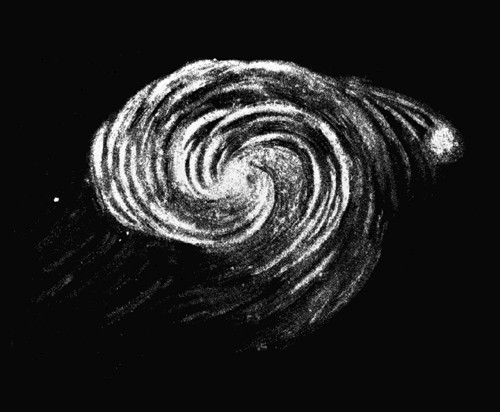
Lord Rosse and the Leviathan, 1845
In 1845, the Irish astronomer William Parsons, the third Earl of Rosse, pointed his enormous 72-inch reflecting telescope — nicknamed the "Leviathan of Parsonstown," the largest telescope in the world for most of a century — at M51 and sketched something no one had drawn before: a clear spiral.
This mattered enormously. At the time, nobody knew that these "spiral nebulae" were separate galaxies far beyond the Milky Way — that wouldn't be settled until Edwin Hubble's work in the 1920s. But Rosse's drawing was the first hint that the faint smudges in the sky had real, organized structure. M51 became the prototype, the object that put the word "spiral" into astronomy.
The beauty is being made by gravity
The small, ragged galaxy at the tip of M51's outer arm is NGC 5195. It is not a quiet bystander — it has been sliding past the Whirlpool for hundreds of millions of years, and its gravity is dragging on M51's spiral arms like a hand pulling on a spinning skirt.
That interaction is exactly why M51 looks so spectacular. The gravitational tug compresses gas along the arms, triggering bursts of new star formation that light them up in pink and blue. The crisp, almost theatrical structure that makes M51 one of the most photographed spirals in the sky is a side effect of a slow-motion collision.
Picture two dancers, one much larger, holding hands and spinning. The big one's dress flares out into a perfect curve — precisely because the small one is pulling. That flare is M51's spiral arms.
Three things hiding in this galaxy
A supermassive black hole
M51's bright core is an active galactic nucleus. Material funneling toward a central supermassive black hole heats up and glows, and Hubble has imaged dark dust crossing in front of it in an "X" shape.
A candidate alien planet
In 2021, astronomers reported M51-ULS-1b — a possible planet detected by the dip it caused in an X-ray source. If confirmed, it would be the first planet ever found in another galaxy, roughly 28 million light-years away.
A serial supernova host
M51 has produced at least three observed supernovae since 1994 (1994I, 2005cs, 2011dh) — a reminder that its star-forming arms are also stellar graveyards.
Finding the Whirlpool
M51 sits just below the last star in the Big Dipper's handle (Alkaid). Star-hop a few degrees south-west and you are there. It is one of the easier galaxies to locate, though seeing the spiral structure by eye takes dark skies and patience.
Best setup
Binoculars show two faint fuzzy blobs (M51 and NGC 5195). A 6–8 inch telescope under dark skies begins to reveal the spiral arms; larger apertures show the connecting bridge to the companion.
Best season
Spring and early summer evenings in the Northern Hemisphere, when the Big Dipper rides high overhead. From Minnesota it is well placed for much of the year.
From one spiral to a dragon full of galaxies
M51 is a single galaxy you can frame in one eyepiece. But swing your gaze north and east, away from the Hunting Dogs and into the long, winding constellation Draco the Dragon, and the lesson changes from structure to perspective.
There, three galaxies — the Draco Triplet — line up shoulder to shoulder in a single field: an elliptical, an edge-on spiral, and a face-on barred spiral. They look like a family, but they are scattered across tens of millions of light-years and only appear adjacent from our vantage point. Draco also hides the dazzling Cat's Eye Nebula and an edge-on galaxy sliced cleanly in two by dust.
The giant telescope that drew the spiral
The instrument that first revealed M51's spiral was a monster. William Parsons, the third Earl of Rosse, cast a three-ton speculum-metal mirror six feet across and slung it between two masonry walls at Birr Castle in Ireland. He finished it in 1845 and called it the Leviathan of Parsonstown. No telescope on Earth gathered more light for the next seventy years.
Thomas Lefroy, a fellow Irish member of parliament, looked through it and wrote home about what he saw:
"The planet Jupiter, which through an ordinary glass is no larger than a good star, is seen twice as large as the moon appears to the naked eye."
— Thomas Langlois Lefroy, on Lord Rosse's Leviathan (Memoir, 1871)
Rosse turned that light on the faint smudges other astronomers had logged as round nebulae. Where John Herschel had recorded two vague circles, Rosse traced a clean two-armed spiral with a companion clinging to the tip of one arm. He had already named the Crab Nebula from an earlier sketch. He now drew M51 so accurately that his 1845 drawing still matches Hubble's photographs. He believed these spirals were dense swarms of unresolved stars rather than glowing gas, a guess that made sense in 1845 and turned out wrong. He had no way to know he was looking at another galaxy.
Sources & Image Credits
Hubble Space Telescope images used under open science and education licenses:
- ESA/Hubble — The Whirlpool Galaxy M51 (heic0506a)
- ESA/Hubble — M51 visible/infrared comparison (heic0506b)
- ESA/Hubble — The Heart of the Whirlpool Galaxy (opo0110a)
- NASA — Hubble Space Telescope mission reference
- W. Parsons (Lord Rosse), spiral structure of M51, 1845
The Whirlpool is a portrait of motion held still — a galaxy whose grace was carved by a collision, reminding us that in the universe even destruction can look like a dance.
All Astronomy Notes · Draco Constellation · Andromeda Galaxy · Veil Nebula · Cassiopeia · Hercules Cluster · Ring Nebula