The enemy who broke the frontier
Ballomar was a formidable adversary, and this tribute does not shrink him — a hero is measured by what he faced. Cassius Dio first introduces Ballomar as the leader of a diplomatic delegation after Germanic groups crossed the Danube, and later ties him to the coalition whose offensives shattered Rome's northern defenses. That coalition did what Rome had not seen in generations: it penetrated toward Italy, destroyed the town of Opitergium, and threatened Aquileia. The psychological blow was enormous. Italy itself — the heart of the empire — suddenly no longer felt safe.
“king of the Marcomani.”
Cassius Dio, Roman History, Book 72 — the entire surviving self-description of the enemy
That is nearly all antiquity preserves of Ballomar in his own right: a title. He was real, dangerous, and effective, and no words of his survive for us to put in his mouth — so none are invented here. What we have in full is the answer Rome gave him. That answer was Marcus.
The hero's answer
Here is why this is a story about Marcus and not about Ballomar. Marcus Aurelius did not choose the life of a soldier. By temperament and training he was a reader, an apprentice in Stoic philosophy who would have been content in a lecture room for the whole of his life. The Marcomannic crisis dragged him out of the palace and onto the Danube — and instead of flinching, he went. A man in his late forties, in fragile health, with no love of camps, took personal command on the frontier and stayed there, on and off, for the rest of his reign.
Think about what that costs. He learned to lead armies because his people needed him to, not because he wanted glory. He spent his last decade in tents and winter quarters when he could have hidden behind the walls of Rome. And in those same tents, by lamplight, he wrote the Meditations — a private notebook reminding himself to do the work nature assigned, to stay just, to stay calm. The most beloved book of inner peace in the Western tradition was composed by a man at war with Ballomar's coalition. That is the heroism: not that he enjoyed it, but that he did it well and stayed himself while doing it.
The storm that saved the legion
From this war comes one of antiquity's most celebrated episodes — the “rain miracle,” when a Roman force trapped and dying of thirst was saved by a sudden storm that broke over the enemy. Ancient tradition credited the deliverance to Marcus's favor with the gods, and the scene was carved onto the Column of Marcus Aurelius in Rome. Whether miracle or luck, the story tells us how his own age saw him: as the emperor heaven itself would rescue.
What the war made
Ballomar and the Marcomannic crisis created the whole world of Marcus's most famous work. The duty, the impermanence, the counsel to accept what one cannot command — those pages read the way they do because they were written into invasion, plague, and mud, not into a comfortable retirement. The enemy pressed him to the limit of endurance. He met the limit and did not break. Read alongside the full account of the adversaries, Ballomar is the first proof of the thesis of this whole tribute: the harder the enemy, the clearer the hero.
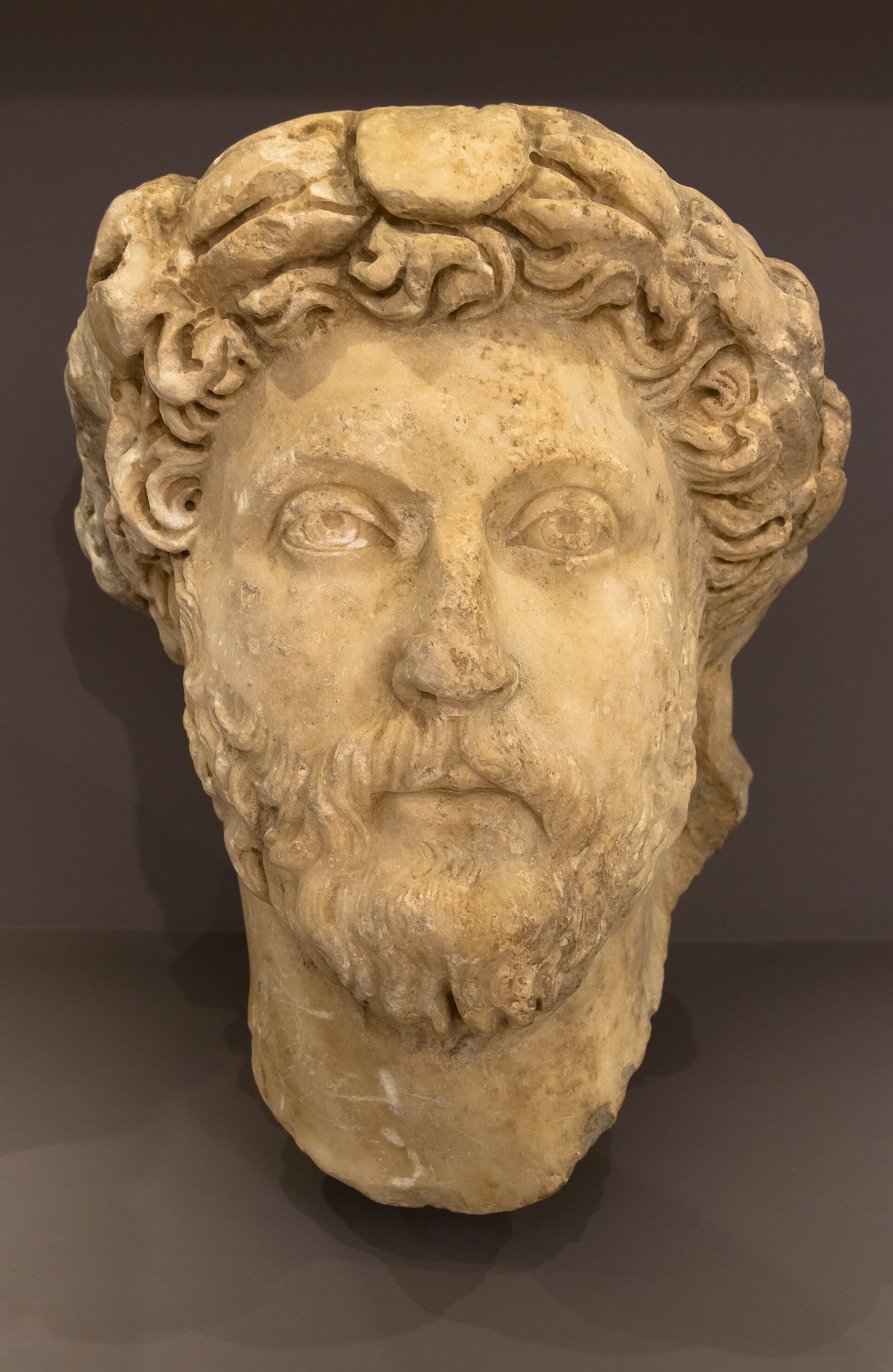 Marcus Aurelius