
London System Variations
Jobava London, Anti-London defenses, and London vs fianchetto setups — the full repertoire beyond the basics.
D00 (Jobava 2.Nc3)
A48 (KID vs London)
D02 (Torre Attack)
3.Bf4 e6 4.e3
or 4.f3 for aggression
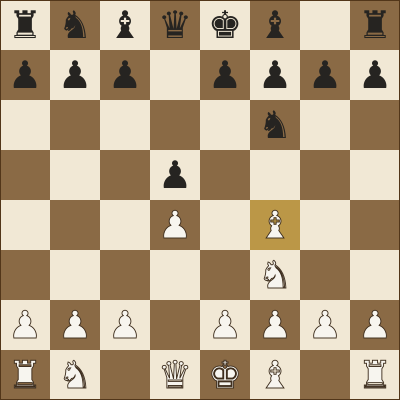
The Jobava London: Nc3 Instead of Nf3
After 1.d4 d5 2.Nc3 Nf6 3.Bf4 e6 4.e3 Be7 — the Jobava London. The highlighted Nc3 (instead of the standard Nf3) is the defining move of the Jobava, keeping f3 available for the pawn or other pieces.
Georgian grandmaster Baadur Jobava popularized this aggressive London variant: by playing 2.Nc3 before Nf3, White keeps the f-pawn free to play f3 (creating a strong pawn center with d4-e3-f3) or other setups not available in the standard London. The Nc3 also immediately targets d5, creating tactical threats if Black plays ...dxc4 or ...d4.
Aggressive Plan: f3 + e4
After 2.Nc3 Nf6 3.Bf4, White can play 4.f3! aiming for a large center. After 4...e6 5.e4 dxe4 6.fxe4, White has a massive pawn center and open f-file. Black must play precisely to avoid getting steamrolled. Wesley So used this idea to defeat several grandmasters.
Positional Plan: Bd3 + Nge2
A calmer approach: 2.Nc3 d5 3.Bf4 Nf6 4.e3 e6 5.Bd3, developing naturally. White castles kingside and prepares h3-g4 or simply improves pieces. The Nc3 helps control the center and can shift to e2-g3 or d2 depending on Black's setup. Kramnik occasionally used this idea.
London vs King's Indian Setups (...g6, ...Bg7)
When Black sets up a King's Indian formation against the London (...Nf6, ...g6, ...Bg7, ...0-0, ...d6), White faces a different type of position. Black's setup is flexible and doesn't concede the center. White should continue with standard London moves and prepare a central advance with c4 or e4.
The key difference from the standard London is that Black's Bg7 exerts long-diagonal pressure that the Bf4 doesn't directly counter. White typically plays h3 (to stop ...Ng4 or ...Bg4) and then prepares c4 or central action. The game resembles a King's Indian reversed.
White's Plan vs KID Setup
- Complete development: e2, Nbd2, 0-0
- Play c4 to challenge Black's center
- Or play e4 directly for a large center
- h3 to prevent ...Ng4 pin
- Prepare kingside play with g4 if Black plays ...e5
Black's Plan in KID vs London
- Play ...c5 or ...e5 to fight for center
- ...Nc6-d4 knight outpost
- Queenside expansion: ...b5-b4
- Kingside: ...f5 pawn storm with g7-bishop battery
- ...c5-c4 to lock the queenside
London vs Dutch (1...f5) and Other Setups
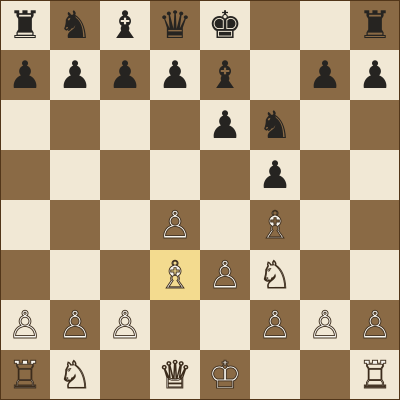
When Black plays the Dutch Defense (1...f5), White's London setup adapts naturally. White places the bishop on f4 and develops normally. The f4-bishop targets e5 — a natural outpost given Black's f5 advance. White often maneuvers the bishop to e5 or d6, pressuring Black's kingside structure.
The most principled Anti-London: Black immediately mirrors White's Bf4 idea by playing 2...Bf5. White must adjust — the bishop on f5 can be challenged by 3.c4 or accepted as a fait accompli. After 3.c4 e6 4.Nc3 Nf6, White can try 5.Qb3 targeting b7 and pressuring the position. Black's solid setup gives decent counterplay.
London vs ...c5 Challenges
Black frequently plays ...c5 to strike the center before White consolidates. After 1.d4 d5 2.Nf3 Nf6 3.Bf4 c5 4.e3 Nc6 5.c3, White maintains the pawn structure. After 5...e6 6.Nbd2, White has a solid setup and Black must work to prove equality. White's Bd3 and 0-0 followed by Ne5 is a typical attacking plan.
London vs ...e6 Classical
The most common London game: 1.d4 d5 2.Nf3 Nf6 3.Bf4 e6 4.e3 Be7 5.Bd3 0-0 6.0-0 c5. White has a solid position; Black seeks central play with ...c5 and ...Nc6. White's plan involves Ne5-Nd2-f3 or simply keeping pieces active. A typical instructive middlegame with small positional advantages for both sides to fight over.
Is the London Actually Boring?
The reputation for boringness comes from games where White mechanically "completes development" without a plan and allows Black to equalize easily. Properly played, the London is not boring at all — it's a weapon that:
- Allows White to choose the pawn structure rather than reacting to Black's
- Offers concrete attacking plans with h3-g4 or f3-e4 pawn storms
- Transitions into rich middlegames when Black tries to challenge aggressively
- Gives White a reliable edge against passive or unprepared play
Magnus Carlsen's London games are instructive: he frequently chooses unusual move orders and setups, avoiding symmetrical exchanges and steering toward rich strategic battles. His 2023–2025 London games demonstrated that the opening can be a winning weapon at 2800+ Elo.
Carlsen often accepts the bishop exchange with hxg3, opening the h-file. The doubled g-pawns actually strengthen White's kingside pawn structure for defense while the open h-file gives attacking potential. Black's Bd6 has been traded, losing a key defender of the kingside. White follows with c3, Nbd2, and eventually castles queenside or plays an innovative middlegame plan.
Variation Summary
| Variation | Key Move | Character | Good for |
|---|---|---|---|
| Standard London | 2.Nf3 + 3.Bf4 | Solid, reliable | All levels wanting consistency |
| Jobava London | 2.Nc3 + 3.Bf4 | Aggressive, tactical | Players wanting sharp positions |
| London vs KID | 3.Bf4 + 5.h3 | Strategic battle | Positional players |
| London vs ...c5 | 4.e3 + 5.c3 | Solid structure | Consistent setup players |
| Anti-London (2...Bf5) | Black mirrors | Symmetrical, fighting | Black players wanting equality |
Frequently Asked Questions
The Jobava London plays 2.Nc3 before Nf3, keeping the f-pawn free to advance to f3 for a strong pawn center (d4-e3-f3), or to allow other aggressive setups. The Nc3 creates immediate tactical threats against d5 and allows Qd2 setup or e4 breaks not available in the standard London. It's more complex and requires more concrete calculation.
Only when played without understanding. The London allows White to dictate the game's structure rather than reacting to Black's choices. The Jobava London creates genuinely sharp positions. Carlsen's London games are rich strategic battles, not symmetrical draws. The key is understanding White's attacking plans — h3-g4 pawn storms, Ne5 outpost, Nd2-f3-e5 maneuvers — rather than just "developing pieces."
The most principled Anti-London is 2...Bf5, mirroring White's bishop idea. White typically responds with 3.c4 or 3.e3 e6 4.Bd3 Bxd3 5.Qxd3. None of these approaches refute the London — Black reaches playable positions but doesn't demonstrate an objective advantage. The London remains sound regardless of Black's setup.
Active play is essential — passive development allows White to build unchallenged. Best responses include 2...Bf5 (mirror), 2...c5 (center strike), or a KID fianchetto (...g6, ...Bg7). Avoid symmetrical ...d5-...e6-...Nf6 setups without ...c5 — White is perfectly happy if Black just mirrors the setup without challenging the center.
Carlsen seeks rich, unbalanced middlegames rather than safe equality. He uses unusual move orders, accepts the hxg3 structure after bishop trades, delays castling to maintain flexibility, and often plays g4 pawn storms even from the London starting position. His London games demonstrate that the opening is a platform for creativity rather than a formulaic system.
Absolutely — ...Nf6, ...g6, ...Bg7, ...0-0, ...d6 is a perfectly valid setup. White typically responds with h3 (preventing ...Ng4), c4 to challenge the center, and normal London development. The game resembles a reverse KID and offers rich strategic play for both sides.
Further Reading & Sources
Books
- Carlsen-style London games in recent databases
- Lakdawala, The London System
- Kovačević, The Jobava London
Online Resources
- Chessable — London System courses
- Chess.com — London System guide
- Lichess.org explorer — D02-D04
Model Games
- Carlsen – Various, 2023 (Modern London)
- Jobava – Diverse opponents (Jobava London)
- So – Opponents 2018-2022 (Aggressive f3)
Opening analysis based on current grandmaster practice. ECO classifications from standard references.