
London System Advanced: Jobava Attack & Structural Mastery
The Jobava Attack, Torre hybrid systems, queenside expansion, and how the world's best players convert London endgames — a complete advanced guide.
London System
Jobava Attack
Torre Hybrid
Jobava Attack's
central break.
Space and tempo.
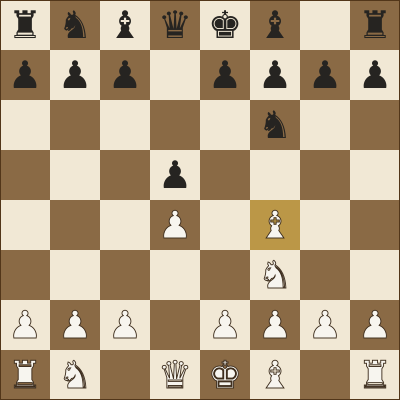
Parts 1 and 2 covered the classic London setup (1.d4 d5 2.Nf3 Bf4) and its major variations. This page goes deeper — into the Jobava Attack (Nc3 before Nf3), Torre hybrid ideas, the concrete plans in London endgames, and the structural nuances that explain why the world's top players keep returning to this opening decade after decade. The London is not a shortcut — it is a system with real strategic depth.
The Jobava Attack: 1.d4 Nf6 2.Nc3 d5 3.Bf4
After 1.d4 Nf6 2.Nc3 d5 3.Bf4 e6 4.e3 — the Jobava Attack tabiya. White's knight (highlighted on c3) supports the future e4 break. Note Ng1 and Bf1 both still home: White delays kingside development to keep options open.
The Jobava Attack — better known as the Jobava London — is defined by the early 2.Nc3 — placing the knight where it supports the future e4 advance rather than on f3 where it would block the f-pawn. Named after Georgian GM Baadur Jobava, who pioneered it alongside Richard Rapport, it is the most aggressive London-family setup at the top level.
The position after 4.e3 looks quiet, but the strategic ambition is high. White intends to castle, play Bd3 or Be2, and prepare the central break with e4. Because the knight is already on c3, this break costs no extra preparation — it becomes a real threat from move 4.
Jobava Attack — Main Line
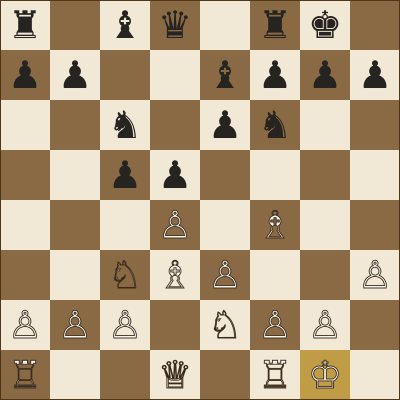
White develops with Nge2 — not Nf3 — keeping the f-pawn free. After castling, White can advance e4 or swing the knight to g3-f5 or g3-h5 targeting the kingside. Black's counterplay with ...c5 and ...Nc6 is natural but White's spatial advantage is real.
When Black plays 4...c5
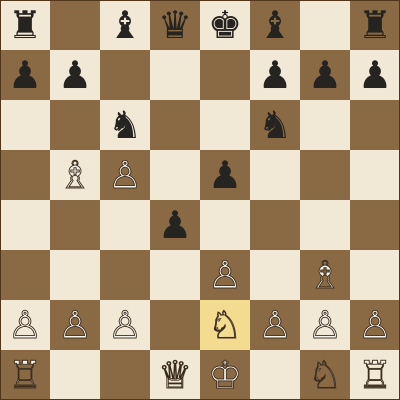
If Black immediately counters with 4...c5, White can take and hold the pawn temporarily or allow the center to open. The resulting positions feature dynamic piece play, with White's bishop pair compensating for Black's central pawns. It is one of the sharpest branches of the entire London family.
The e4 Break: London's Hidden Aggression
The defining strategic idea of the Jobava Attack is the e4 central break. In the standard London with Nf3, White cannot play e4 without first moving the knight. In the Jobava Attack, White is always ready. This tempo difference is the entire reason for preferring 2.Nc3.
After 9.e4!, White opens the position with the bishop pair and the more active setup. If Black takes (9...dxe4), after 10.Nxe4 White has a central knight, active bishops, and open lines. If Black ignores it, White can push further with e5, gaining more space. This break is the thematic punctuation that makes the Jobava Attack more than a waiting system.
After 9...dxe4 10.Nxe4
Black accepts the open game. White's Nxe4 lands a powerful centralized knight, and Bf4 will be very active on the long diagonal. If Black plays ...Nxe4 11.Bxe4, White has the bishop pair and semi-open e-file — classic London endgame territory.
After 9...cxd4 10.Nxd4
Black tries to liquidate the center. After 10.Nxd4 Nxe4? 11.Ncxe4 White is simply better with an advanced pawn on e4, active pieces, and Black's pieces temporarily loose. More careful is 10...Nc5 or 10...Bb7, but White keeps a pleasant structural advantage in all lines.
Torre Hybrid: When Bf4 Becomes Bg5
The London and Torre Attack are cousins — both feature 1.d4 Nf3 with an early bishop development. The difference: London's bishop goes to f4, Torre's goes to g5. At advanced levels, White can deploy both ideas in one game, playing Bf4 and switching to Bg5 (or vice versa) based on Black's setup. This flexibility is a strategic weapon.
In this line, after Black's ...Bd6 threatens to trade bishops, White retreats to Bg3 — keeping the bishop active and avoiding a favorable trade. Now White's bishop on g3 eyes the h2-b8 diagonal and will pressure Black's kingside after castling. This bishop redeployment is one of London's most instructive features: the bishop is not trapped on f4 but is a mobile piece throughout the game.
Bg5 vs. Nf6 Systems
After 1.d4 Nf6 2.Nf3 e6 3.Bg5, White takes the Torre path, pinning the knight immediately. The pin is uncomfortable for Black because ...h6 4.Bh4 g5?! 5.Bg3 Ne4 leads to tactical complications. Most Black players respond with 3...d5 or 3...Be7, keeping the position solid — which is exactly what London/Torre White wants.
The Colle-London Blend
Some practitioners blend London's Bf4 with the Colle System's e3-Bd3-0-0-Nbd2 structure — but the move order matters: once e3 is played, the c1-bishop is locked inside the pawn chain and can never reach f4. The genuine blend develops the bishop first: 1.d4 d5 2.Nf3 Nf6 3.Bf4 e6 4.e3 c5 5.c3 Nc6 6.Nbd2 Bd6 7.Bg3 — London bishop outside, Colle shell inside. If White has already committed to an early e3, the right plan is the Colle-Zukertort: b3 and Bb2, giving the bishop the long diagonal instead.
London vs. King's Indian & Grünfeld Setups
When Black plays for ...g6 and ...Bg7 (King's Indian or Grünfeld setup), the London System remains fully functional — and in some respects becomes easier to handle. White does not face the explosive counterattacks typical of those openings when facing 1.d4 Nc3/Nf3 setups.
This is a position where Black's fianchettoed bishop on g7 — so powerful in the King's Indian proper — has less impact. White's solid pawn chain (c3, d4, e3) and the bishop on f4 control the dark squares, limiting the g7-bishop's scope. The position is slightly better for White due to superior pawn structure and more active piece coordination.
Black has played the Grünfeld-style ...d5 and ...c5 counter, but the recapture with 8.exd4 (rather than Nxd4) gives White a solid d4-d5 chain option or an IQP structure. In either case, Black's Bg7 is less effective than in the pure Grünfeld because White never played an early c4 — so there is no weakened d4 square to exploit. White maintains the positional upper hand.
Pawn Structure Mastery: The London Triangle
The heart of the London System is a pawn triangle: d4 + e3 + Bf4. This triangle controls the e5 and c5 squares, supports a solid kingside, and allows queenside expansion with c4 at the right moment. Mastering these structural themes is what separates London practitioners from London tourists.
| Structural Theme | White's Plan | Key Move |
|---|---|---|
| Black plays ...c6 | Expand on queenside with c4, forcing a decision. If Black takes, White recaptures and has an open c-file. If Black ignores, c5 space is gained. | c4 |
| Black plays ...c5 | Maintain tension or take with dxc5. After dxc5, Black must recapture, giving White the d-file and sometimes a space advantage with e4. | dxc5 or d5 |
| Black castles kingside | Consider the kingside attack with h3, g4, g5, especially if Black's knight is on f6. Alternatively, build the center and grind. | h3, g4 |
| Bishops traded off | After Bf4 is traded for a Black knight or bishop, White recaptures and the resulting endgame often favors the side with better pawns — typically White. | Bxf4 recapture |
| Both sides castle | Maneuver the knight (Nf3-e5 or Ne5-d3/f3) to maximize pressure. The e5-outpost for the knight is the London's version of the "strong square." | Ne5 |
In almost every London game, White's knight strives for the e5 square. Once Ne5 is established and Black cannot easily dislodge it (because ...f6 weakens the king), White has a powerful centralized piece that simultaneously restricts Black's queenside, eyes the kingside, and ties Black's pieces to its defense. This is the London's equivalent of the KID knight on d4 — a cornerstone of the entire system.
Queenside Expansion: The c4 Break
When Black builds a solid setup with ...c6 (the most common anti-London structure), White has a powerful long-term weapon: the c4 pawn break. This strike on the queenside opens files, challenges Black's d5 anchor, and creates an IQP or passed-pawn scenarios.
After 10.c4!, White strikes in the center at exactly the right moment. If 10...cxd4 11.exd4 dxc4 12.Bxc4, White has an isolated d4 pawn but tremendous piece activity, the half-open c-file, and Black must deal with the well-placed Ne5. In practice, White tends to attack on the kingside faster than Black can generate queenside counterplay.
After 10...cxd4 11.exd4
White accepts the IQP structure in exchange for piece activity and space. The IQP is not a weakness here — with Ne5 already in place and Bd3 eyeing h7, White has a direct kingside attack. The position is roughly equal but White's play is easier to find.
After 10...dxc4 11.Nxc4
Black captures on c4, but after 11.Nxc4 White's knight has a fantastic c4 outpost, d4 is protected, and White has half-open d-file pressure. Black must untangle with ...Bb7 and ...Rc8, but White maintains a comfortable space advantage with active pieces.
Move-Order Subtleties and Anti-London Lines
London players must be aware of how move order affects what Black can play. The classic trick is the Anti-London: after 1.d4 d5 2.Nf3 Nf6 3.Bf4, Black can try 3...c5!? immediately, or even 3...Nh5!? — attacking the bishop directly before it is fully supported.
The cheeky 3...Nh5 attacks the bishop immediately. White should play 4.Bg5! rather than retreating passively. After 4...h6 5.Bh4 g5 6.e3 gxh4 7.Qxh5, White has regained the piece and Black's kingside is significantly weakened. This tactical sequence is essential for London players to know at club level and above.
Anti-London: 3...c5 Immediately
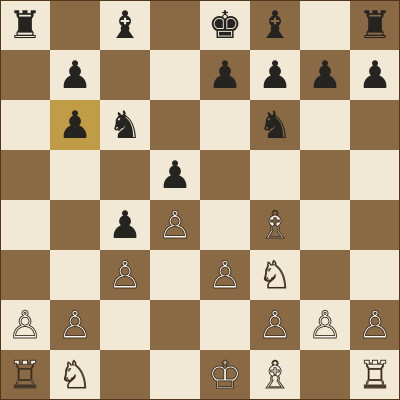
Black forces the queen trade, aiming for an equal endgame. After 7.Qxb6 axb6, the queens come off early and Black hopes to use the a-file and pawn structure. White should not fear this — the position is playable and White's structure is sound.
Black's ...Bf5 Development
If Black mirrors White's bishop development with 2...Bf5, the position is symmetrical but White still has a slight advantage due to moving first. After 6.Bd3 Bxd3 7.Qxd3, White has the bishop pair and a tempo up in development.
Carlsen's London Endgame Technique
Magnus Carlsen has done more than any player to rehabilitate the London System at the top level. His approach is not to win with tactics in the opening — it is to reach structurally favorable endgames and then convert with technique that is genuinely world-class. Understanding Carlsen's approach requires understanding what a "good London endgame" looks like.
After White's bishop is traded on d6, the position looks symmetrical — but it is not. White's knight on d2 will maneuver to b3 (attacking c5 and d4), and White's remaining bishop on f1 is the stronger bishop because Black's queenside is still locked. These tiny advantages accumulate over 40-50 moves in Carlsen's hands.
Rook Activity in London Endgames
After simplification, White typically has a rook that reaches the 7th rank or penetrates via the c-file after c4 dxc4 Bxc4. The c-file and d-file are White's highways. Black's rooks often end up passive defending against White's active play on both flanks — a classic "two weakness" principle at work.
The Good Knight vs. Bad Bishop Endgame
In many London endgames, White's knight (especially on e5 or d4) outperforms Black's bishop, which is restricted by Black's own pawns on the same color. This is the mirror image of the Queen's Gambit Declined good-bishop structure, applied from the White side. Carlsen has converted this edge dozens of times at the elite level.
Carlsen's London games typically feature: (1) solid development with no weaknesses, (2) the Ne5 outpost established early, (3) avoiding theoretical complications where Black is well-prepared, (4) reaching an endgame that is "only slightly better" for White — and then grinding. His 2022 World Championship blitz game against Nepomniachtchi from a London System is a model of this method: completely outplayed from a "balanced" position using pure technique.
Champions of the London System
Vladimir Kramnik
Kramnik adopted the London System as a surprise weapon during his later career, using it to avoid the massive preparation of younger opponents. His London games feature deeply prophylactic play — stopping Black's counterplay before it starts, then slowly improving pieces. Kramnik's London games are textbooks on "playing without risk while still pressing."
Magnus Carlsen
The current London System ambassador. Carlsen uses the London as his primary 1.d4 weapon in rapid and blitz, but has also played it in classical events. His willingness to enter any kind of London endgame — with bishops, without bishops, with isolated pawns — reflects his confidence in outplaying opponents in technical positions rather than memorizing theory.
Gawain Jones
One of England's most prominent London-family specialists. Jones has played the aggressive Nc3 systems at GM level, demonstrating their practical effectiveness. His handling of the e4 break and the complications after 2.Nc3 d5 3.Bf4 c5 is essential study material for London practitioners — proof that the Jobava Attack is not just a club weapon but theoretically demanding at the top.
Michael Adams
Adams ("Mickey") is one of England's greatest players and a long-time London practitioner. He favors the solid, patient approach — building the Bf4 triangle and waiting for Black to commit before deciding on a queenside or kingside plan. Adams's London games are models of positional patience and precise technique.
Mark Hebden
Hebden is arguably the English GM who did the most to develop the theory of the true Barry Attack — 1.d4 Nf6 2.Nf3 g6 3.Nc3 d5 4.Bf4, the same aggressive formation aimed specifically at Black's kingside fianchetto — in the 1980s–90s. He faced every Anti-London idea imaginable and worked out the practical solutions. (The origin of the nickname "Barry" is obscure English club slang; it does not come from any player's name.) His games are a gold mine for practical London play.
Frequently Asked Questions
The Jobava Attack — often called the Jobava London — is the London System with 2.Nc3 instead of 2.Nf3: specifically 1.d4 Nf6 2.Nc3 d5 3.Bf4. The key idea is that Nc3 supports the future e4 central break without the knight having to move a second time. Named after Georgian GM Baadur Jobava and developed alongside Richard Rapport, it is the most aggressive form of the London family. The closely related Barry Attack — 1.d4 Nf6 2.Nf3 g6 3.Nc3 d5 4.Bf4 — uses the same formation, but specifically against a Black kingside fianchetto.
White's setup is Nc3 + Bf4 + e3 + Bd3 (or Be2) + Nge2 + 0-0, and then e4 as soon as possible. The move Nge2 (rather than Nf3) is crucial — it avoids blocking the f-pawn. After 0-0, the threat of e4 is immediate and Black must respond precisely. Common continuations involve Black taking on d4 or e4 to relieve the tension, after which White recaptures with active pieces.
Both are 1.d4 systems with early bishop development, but the bishop goes to different squares: Bf4 in the London, Bg5 in the Torre. The Torre pin on Nf6 creates more immediate tactical tension; the London's Bf4 is quieter but very solid. Advanced London players learn to be flexible — the bishop can switch from f4 to g3 or even g5 depending on Black's setup, blending both systems in a single game.
Black's best practical approaches include: (1) ...c5 to challenge d4 immediately, (2) ...Bf5 to mirror the bishop development and aim for symmetry, (3) the ...Nh5 attack on the bishop (requires precise follow-up), or (4) fianchetto with ...g6 ...Bg7 and ...c5 counterplay. The most theoretically challenging is 3...c5 with the queen sortie to b6, pressuring b2 and d4 simultaneously.
The London's appeal at the elite level is strategic rather than theoretical — it avoids deep preparation while giving White a reliable, solid structure. Carlsen uses it specifically because opponents cannot prepare a knockout blow against the London; there is no forcing theoretical refutation. The positions require genuine chess understanding to play both sides, which favors the stronger player regardless of opening preparation. The London also tends to produce the slightly imbalanced endgames where Carlsen excels.
Five essential themes: (1) the Ne5 outpost — a knight on e5 that cannot be easily challenged is London's strategic crown jewel; (2) the c4 break — striking the queenside when Black has committed to ...c6; (3) the e4 break (Jobava Attack) — the most ambitious central advance; (4) the Bf4 bishop versus Black's dark-squared bishop — the London's bishop pair advantage in open positions; and (5) endgame pawn structure — White's c3-d4-e3 chain tends to be more resilient than Black's queenside pawn structure in many simplified positions.
Every opening belongs to a family — browse the three theme clusters: Romantic & Attacking Gambits · Flank & Hypermodern Systems · Solid Defenses.
Chess Opening Deep Dives
This page is part of a complete series covering major chess openings — history, variations, strategic concepts, and advanced analysis. Explore the full series to build a complete opening repertoire.