
The Zodiacal Cloud
Spread through the inner Solar System is a faint, flattened haze of dust — the zodiacal cloud. We see it as the zodiacal light: a soft, ghostly pyramid rising from the horizon before dawn and after dusk, the sunlight of our own star scattering off the debris of comets and asteroids.
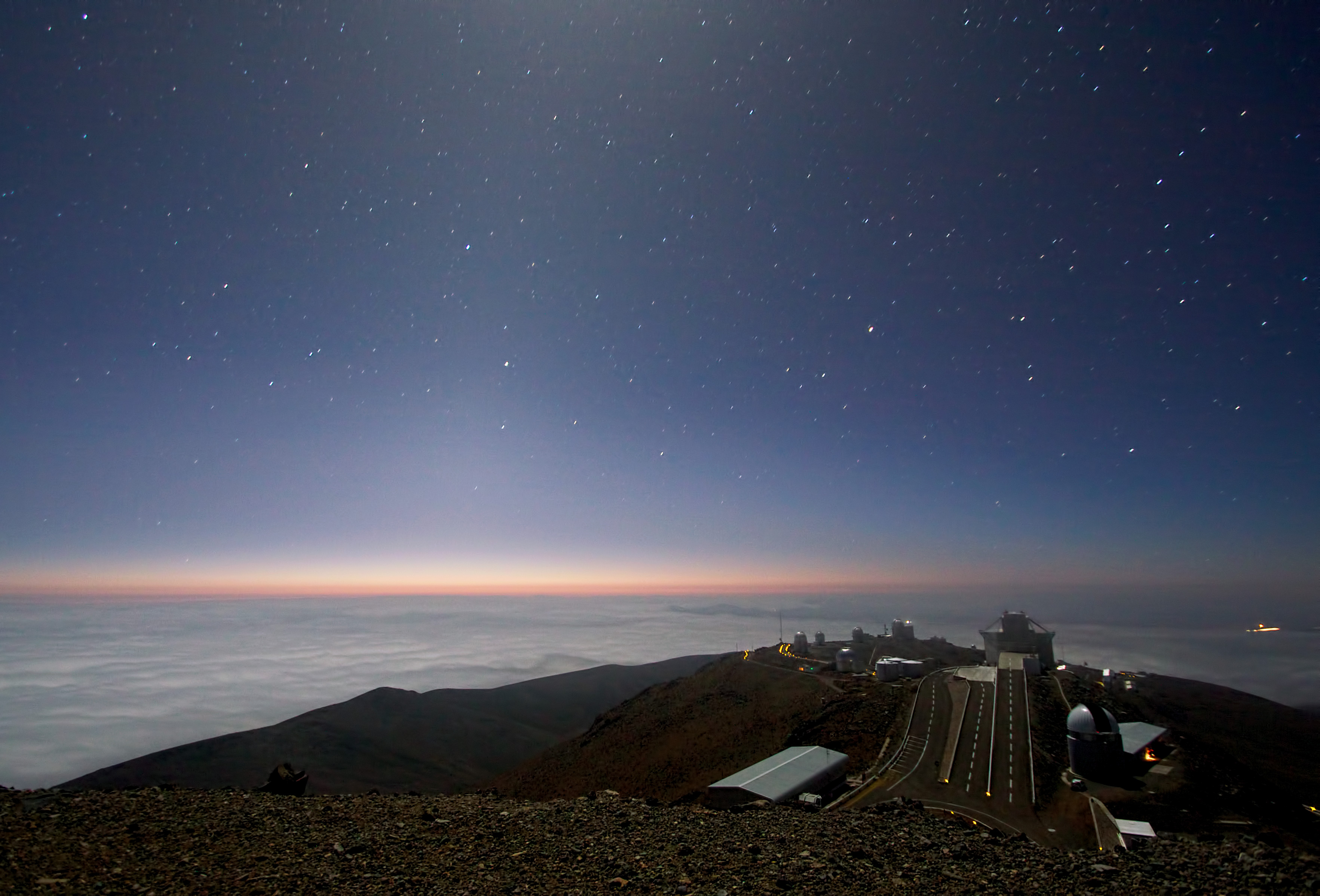
Image credit: ESO. The zodiacal light glows above ESO's La Silla Observatory in Chile — a faint cone of light leaning up from the horizon along the ecliptic, visible only from the darkest sites, far from city glow.
What it is
Sunlight scattered by interplanetary dust
Where the dust is
A flattened cloud along the ecliptic, inner Solar System
Dust source
Comet trails and asteroid collisions
Best seen
Dark, moonless skies near dawn or dusk
A disk of cosmic dust we live inside
The zodiacal cloud is a vast, gently flattened disk of tiny dust grains — most no larger than smoke particles — spread through the inner Solar System and concentrated toward the plane of the planets. Earth orbits right through it. The grains come from two main sources: the dusty trails shed by comets as they near the Sun, and the debris thrown off when asteroids collide in the belt. Over time this dust spirals slowly sunward, so the cloud is constantly being lost and constantly replenished.
We don't see the dust directly; we see the sunlight it scatters. Along the band of the ecliptic — the same line the Sun, Moon, and planets follow, running through the zodiac constellations — that scattered light gathers into the soft glow called the zodiacal light. Directly opposite the Sun in the sky, the same dust produces an even fainter brightening called the Gegenschein ("counter-glow"), where the grains reflect sunlight straight back at us.
It is faint, but it is not trivial: across the whole sky, the zodiacal light contributes more total illumination than all the stars combined. We simply spread it out and rarely notice it — unless we go somewhere truly dark.
This is the page where observing is the whole point
Unlike the frozen outer regions of this section, the zodiacal light is something you can genuinely go out and see with nothing but your eyes — but it demands the right conditions, and chasing it is a rewarding project. The enemy is light: you need a truly dark site, well away from any town glow, and a night with no Moon.
Timing and geometry are everything. Look about 90 minutes after sunset (or before sunrise), toward the point on the horizon where the Sun went down (or will come up). You want a season when the ecliptic stands steeply from the horizon: from mid-northern latitudes, that means the western sky on spring evenings (February–April) and the eastern sky on autumn mornings (September–November). When conditions are right, a soft, tall cone of light — brighter at the base, tapering upward and tilted along the zodiac — will slowly reveal itself. Give your eyes 20–30 minutes to fully dark-adapt.
Conditions
A genuinely dark site, no Moon, clear and transparent air. Light pollution erases it completely.
When & where
Spring evenings, look west after dusk; autumn mornings, look east before dawn — when the ecliptic is steep.
Bonus target
The Gegenschein — a faint oval glow directly opposite the Sun. One of the hardest naked-eye sights there is.
New to stargazing? See how to observe the night sky, and if you're choosing gear, the no-hype telescope buying guide.
The "false dawn" and the light that isn't pollution
Long before anyone knew about interplanetary dust, people noticed the zodiacal light — and misread it. In desert cultures with dark skies, the pre-dawn cone of light was known as the "false dawn": a glow that rises in the east and looks for all the world like the coming sunrise, only to fade again before the true dawn arrives. In Islamic tradition this subh kadhib ("deceptive dawn") is distinguished from the true dawn that begins the morning prayer — a practical, centuries-old piece of naked-eye astronomy woven into daily life.
The modern misconceptions are different. Because it is faint and near the horizon, the zodiacal light is often mistaken for the glow of a distant city — light pollution. It is the opposite: you can only see it because there is no light pollution. It is also confused with the Milky Way, but the two are unrelated — the Milky Way is the light of distant stars in our galaxy, while the zodiacal light is our own Sun reflecting off dust next door. The giveaway is direction: the zodiacal light follows the ecliptic and points back toward the Sun, not along the galactic band.
The name comes from the zodiac — from the Greek zōidiakos, "circle of little animals" — because the light runs along the ecliptic, through the ancient constellations of the zodiac. Those constellations carry their own deep well of Greek and Roman myth.
Primary sources: NASA — Zodiacal Light and the ESO image "Moonlight and zodiacal light over La Silla" (potw1325a). Image credit: ESO.
It is the humblest sight in this whole tour and, in a way, the most intimate: not a distant world of ice, but the dust of our own neighborhood, lit by our own Sun — a faint pyramid of light you can walk out under a dark sky and see for yourself.
Explore the structure of the Solar System
The zodiacal cloud is the final stop in a tour of the Solar System's belts, rings, and clouds — the leftover architecture between and beyond the planets.
The Solar System (hub) · Asteroid Belt · Kuiper Belt · Scattered Disk & Oort Cloud · Planetary Rings · Zodiacal Cloud
More astronomy notes
Continue through the astronomy section for beginner-friendly notes, image credits, viewing tips, history, and the stories behind the night sky.
The Solar System · Planetary Rings · Asteroid Belt · Astronomy · Interests