King's Indian Defense Variations
The Classical KID's great attacking lines — Mar del Plata, Gligorić System, and Petrosian Variation — explained from first principles.
E97 (Mar del Plata)
E92 (Gligorić)
E93 (Petrosian)
3.Nc3 Bg7 4.e4 d6
5.Nf3 0-0 6.Be2 e5
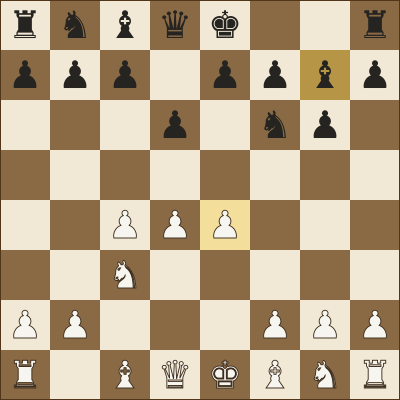
The Classical KID After 7.0-0
After the Classical tabiya 1.d4 Nf6 2.c4 g6 3.Nc3 Bg7 4.e4 d6 5.Nf3 0-0 6.Be2 e5 7.0-0, Black's move choice determines which major variation arises. The three principal replies — 7...Nc6 (Classical/Mar del Plata path), 7...Na6 (Gligorić defense), and 7...Nbd7 — each lead to fundamentally different strategic battles. White most often plays 7.d5 instead to enter the Petrosian Variation.
After 1.d4 Nf6 2.c4 g6 3.Nc3 Bg7 4.e4 d6 5.Nf3 0-0 6.Be2 e5 7.0-0 Nc6 — the Classical KID. The highlighted Nc6 is one of Black's main continuations, preparing ...Nd4 and keeping the queenside flexible while the kingside drama is still to come.
The Mar del Plata Variation
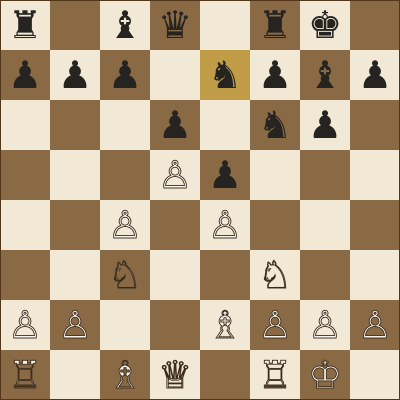
The Mar del Plata — named after the Argentine city where key games were played in the 1950s — is the most explosive Classical KID variation. After White plays 8.d5 closing the center, both sides launch simultaneous pawn storms: Black on the kingside with ...f5-f4-g5-g4, White on the queenside with c5-c6-b5-b6.
The race to deliver checkmate is real. If Black's attack arrives first with ...g4, ...Nf6, ...Bh3, and ...Qd7 pointing to h3, White's king will be mated. If White's queenside expansion arrives first with c5 breaking through, Black's attack may arrive too late and White will have a passed pawn on the 7th rank.
Black's Attacking Plan
- 10...f5 11.f3 f4 — locking the kingside pawn
- 12...g5 — preparing g4 advance
- Knight maneuver: ...Nd7-f6 or ...Nc5-e6 supporting g4
- ...Qd7 aiming at h3 after ...Bh3
- ...Rf6 — rook lift to g6 or h6
White's Queenside Plan
- 11.Nd2-b3 or 11.f3 f4 12.c5 — immediate thrust
- c5-c6 creating a passed pawn
- b4-b5-a5 — space expansion
- Knight to a4-c3-b5 supporting c6
- Rook to c-file after c6xb7
The critical theoretical position arises after 9.Ne1 Nd7 10.Nd3 f5 11.f3. White's f3 prepares both Nd2-f1-e3-d5 (a knight maneuver to the d5 outpost) and stops ...f4 temporarily. Black's response 11...f4 immediately locks the kingside and declares the attack is coming. Fischer played the Mar del Plata in some of his most famous victories — the "Game of the Century" concept of uncompromising attacking play matches perfectly with this variation.
The Gligorić System (7.Be3)
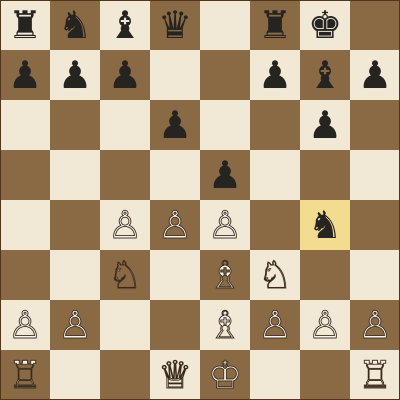
In the Gligorić System, White plays 7.Be3 before castling, preparing d5 immediately to close the center. This sidesteps the sharpest Mar del Plata lines. After 7...c6, Black challenges the center before White plays d5. After 8.d5 cxd5 9.cxd5, we reach a blocked central structure where Black seeks activity with ...a5, ...Nd7-c5, and ...b5.
White's bishop on e3 is well-placed: it controls the d4-square, defends against ...Ng4, and prepares queenside operations. The Gligorić is slightly quieter than the Mar del Plata but still offers both sides winning chances. Grandmaster Svetozar Gligorić developed and analyzed this system extensively in the 1950s–70s.
Plans for Black
- ...a5-a4-a3 space grab on queenside
- Knight to c5 via d7-c5
- ...f5 to start kingside activity
- ...Nf6-h5-f4 knight maneuver
Plans for White
- b4-b5 space expansion
- Na4 eyeing c5 or b6
- a4-a5 fixing Black's queenside
- f3-f4 central pawn advance
The Petrosian Variation (7.d5)
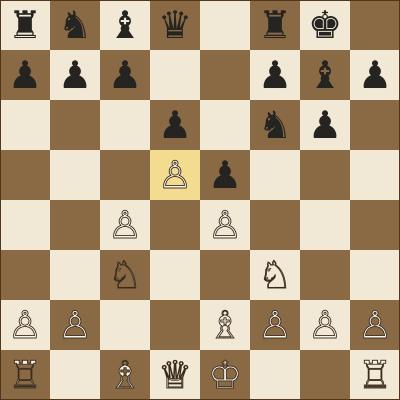
Tigran Petrosian's contribution to KID theory was the early 7.d5, closing the center before Black can launch counterplay. White avoids the sharp Mar del Plata race entirely, instead planning a controlled queenside expansion. Black's kingside play is slowed down because the center is locked and White hasn't played into the typical f5-f4 race position.
After 7...Nbd7, Black plans ...Ne5, ...Nh5, and ...f5 to still generate kingside play, but now White's queenside plan with c5, b4-b5-a5 is more effective because it arrives in a calmer position. The Petrosian requires patient positional understanding — it's the kind of system that wins by accumulating small advantages rather than tactical brilliance.
After 7.d5 Nbd7 8.Bg5 h6 9.Bh4 g5 10.Bg3 Nh5, Black's knight aims for f4 — a powerful outpost if Black can plant it there. White typically responds with 11.h3 or 11.Ne1 to prepare f3. The kingside pawn structure around g5-h6 now becomes important — Black is committing to an aggressive posture but weakening h5 in return.
Champions of the Classical KID
Bobby Fischer
Fischer used the KID as his primary defense against 1.d4 throughout his career. His attacking games in the KID were instructional masterpieces — he showed how Black could create winning attacks against even the most solid White setups. Fischer's preparation for KID positions was meticulous; he knew the theory deeper than most opponents.
Garry Kasparov
Kasparov adopted the KID from Fischer's legacy and made it his own. He used the Mar del Plata extensively, winning spectacular attacking games. His 1993 game against Deep Blue (the original) and 1995 rematch games frequently featured KID-style attacks. Kasparov's understanding of the critical race positions in the Mar del Plata was unmatched.
Mikhail Tal
Tal's dynamic attacking style fit the KID perfectly. He played the KID throughout the 1950s-60s, contributing to some of the most beautiful attacking games in chess history. His 1960 World Championship win over Botvinnik featured KID positions where Tal sacrificed material for the kind of king attack the KID was designed to produce.
Frequently Asked Questions
The Mar del Plata arises after 8.d5 Ne7 9.Ne1 Nd7 10.Nd3 f5. It's the most uncompromising Classical KID line — both sides launch opposite-wing attacks simultaneously. Black storms the kingside with ...f5-f4-g5-g4; White attacks the queenside with c5-c6-b5. It's chess's quintessential double-edged race position.
After ...f5, Black continues with ...f4, then advances ...g5-g4. The f4-pawn locks the position, the g4 advance opens the g-file for the h8-rook. The Bg7 becomes a monster once the diagonal opens. Supporting pieces: knight to f6 (or f8-h7-g5), ...Qd7 preparing ...Bh3, ...Rf6 rook lift to the kingside.
White plays 7.Be3 before castling, preparing an early d5. Black typically responds with 7...c6 to challenge the center before White closes it. After 8.d5 cxd5 9.cxd5 Nbd7, Black seeks counterplay with ...a5 and ...Nc5. The Gligorić is slightly quieter than the Mar del Plata but still combative.
Petrosian's 7.d5 closes the center early, removing Black's main counterplay options. White then expands on the queenside with c5, b4-b5, and a4-a5 in a controlled positional game. Black tries to generate kingside play with ...Nh5, ...f5, and the eventual ...g5-g4 push, but the pace is slower and White has more time to coordinate.
Absolutely. The KID continues to be played at the highest level by grandmasters who prize dynamic, unbalanced positions. Magnus Carlsen has used it, as have Hikaru Nakamura and Teimour Radjabov. The opening's resilience comes from its dynamic nature — White must find a concrete way to prove an advantage, which is extremely difficult against prepared opponents.
Both players were attacking geniuses who wanted winning chances with Black. The KID provides unbalanced positions where Black genuinely fights for an advantage rather than simply equalizing. Fischer felt chess should be a fight from move one; Kasparov admired its rich theoretical battles and winning potential at the highest level. For both men, the KID expressed a competitive philosophy about how to play chess.
Further Reading & Sources
Books
- Kasparov, My Great Predecessors, Part IV (Fischer chapter)
- Avrukh, King's Indian Defense (Grandmaster Repertoire)
- Panczyk & Ilczuk, King's Indian Battle Plans
Online Resources
- Lichess.org — Classical KID explorer
- Chess.com — King's Indian Defense lessons
- ChessBase database — filter E97
Model Games
- Fischer–Gligorić, 1959 Candidates (Mar del Plata)
- Kasparov–Deep Blue, 1997 Game 1
- Tal–Botvinnik, 1960 World Championship Game 6
ECO classifications per ECO. Strategic analysis drawn from published grandmaster commentaries.