King's Indian Defense — Advanced
Averbakh System, Sämisch Anti-KID, Four Pawns Attack, and the structural battles that define grandmaster King's Indian play.
KID advanced systems:
Averbakh, Sämisch,
Four Pawns
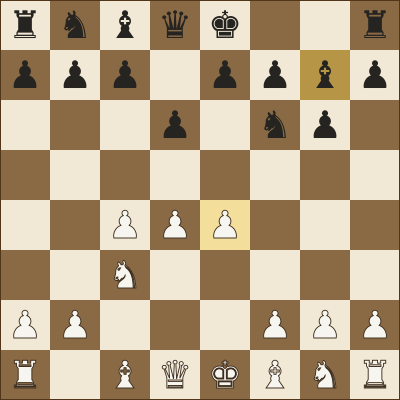
The Averbakh System: Preventing ...e5
The Averbakh System is one of White's most principled anti-KID weapons. By playing 6.Bg5, White pins Black's knight and prevents the thematic ...e5 advance that fuels the standard KID kingside attack. Without ...e5, Black must find a completely different plan — and that's exactly the point.
The g5 bishop creates immediate problems for Black: the Nf6 is pinned against the queen, and the simple threat of Nd5 or Bxf6 (doubling pawns) hangs over the position. Black must address this immediately.
In the Classical KID (Part 2), White plays 5.Nf3 and Black responds 5...0-0 6.Be2 e5, launching the standard kingside attack. In the Averbakh, White skips Nf3 and plays 6.Bg5 instead, making ...e5 physically dangerous. The point: 6...e5? runs into 7.dxe5 dxe5 8.Qxd8 Rxd8 9.Nd5!, when the g5–d8 pin costs Black material — 9...Nxd5 drops the exchange to 10.Bxd8, and otherwise 10.Nxc7 or 10.Nxf6+ wins material anyway. Black must find alternative counterplay.
Black's Main Responses to 6.Bg5
With 6...c5, Black immediately challenges d4 and transposes into a type of Modern Benoni. After 7.d5 h6 8.Bf4, Black can play ...e6 to open the center. This is aggressive and leads to complex positions where Black's fianchettoed bishop becomes very powerful on the long diagonal.
Soviet GM Efim Geller pioneered 6...Na6, preparing ...c5 with the knight already active. The knight heads to c7, then a6-b4 or d7-e5, and Black pursues queenside play with ...b5. This indirect approach avoids the pin issues and maintains flexibility.
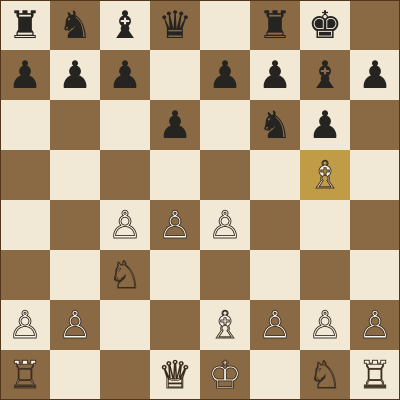
6...h6 chases the bishop immediately. After 7.Be3 c5, play transposes into a Modern Benoni structure where both sides fight for the center. The h6 move costs a tempo but the bishop on e3 is less active than on g5.
The Sämisch Anti-KID: 5.f3
If the Averbakh is a strategic weapon, the Sämisch is a blunderbuss. White plays 5.f3 — a move that supports e4, prepares Be3 and a queenside attack, and signals that White intends to play for mate. The Sämisch is one of the most dangerous anti-KID weapons at club level precisely because the attacking ideas are so direct.
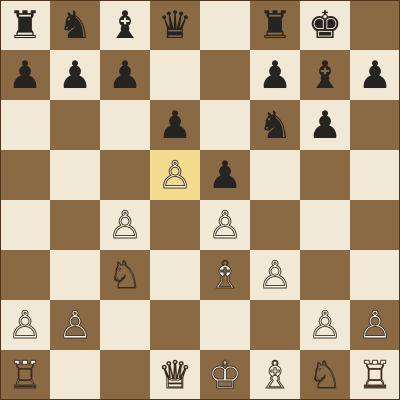
After 7.d5, the game is closed and both sides pursue plans on opposite wings with maximum urgency. White attacks on the kingside with g4, h4, g5, Qd2, and O-O-O. Black counters on the queenside with ...c6 and ...a5-a4, and strikes at the center with the ...f5 pawn break. The one who moves faster typically wins.
White's Queenside Attack Plan
- Qd2 — prepares O-O-O and h4-h5
- O-O-O — king to safety and attacks
- g4-g5 — pawn advance on the kingside? No — queenside!
- h4-h5 — break open Black's king shelter
- b4 — queenside space after a3
Black's Kingside Attack Plan
- ...c6 — challenge White's d5 pawn
- ...f5 — the thematic KID kingside break
- ...Nf6-e8-d7 — reposition the knight
- ...a5 — prevent White's b4 advance
- ...Bh6 — pressure White's Be3
Sämisch games are often decided in the first 25 moves — whoever breaks through first wins. If White castles queenside on move 8 and Black plays too slowly on the kingside, White's h4-h5-h6 battering ram can be decisive. If Black achieves ...f5 before White's attack matures, the Bg7's diagonal opens and White's king comes under fire. Tempo is everything in Sämisch positions.
Famous Sämisch Games
Some of the most brilliant attacking games in KID history come from the Sämisch. Mikhail Tal used the Sämisch brilliantly with White, launching crushing kingside attacks. Bobby Fischer defeated Reshevsky in the 1958 US Championship in a famous Sämisch battle. The variation rewards tactical and attacking players on both sides.
The Four Pawns Attack: Maximum Pawn Center
The Four Pawns Attack is White's most ambitious anti-KID system — building a massive pawn center with c4-d4-e4-f4 on the first five moves. The logic is pure aggression: overwhelm Black's position with a pawn avalanche before the fianchettoed bishop can influence the game.
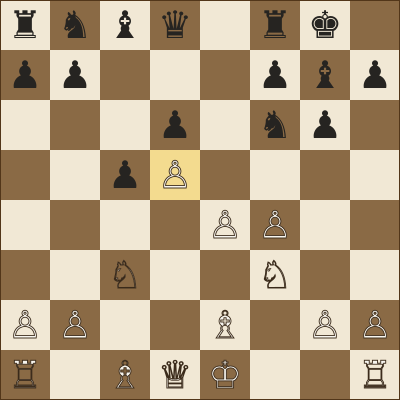
After 9.cxd5, White's position looks dominating — but Black has resources. The key idea is 9...b5!, sacrificing material to break up White's center. After 10.Bxb5 Nxe4 11.Nxe4 Qa5+ 12.Nc3 Bxc3+ 13.bxc3 Qxb5, Black has traded off some material and created permanent weaknesses in White's pawn structure. The resulting positions are dynamically balanced.
Black can also recapture and attack the center with ...Re8, targeting the e4 pawn. This leads to more positional play where Black's piece activity compensates for White's space advantage.
KID Endgame Structure: The Bishop Battle
Understanding KID endgames is crucial because many games from the Averbakh, Sämisch, and even Classical variations reach endings where the structural themes determine the result.
The Bg7: Black's Crown Jewel
The fianchettoed Bg7 is the most important piece in Black's arsenal. In closed positions it slumbers, but once the position opens — after ...e5 and ...exd4 exchanges, or after ...f5-f4 — the bishop becomes terrifying. The g7-a1 diagonal, pointing at White's king-side, is often decisive. Never trade the Bg7 without excellent compensation.
The Backward d6 Pawn
Black's d6 pawn can become a long-term weakness in the endgame — especially if White can fix it with d5 and attack along the d-file. Black must keep the d-pawn mobile, either by playing ...c5 (supporting d6) or ...d5 (counterattacking). When the d-pawn is defensible, it's fine; when it's attacked by White's rooks and a well-placed knight on c4, it can cost the game.
Knight vs. Bishop Endgames
KID endgames frequently feature White's knights against Black's bishops (especially the Bg7). In closed pawn structures — common in the Averbakh and Sämisch aftermath — White's knights can be superior, finding strong outposts on d5, f5, or e6. In open positions, the Bg7 wins clearly. Identifying which type of position is arising is a key skill in handling KID endgames.
Queenside Pawn Advances
In KID endgames, Black often has queenside pawns on a5-b4 or a5-b5 — the legacy of the typical KID queenside attack that didn't quite break through in the middlegame. White must be alert to ...a4-a3 breaks that create passed pawns. Conversely, White's queenside majority (c4-d4-e4 vs. Black's ...c5 pawn) can be decisive in the endgame if the center is locked and White can advance the c-pawn.
Prophylaxis and the KID: Petrosian System
The Petrosian System (4.Nf3 d6 5.Bg5 or 4.e4 d6 5.Nf3 0-0 6.Be2 e5 7.d5 — after Black plays ...e5 first, then White closes with d5) represents the prophylactic approach to the KID. Named after Tigran Petrosian, the master of prevention, this system is about limiting Black's counterplay before it begins rather than attacking head-on like the Sämisch.
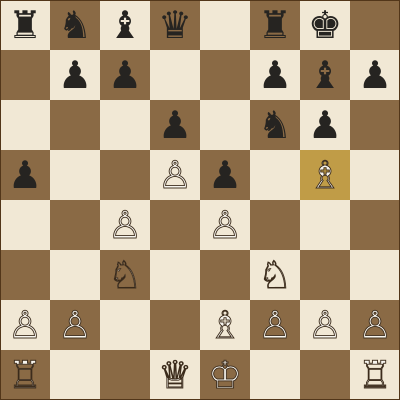
After allowing ...e5 (the normal KID move), White closes with 7.d5 and then plays 8.Bg5! — pinning the f6 knight in the closed position. Black must either play the slow ...h6 (losing time) or find active queenside play with ...a5-a4 and ...Na6-c5. The Petrosian System rewards patient positional play — it's less about tactics and more about long-term piece placement and pawn structure.
Tigran Petrosian (World Champion 1963–1969) showed that it's often better to prevent your opponent's active play than to react to it. His KID systems anticipate and neutralize Black's counterplay before it begins. This preventive approach — sometimes called "prophylaxis" — is a cornerstone of modern grandmaster play and one of the most valuable lessons any improving player can internalize.
Champions of the King's Indian Defense
David Bronstein
Together with Isaac Boleslavsky, Bronstein was one of the co-inventors and popularizers of the King's Indian Defense in the 1940s and 1950s. Before their work, the KID was considered dubious — Bronstein proved it was not only sound but full of attacking potential. His games from the 1951 World Championship match against Botvinnik showed the KID at its most creative.
Bobby Fischer
Fischer used the King's Indian Defense extensively early in his career, achieving spectacular attacking results. His game against Byrne (1956, "The Game of the Century") featured a KID-like fianchetto setup. Against the Sämisch and Averbakh, Fischer demonstrated that Black's counterplay was always sufficient. His direct, uncompromising approach made the KID a weapon suitable for the highest level.
Efim Geller
Geller was arguably the greatest King's Indian specialist of his era. He played it for decades against world-class opposition, developing many of the key defensive and attacking ideas used today. The "Geller Variation" in the Averbakh (6...Na6) bears his name. He famously had a positive score against Fischer in their individual games, largely through KID battles.
Garry Kasparov
Kasparov switched to the KID after the Grünfeld in the 1980s and used it as one of his primary weapons throughout his world championship era. His games in the KID against Karpov and other top players produced some of the most exciting chess of the 20th century. Kasparov's approach combined deep preparation with tactical brilliance — particularly in the Mar del Plata and Classical variations.
Frequently Asked Questions
The Averbakh System arises after 1.d4 Nf6 2.c4 g6 3.Nc3 Bg7 4.e4 d6 5.Be2 0-0 6.Bg5. White pins the Nf6 to prevent ...e5, denying Black's standard counterplay. Black must respond with 6...c5 (Benoni-like play), 6...Na6 (Geller's idea, preparing ...c5 from the flank), or 6...h6 7.Be3 c5 (active chase of the bishop). The system demands that Black understand queenside counterplay rather than relying on the typical ...e5 break.
The Sämisch (5.f3) is White's most aggressive anti-KID weapon. After 5.f3 0-0 6.Be3 e5 7.d5, both sides race to attack on opposite wings. White plays Qd2, O-O-O, h4-h5 (kingside attack against Black's king). Black counters with ...c6 and ...a5-a4 (queenside attack against White's king) plus the central ...f5 break. The Sämisch is very tactical and rewards aggressive play on both sides.
The Four Pawns Attack (5.f4) looks overwhelming but is overextended. Black's main response is 5...0-0 6.Nf3 c5 7.d5 e6 8.Be2 exd5 9.cxd5 and now 9...b5! — sacrificing material to break up White's center. Black can also try 9...Re8 (attacking e4) or direct counterplay in the center. The key insight: White's massive pawn center is vulnerable once Black finds the right counterattack.
KID endgames typically feature the Bg7 as Black's primary asset and a backward d6 pawn as a potential weakness. White often has a space advantage and active knights on d5 or c4. Black's queenside pawns (a5-b5 or a5-b4) can create passed pawns in the endgame. The fundamental rule: don't trade the Bg7 without excellent compensation — it becomes extremely powerful in open positions.
Yes. Black has several viable responses: 6...c5 transposes to Benoni-like positions; 6...Na6 prepares ...c5 with flexibility; 6...h6 7.Be3 c5 leads to sharp play. Top players including Geller, Fischer, Tal, and Kasparov all handled the Averbakh successfully. The key is finding queenside counterplay with ...c5 when ...e5 is denied.
Fischer's KID games against the Sämisch showed his fearless attacking approach. He typically played the main line 5...0-0 6.Be3 e5 7.d5, generating kingside attacks against White's uncastled king with maximum energy. Fischer understood that in the Sämisch, slow play gets punished — both sides must attack immediately. His direct, concrete style was perfectly suited to the race conditions the Sämisch creates.
Every opening belongs to a family — browse the three theme clusters: Romantic & Attacking Gambits · Flank & Hypermodern Systems · Solid Defenses.
Explore the Full Series
Covering seven major openings across multiple parts each — history, key ideas, major variations, and advanced structural themes for every level of player.