
Italian Game: Advanced
The romantic gambits are only half the Italian's story. At the top of the modern game it has become a slow, subtle weapon — the Giuoco Pianissimo, where White keeps the tension with c3 and d3 and grinds for an edge. This is how Carlsen and Caruana play 1.e4 e5.
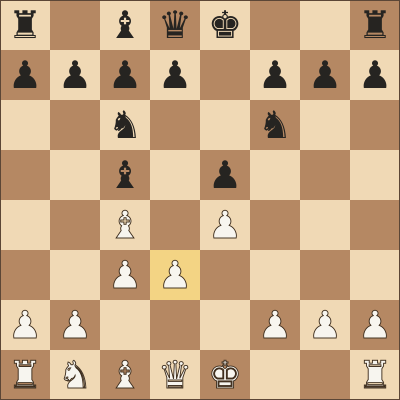
The modern Italian: the Giuoco Pianissimo after 4.c3 Nf6 5.d3 (highlighted). No early d4, no fireworks — White keeps every piece on the board and plays for a long maneuvering battle. It is the most common way elite players handle 1.e4 e5 today.
The Giuoco Pianissimo — c3 and d3
The phrase Giuoco Pianissimo means "the very quiet game," and that is exactly the point. Rather than rushing the centre with d4, White supports it with d3 and develops behind the pawns: Nbd2, Bb3 (tucking the bishop away from a future ...Na5), Re1, h3, and only much later a central or kingside break. Black mirrors with ...d6, ...a6, ...Ba7, ...0-0.
The reason elite players love it is practical: the symmetrical early d4 lines have been analyzed to a draw, so keeping the tension is the way to actually play chess. Whoever understands the resulting middlegame — when to break with d4, when to expand with a4 or g4, which pieces to trade — wins the game. It is an opening of plans, not memorization.
After 4.c3 Nf6 5.d3 — the Giuoco Pianissimo. White's modest d3 (highlighted) keeps the centre closed and the pieces on the board. The plans: Nbd2-f1-g3, Bb3, Re1, h3, and a slow build-up toward d4 or a kingside pawn storm.
The Møller Attack and the d4 lines
For a century the main line ran with the immediate central break 5.d4. After 5...exd4 6.cxd4 Bb4+, the sharp 7.Nc3 introduces the Møller Attack, where White sacrifices a pawn (and sometimes the exchange) for a powerful initiative after 7...Nxe4 8.0-0. These lines produced brilliant attacking games for generations.
Modern analysis has found accurate defenses for Black, so the d4 lines are no longer the elite battleground — but they remain excellent practical weapons and superb teaching material, because every move is concrete and forcing.
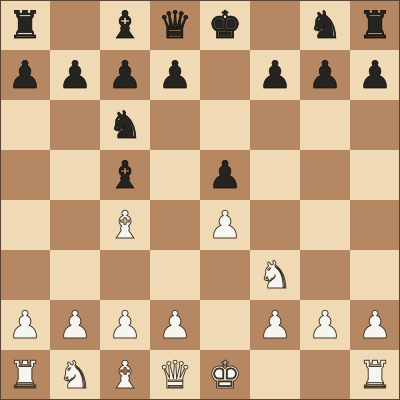
The Giuoco Piano position from which both modern and classical plans branch. The quiet 4.c3/5.d3 keeps the structure intact; the older 4.c3/5.d4 blasts the centre open for the Møller Attack and its tactical fireworks.
Many roads to the same structures
One reason the Italian is so practical is that it can be reached from several move orders, and most of them funnel into the same Pianissimo middlegames. The Bishop's Opening (1.e4 e5 2.Bc4 Nf6 3.d3) sidesteps the Two Knights and the Petroff and transposes straight into a slow Italian. Vienna and even some Petroff move orders can land in the same positions.
The takeaway for the improving player: don't memorize one sequence — understand the structure. If you know the plans of the Giuoco Pianissimo (where the pieces belong and when to break with d4), you will play every transposition correctly, no matter which order the moves arrive in.
Advanced Italian — FAQ
Why do top players prefer the Giuoco Pianissimo over the old d4 lines?
The early d4 lines have been analyzed to forced equality, so elite players keep the tension. With c3, d3, Nbd2, Bb3, and Re1, White keeps the pieces on and steers into a long maneuvering battle where understanding beats memorization. Carlsen has scored heavily this way.
What is the Møller Attack?
An aggressive old Giuoco Piano line: 4.c3 Nf6 5.d4 exd4 6.cxd4 Bb4+ 7.Nc3 Nxe4 8.0-0, with White sacrificing a pawn for a raging initiative. Rare at the top today thanks to precise defenses, but still a dangerous practical try.
What move orders lead to the Italian Game?
Besides 1.e4 e5 2.Nf3 Nc6 3.Bc4, the Italian arises via the Bishop's Opening (2.Bc4 Nf6 3.d3) and from Vienna and Petroff move orders, usually transposing into the same Giuoco Pianissimo structures. Understanding the plans matters more than memorizing one sequence.
Is the Italian still good at the highest level?
Yes — the slow Giuoco Pianissimo is one of the most common elite openings today. Carlsen, Caruana, and Nepomniachtchi use it to sidestep the Ruy Lopez Berlin while still posing long-term practical problems.
The Giuoco Pianissimo — the slow c3/d3 build-up that defines the modern elite Italian. A battle of plans, not memorized lines.
The Giuoco Piano crossroads — from here White chooses the quiet d3 or the old d4 break of the Møller Attack.
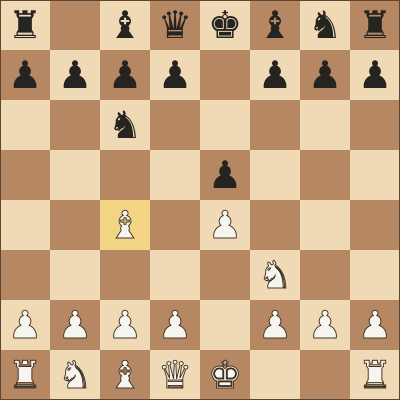
It all starts with 3.Bc4 — whether the game stays quiet or explodes, the bishop's eye on f7 is the constant thread of the Italian.
- Ntirlis, N. (2017). Playing 1.e4 e5 (Italian / Giuoco Pianissimo coverage). Quality Chess.
- Papin / Italian repertoire surveys, New In Chess Yearbooks.
- Carlsen's Giuoco Pianissimo games, 2015–2024 (elite practice).
- ECO classification C53–C54. Online: Lichess opening explorer (Giuoco Pianissimo filter).
Every opening belongs to a family — browse the three theme clusters: Romantic & Attacking Gambits · Flank & Hypermodern Systems · Solid Defenses.
You've finished the Italian Game series
The Italian is one of seven-plus openings covered in depth on this site. Compare it with its great rival the Ruy Lopez, or branch out into the Sicilian, French, and Queen's Gambit.