
The Habitable Zone
Around every star there's a band that's not too hot and not too cold — the range where a world could hold liquid water on its surface. Astronomers call it the habitable zone; everyone else calls it the Goldilocks zone. It's the first place we look for life. It's also widely misunderstood.
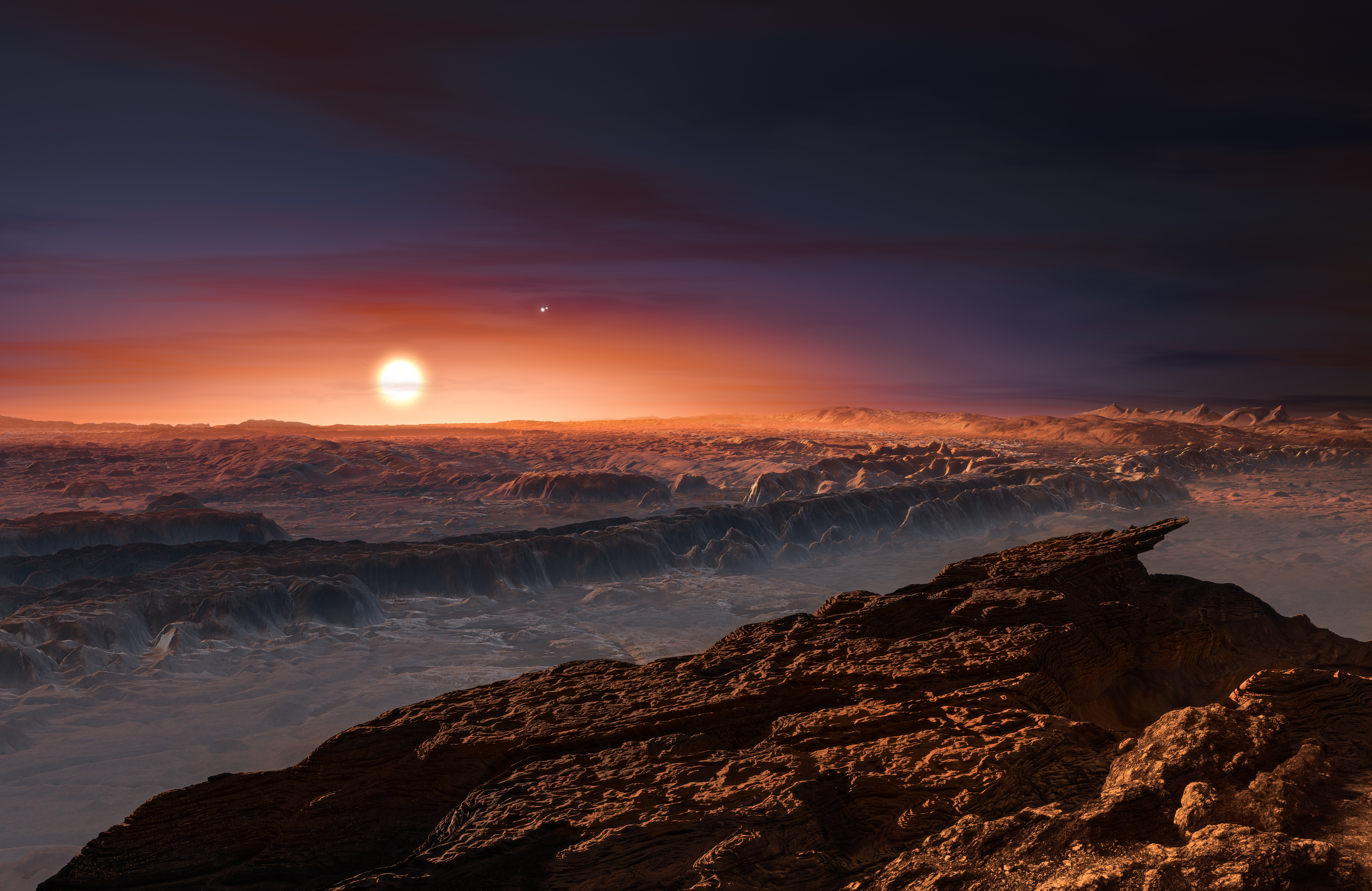
Artist's impression: ESO/M. Kornmesser. The surface of Proxima b — the nearest exoplanet, orbiting in the habitable zone of the closest star to the Sun. Whether it actually holds water is unknown; being in the zone is a permission slip, not a guarantee.
Not too hot, not too cold
Liquid water seems to be essential for life as we know it — and water can only stay liquid within a certain temperature range. Too close to a star and any water boils away; too far and it freezes solid. In between lies a band, at just the right distance, where a planet with the right atmosphere could keep oceans on its surface. That band is the habitable zone.
Where the zone sits depends on the star. A bright, hot star pushes its habitable zone far out; a dim, cool red dwarf has a narrow zone hugging in close. In our own system, Earth sits comfortably inside the Sun's habitable zone, Venus rides its scorching inner edge, and Mars hovers just beyond the cold outer edge.
Diagram by Michael Paycer. The zone shifts with the star: hotter stars push it outward, cooler stars pull it in close.
Being in the zone isn't enough
Here's what the headlines skip. The habitable zone is defined purely by distance and starlight — it says nothing about whether a planet actually has water, an atmosphere, or a stable climate. A bone-dry rock in the zone is still a bone-dry rock. A world with a runaway greenhouse, like Venus, sits near the zone and is hot enough to melt lead. Being in the habitable zone is necessary, not sufficient.
Real habitability depends on a long list of things we mostly can't yet measure from light-years away: a protective atmosphere of the right thickness, a magnetic field to fend off stellar radiation, the right chemistry, geological activity, and time. Red-dwarf zones carry their own hazard — planets huddle so close that the star's flares may strip their air away. So when you read that a planet is "in the habitable zone," read it as: worth a closer look — not habitable.
We have found a handful of roughly Earth-sized planets in their stars' habitable zones — TRAPPIST-1 e, Proxima b, and others. As of 2026, we have not confirmed an atmosphere, let alone water or life, on any of them. The James Webb Space Telescope is looking; the early TRAPPIST-1 results are tantalizing but inconclusive. This is a field at the very beginning of answering its biggest question — which is exactly what makes it worth watching.
From the Drake equation to "are we alone?"
Once you accept that billions of stars have planets, and some fraction of those sit in habitable zones, a natural question follows: how many might host life — or civilizations? In 1961 the astronomer Frank Drake wrote this as a famous chain of probabilities, the Drake equation, multiplying the rate of star formation by the fractions of stars with planets, habitable planets, planets where life arises, and so on. It's less a formula for an answer than a way to organize our ignorance: exoplanet science is now filling in the first few terms with real numbers for the first time.
And that raises a genuine puzzle. If the galaxy is so rich with worlds and so old, where is everybody? The physicist Enrico Fermi asked exactly that over lunch one day — the Fermi paradox. The apparent silence of a universe full of planets is one of the deepest tensions in modern science, and the possible answers — that life is rare, that intelligence is rare, that civilizations are short-lived, that we haven't looked properly — run straight past astronomy and into questions of meaning, mind, and our place in things.
"Are we alone?" starts as a question about planets and ends as a question about existence. That doorway — from the night sky into meaning and mind — is exactly what the Philosophy section explores. If the stars have you wondering about our place in the cosmos, that's the thread to pull.
Getting the Goldilocks zone right
"A planet in the habitable zone is habitable." — No; the zone only tells you the distance is right, not that the planet has water, air, or a stable climate. "Habitable means inhabited." — Different words entirely; we've confirmed neither for any exoplanet. "The zone is a fixed distance." — It shifts with the star's brightness, and even drifts over a star's lifetime as the star ages. And "find the zone and you've found E.T." — the zone is where we point our best instruments next, the start of the investigation, not the finish line.
Famous Exoplanets · What Is an Exoplanet? · Finding Exoplanets · Philosophy · Exoplanets Hub · Glossary
Return to Michael Paycer
Explore Michael Paycer's professional SQL Server, cloud, ETL, API, automation, and consulting pages, or continue browsing the personal interests section.