
Famous Exoplanets
Out of more than 6,000 known worlds, a handful stand out — the first one found, the seven that orbit one small star, the nearest one to home, and a few so strange they sound invented. These are the exoplanets worth knowing by name, and why each one matters.
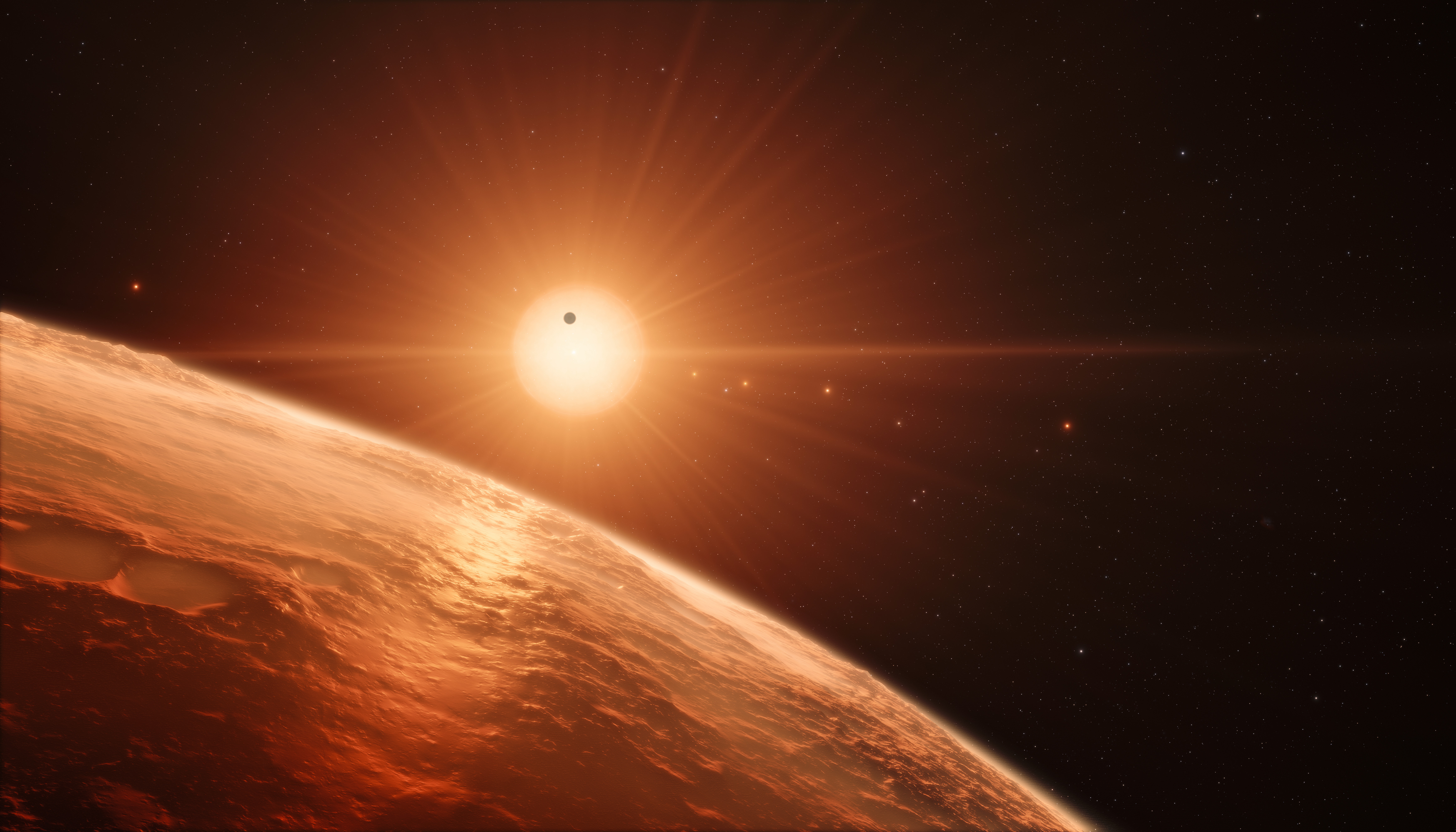
Artist's impression: ESO/N. Bartmann/spaceengine.org. Standing on one TRAPPIST-1 planet, the others would loom in the sky larger than our Moon — seven Earth-sized worlds packed into a system smaller than Mercury's orbit.
51 Pegasi b — the one that started it all
In October 1995, Swiss astronomers Michel Mayor and Didier Queloz announced a planet orbiting 51 Pegasi, an ordinary Sun-like star about 50 light-years away in the constellation Pegasus. It was the first planet ever confirmed around a normal star, and it won them the 2019 Nobel Prize in Physics. It also broke every expectation: a gas giant half the mass of Jupiter, whipping around its star every four days at a distance far closer than Mercury. Nobody had thought a giant planet could exist there. It forced theorists to accept that planets migrate, and it launched the entire "hot Jupiter" class and the exoplanet era with it. It's informally nicknamed Bellerophon, after the Greek hero who tamed Pegasus.
TRAPPIST-1 — seven Earths around one star
Announced in 2016–2017, TRAPPIST-1 is the crown jewel of the search for other Earths: seven roughly Earth-sized rocky planets orbiting a small, cool red-dwarf star about 40 light-years away. Three or four of them sit in the star's habitable zone. The whole system is astonishingly compact — all seven orbits would fit inside Mercury's — so from any one planet, its neighbors would hang in the sky as bright discs.
Because the planets transit their small star and pass close to us, TRAPPIST-1 is the best natural laboratory we have for studying temperate, Earth-sized worlds. The James Webb Space Telescope has trained its instruments here — but as of 2026, no atmosphere has been confirmed on any of the seven, and the results for the promising planet TRAPPIST-1 e remain frustratingly inconclusive. It is the most important address in exoplanet science precisely because its biggest questions are still open.
Proxima b — the nearest of all
The closest star to the Sun, Proxima Centauri, has a planet — and at about 4.2 light-years, Proxima b is the nearest exoplanet that exists. Discovered in 2016, it's a little more massive than Earth and orbits within its star's habitable zone, completing a "year" in just 11 days. That closeness makes it the natural first target of any dream of an interstellar probe.
The caveats are real, though. Proxima Centauri is a red dwarf prone to violent flares, and Proxima b orbits so close that those flares may have stripped away its atmosphere long ago. It may be a habitable-zone world with no air to speak of — a reminder that "nearest" and "in the zone" still don't add up to "habitable." Even so, it's the closest piece of real estate beyond the Solar System, and we found it by the radial-velocity wobble of the nearest star.
A few more worth knowing
| World | Why it's famous |
|---|---|
| Kepler-452b | Dubbed "Earth's cousin" — a super-Earth in the habitable zone of a Sun-like star, found by NASA's Kepler mission, which discovered thousands of planets by the transit method. |
| HD 189733 b | A deep-blue hot Jupiter whose cobalt color comes not from oceans but from silicate clouds — where it may rain molten glass, sideways, in 4,000 mph winds. |
| 55 Cancri e | A super-Earth so hot its surface may be partly molten; early hype called it a "diamond planet," a claim later walked back — a textbook case of exoplanet headlines outrunning the data. |
| WASP-12b | A doomed hot Jupiter being devoured by its star, stretched into an egg shape and slowly consumed — a preview of planetary death. |
| PSR B1257+12 planets | The very first confirmed exoplanets (1992), orbiting a pulsar — the dead, spinning core of an exploded star. Bathed in radiation, they are among the most hostile worlds imaginable. |
Many of the nearest bright host stars sit in constellations you can find yourself: 51 Pegasi in Pegasus, and a wealth of Kepler discoveries in the rich star fields of Cygnus and Lyra, where the telescope stared for four years. You can't see the planets, but you can look right at their suns.
When the press gets ahead of the science
"A second Earth has been found." — Every few years a headline says this; every time, it means "Earth-sized and roughly the right distance," not a confirmed twin. "The diamond planet." — 55 Cancri e was sold this way, then quietly downgraded when better data arrived. "TRAPPIST-1 could have life." — It could, but we haven't confirmed so much as an atmosphere there. The pattern is worth remembering: exoplanet discoveries are real and remarkable, but the leap from "interesting world" to "another Earth" is one the data almost never supports yet. The honest version — thousands of worlds, a few tantalizing, none confirmed habitable — is the better story.
What Is an Exoplanet? · Finding Exoplanets · The Habitable Zone · Exoplanets Hub · Pegasus · Glossary
Return to Michael Paycer
Explore Michael Paycer's professional SQL Server, cloud, ETL, API, automation, and consulting pages, or continue browsing the personal interests section.