
Exoplanets
Every star you see at night is a sun, and most of them have planets. In a single human generation we went from knowing zero worlds beyond our own to confirming more than 6,000 — nearly all of them detected without ever taking a picture. This is a plain-English tour of what exoplanets are, how we find the invisible, and which ones are worth knowing by name.
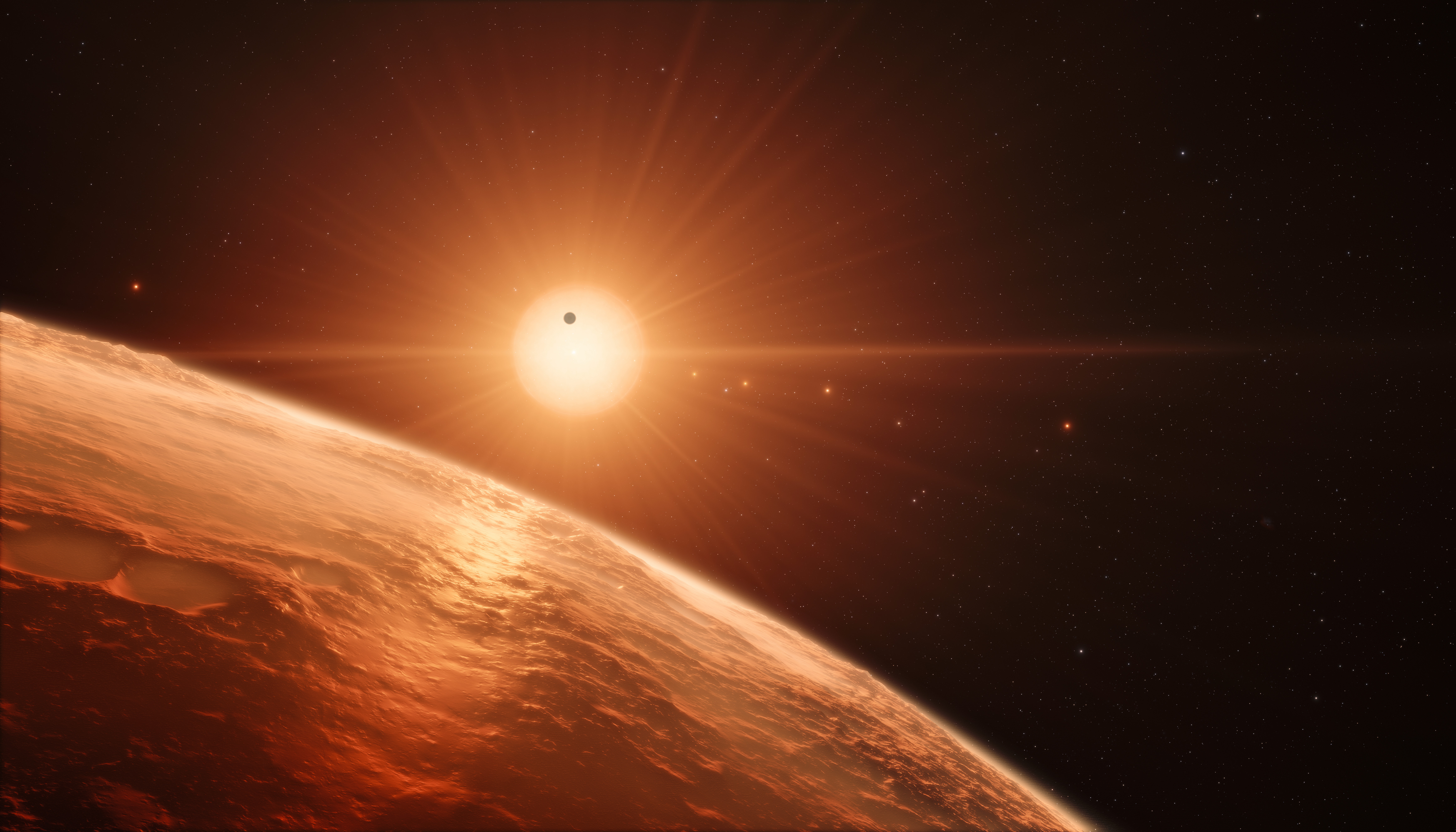
Artist's impression: ESO/N. Bartmann/spaceengine.org. The TRAPPIST-1 system — seven Earth-sized planets around a small, cool star 40 light-years away. No telescope has photographed these worlds; we know them by the shadows they cast.
A universe of planets
An exoplanet (short for "extrasolar planet") is simply a planet that orbits a star other than the Sun. The first one around a normal, Sun-like star — 51 Pegasi b — was found in 1995, a discovery that won the 2019 Nobel Prize in Physics. Before that, we had exactly one planetary system to study: our own. We had no idea whether it was typical or a fluke.
The answer turned out to be humbling. Planets are everywhere. The best current estimates suggest there are, on average, at least as many planets as stars in our galaxy — which means hundreds of billions in the Milky Way alone. We've confirmed only a tiny, nearby sample, but the pattern is unmistakable: planets are the rule, not the exception.
As of 2026, astronomers have confirmed more than 6,000 exoplanets across roughly 4,500 planetary systems, with thousands more candidates awaiting confirmation. The count rises almost every week — this page rounds down deliberately, because any exact figure is out of date by the time you read it.
The four questions this section answers
What Is an Exoplanet?
The definition, the wild variety — hot Jupiters, super-Earths, mini-Neptunes, ocean worlds, and starless rogue planets — and how they compare to the planets we know.
How We Find Them
You can't just point a telescope and look. The clever, indirect methods — transits, stellar wobble, direct imaging, and gravitational lensing — explained with diagrams.
The Habitable Zone
The "Goldilocks" band where liquid water is possible, why it's only the beginning of the habitability question, and where it opens onto the oldest question of all.
Famous Exoplanets
The worlds worth knowing by name — the first one found, the seven planets of TRAPPIST-1, the nearest exoplanet to Earth, and the strangest of the strange.
Seeing the unseeable
Here's the strange truth at the heart of this whole field: we have never seen most exoplanets at all. They are impossibly faint specks lost in the glare of stars trillions of miles away — like trying to spot a firefly next to a searchlight from across a continent. Fewer than a hundred have ever been directly photographed, and even those are just points of light.
Instead, astronomers detect planets by their effects. A planet crossing in front of its star dims the starlight by a fraction of a percent (the transit method). A planet's gravity tugs its star into a tiny wobble we can measure in the star's color (the radial-velocity method). It's detective work, not photography — and it's why a page about thousands of "worlds" is illustrated mostly with artists' impressions. We know their sizes, masses, orbits, and sometimes their atmospheres. We just don't have their portraits.
What the headlines get wrong
"Earth-like planet found!" — usually means "roughly Earth-sized and roughly the right distance from its star." That's a long way from Earth-like. Size and orbit are the easy part; a world's atmosphere, water, and chemistry are what actually matter, and those are far harder to measure. Even the celebrated TRAPPIST-1 planets have unconfirmed atmospheres as of 2026 — the James Webb Space Telescope has looked, and the results so far are frustratingly inconclusive. "A second Earth" makes a great headline and a poor description. The honest state of the science is more interesting than the hype: we have found thousands of worlds, a handful sit in the right temperature range, and we are only now building the tools to ask whether any of them could host life. That open question — are we alone? — is where astronomy hands off to philosophy, and we follow that thread on the habitable zone page.
Return to Michael Paycer
Explore Michael Paycer's professional SQL Server, cloud, ETL, API, automation, and consulting pages, or continue browsing the personal interests section.