
What Is an Exoplanet?
The short answer: any planet that orbits a star other than our Sun. The longer answer is far stranger — because the worlds we've found don't look much like the tidy planets we grew up with. Nature builds planets in shapes the Solar System never prepared us for.
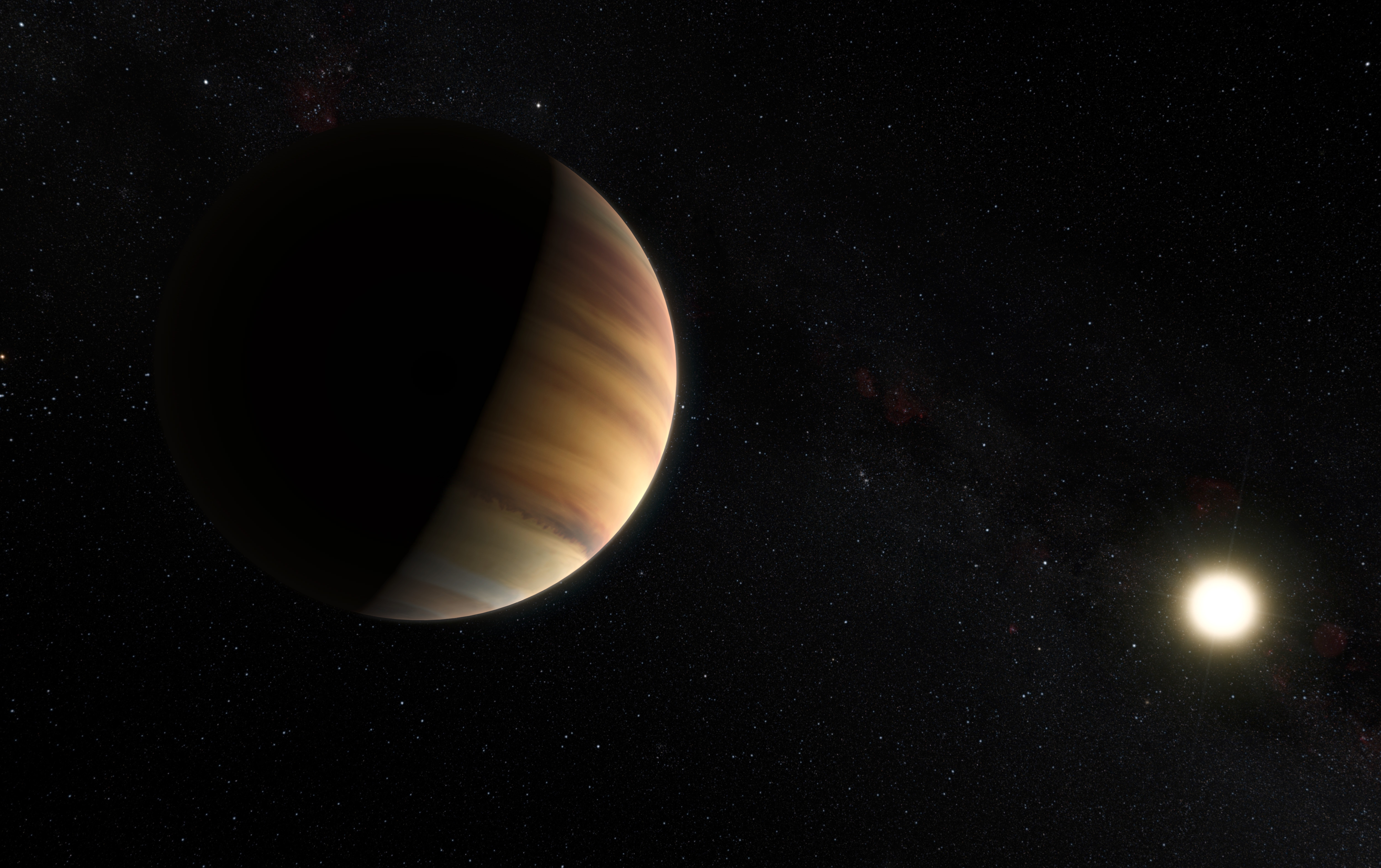
Artist's impression: ESO/M. Kornmesser/Nick Risinger (skysurvey.org). 51 Pegasi b — a "hot Jupiter" and the first planet ever found around a normal star, in 1995. Its very existence broke the rules astronomers thought planets followed.
A planet around another sun
Our Solar System has eight planets orbiting one star. An exoplanet is the same idea, one step out: a planet orbiting a different star. The name is just a contraction of "extrasolar planet" — extra-solar meaning "outside the Solar System."
To count as a planet, an object has to be big enough for its own gravity to pull it round, but not so big that it ignites nuclear fusion in its core and becomes a star itself. Below that line you have planets; above it, you have stars; and the fuzzy in-between objects are called brown dwarfs. Most exoplanets sit comfortably in planet territory, but the range is enormous — from worlds smaller than Mercury to gas giants many times the mass of Jupiter.
The main types of exoplanet
When the discoveries started rolling in, the first surprise was how few of them resembled home. Astronomers had to invent whole new categories. These are the ones worth knowing:
| Type | What it is |
|---|---|
| Hot Jupiter | A gas giant like Jupiter but orbiting scaldingly close to its star — a "year" lasting only days. The first kind found, and once thought impossible. 51 Pegasi b is the classic example. |
| Super-Earth | A rocky world larger than Earth but smaller than Neptune. There's nothing like it in our Solar System, yet it may be the single most common type of planet in the galaxy. |
| Mini-Neptune | A small world wrapped in a thick hydrogen-helium atmosphere over a rock or ice core — like a shrunken version of Neptune. Also extremely common. |
| Gas & ice giants | Jupiter- and Neptune-class worlds in more familiar wide orbits, the easiest big planets to detect. |
| Terrestrial (rocky) | Earth- and Mars-sized rocky worlds. The hardest to find and the most interesting, because this is where liquid water and life could live. The TRAPPIST-1 planets are the showcase. |
| Rogue planet | A world with no star at all — flung out of its system to drift through interstellar space in permanent darkness. Billions may be wandering the galaxy. |
The biggest lesson of the exoplanet era is that our Solar System may be a little unusual. The galaxy's two most abundant planet types — super-Earths and mini-Neptunes — fall in the size gap between Earth and Neptune, and we have neither at home. We were, in a sense, studying planetary science from an atypical sample of one.
How many, and how far
More than 6,000 exoplanets are now confirmed, and the true number in the galaxy runs to the hundreds of billions. But "confirmed" hides a hard truth about distance. The very nearest, Proxima b, is about 4.2 light-years away — roughly 25 trillion miles. With today's fastest spacecraft, a trip there would take tens of thousands of years. These are neighbors we can study but, for now, never visit.
That distance is exactly why we've had to get clever. We can't fly to these worlds, and we can barely photograph them — so we read them indirectly, from the tiny signals they leave on their stars. That detective work is the subject of the next page.
A few things worth straightening out
"Exoplanets are rare." — The opposite is true; planets outnumber stars. "They're all like the planets here." — Also false, and the surprise that reshaped the field: hot Jupiters and super-Earths have no Solar-System counterpart. "A planet needs a star." — Not even that holds; rogue planets drift alone in the dark. And "exoplanet means Earth-like" — no. The word says nothing about size, temperature, or whether anything could live there. It only means: a world, orbiting another sun.
How We Find Them · The Habitable Zone · Famous Exoplanets · Exoplanets Hub · The Planets · Glossary
Return to Michael Paycer
Explore Michael Paycer's professional SQL Server, cloud, ETL, API, automation, and consulting pages, or continue browsing the personal interests section.