French Defense Variations
Winawer Poisoned Pawn, Armenian Variation, Advance, Tarrasch, and MacCutcheon — the full French repertoire in depth.
C10–C12 (Classical/Mac)
C02–C05 (Advance)
C03–C09 (Tarrasch)
3.Nc3 Bb4 4.e5
c5 5.a3 Bxc3+
6.bxc3
The Winawer Variation: 3.Nc3 Bb4
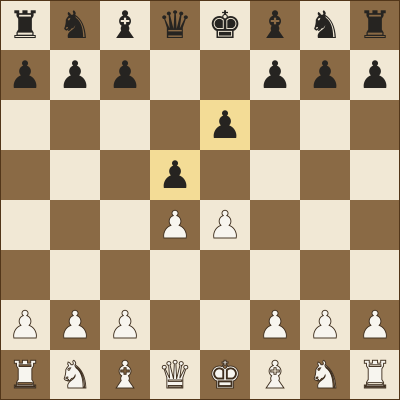
The Winawer is the most complex and theoretically demanding of all French variations. After 3.Nc3 Bb4, Black immediately pins the c3-knight with the f8-bishop. White almost always plays 4.e5, claiming space and starting a race: White attacks kingside, Black counterattacks queenside with ...c5.
After 1.e4 e6 2.d4 d5 3.Nc3 Bb4 — the Winawer Variation tabiya. The Bb4 (highlighted) pins the Nc3, creating immediate tension. Black will exchange on c3 and counterattack with ...c5. This is the most theoretically complex French variation.
The Winawer is named after Simon Winawer, who played it against Steinitz in 1867. Viktor Korchnoi elevated it to a world-class weapon, playing it throughout his career and against every World Champion he faced. The key strategic tension: White gets the bishop pair and kingside space; Black gets queenside counterplay with ...c5 and active piece play.
Winawer Poisoned Pawn: 7.Qg4 Qc7 8.Qxg7
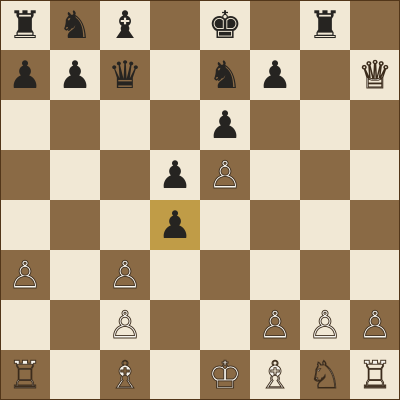
The Poisoned Pawn is the wildest line in the French. After 7.Qg4, White threatens to take g7. If Black plays 7...Qc7 (allowing the capture), after 8.Qxg7 Rg8 9.Qxh7, White has taken two pawns. But Black strikes the center with 9...cxd4 and the White queen is shut out of play on h7 while Black seizes the centre. The resulting positions are so sharp that computers still find new ideas decades after the line was first explored.
Black's Compensation After 8.Qxg7 Rg8
- The White queen is misplaced on h7
- Black's ...cxd4 cxd4 10.cxd4 Nbc6 develops with tempo
- The Rg8 immediately pressures g2 and the White queen
- Black's initiative compensates for the two lost pawns
- One of chess's most deeply analyzed positions
Fischer's Criticism (and Why He Was Wrong)
Bobby Fischer famously declared the Poisoned Pawn unsound for Black. Later analysis and countless grandmaster games proved him wrong — the line is fully playable. Korchnoi, Geller, and later Anand all used it successfully. Fischer's critique actually generated more interest in the line, as analysts worked to prove him wrong.
The Armenian Variation: 5...Ba5!?
Rather than surrendering the bishop with 5...Bxc3+, Black retreats it with 5...Ba5!?, keeping the pin on c3 — a move that seems to walk straight into 6.b4. The point: after 6.b4 cxd4 7.Qg4 Ne7 8.bxa5 dxc3, Black gets a far-advanced pawn on c3 and lasting dark-square play, while White grabs kingside pawns with Qxg7 just as in the Poisoned Pawn. The resulting positions are chaotic and almost impossible to calculate at the board. This is pure preparation chess — you need to know the theory cold to survive as either color.
Armenian grandmasters (hence the name) developed this variation in the Soviet era — above all Rafael Vaganian, who championed 5...Ba5 for decades and inspired a generation of Armenian players to take up the line.
The Advance Variation: 3.e5
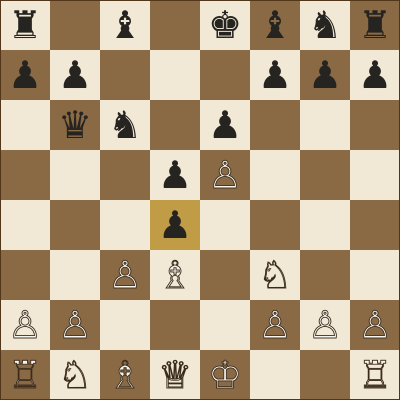
In the French Advance, White immediately pushes to e5, claiming space — the same concept as in the Caro-Kann Advance, but with important differences. In the French, Black's c8-bishop is already locked behind e6. The critical distinction: the French Advance player must find counterplay without the early bishop development that makes the Caro-Kann Advance so reliable for Black.
Black's key plan: ...c5 to challenge the center, ...Nc6-Nb4-Nxd3 to exchange pieces, and ...Qb6 to pressure the b2 and d4 pawns simultaneously. After 5...Qb6 6.Bd3, the game enters rich tactical territory.
A Flexible Move Order: 4.Nf3
White can also play 3.e5 c5 4.Nf3, delaying c3 to keep options open. After 4...Nc6 5.Bd3, White develops aggressively. Black must play carefully to avoid getting squeezed on the kingside. Unlike the Caro-Kann Advance — where 4.Nf3 and Be2 is Nigel Short's named system — in the French this is simply a useful move-order finesse.
Black's Queenside Counterplay
The key to the French Advance is understanding that Black's attack comes on the queenside. After ...c5-...Nc6-...Qb6, Black pressures d4 and b2. If White's center becomes overextended, Black can break with ...f6 to attack e5 directly. Wolfgang Uhlmann was the greatest French Advance practitioner — his games demonstrate masterful queenside play.
The Tarrasch Variation: 3.Nd2
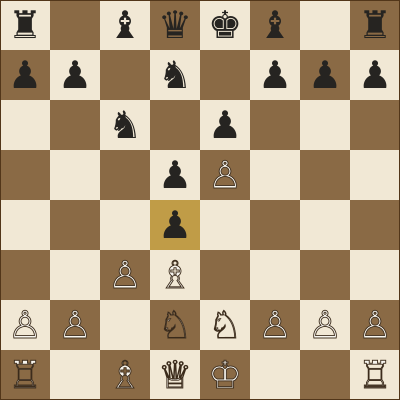
The Tarrasch (3.Nd2) is White's most solid and pragmatic approach to the French. By developing the knight to d2 instead of c3, White avoids the Bb4 pin entirely. The d2-knight supports e4 and can later go to f1-g3 or f3, depending on the position. The Tarrasch is favored by players who want to avoid the theoretical battlefields of the Winawer and Classical.
The tradeoff: the d2-knight temporarily blocks the c1-bishop. After 3...Nf6 4.e5 Nfd7 5.Bd3 c5, Black immediately strikes the center. If White plays 6.c3, the center becomes fixed and the game takes on a classical French structure.
Tarrasch with 3...c5 (Open Tarrasch)
Black immediately challenges the center with 3...c5. This is the Open Tarrasch — very double-edged. After 4.Ngf3 cxd4 5.Nxd4, Black must play precisely. The resulting IQP positions (after ...dxe4) are rich and rewarding for both sides.
Tarrasch with 3...Nf6 (Classical)
Black develops the knight first, then counters with ...c5. After 5.f4, White builds an aggressive pawn center. Black must act quickly with 5...c5 before White consolidates. The f4 advance is aggressive but weakens e4 if the center breaks open.
The MacCutcheon Variation: 4...Bb4
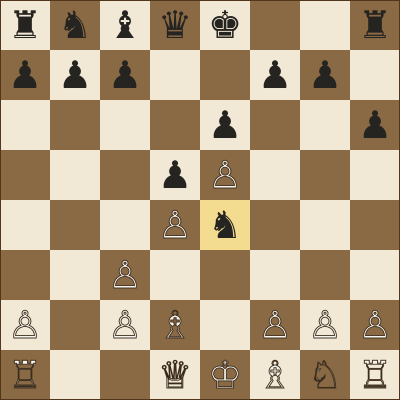
In the Classical French starting position (after 3.Nc3 Nf6 4.Bg5), Black has three major options: the Classical proper (4...Be7), the Burn Variation (4...dxe4), and the MacCutcheon (4...Bb4). The MacCutcheon is the most aggressive — Black immediately pins the Nc3 in Nimzo-style, creating immediate complications.
After 5.e5 h6 6.Bd2 Bxc3 7.bxc3 Ne4, the game is already sharp. Black has the excellent Ne4 outpost in the center, and White has the bishop pair with a pawn center. The game requires concrete calculation from both sides — passive play is quickly punished.
MacCutcheon vs Winawer — What's the Difference?
Both involve Black playing ...Bb4 against White's knight. The difference: in the Winawer (3...Bb4), Black pins immediately before developing the g8-knight. In the MacCutcheon (4...Bb4), Black develops the knight first to f6, then pins. The MacCutcheon leads to positions where Black has the Ne4 outpost; the Winawer leads to the massive queenside counterattack with ...c5. Both are fully sound and offer rich play.
The Bad Bishop Problem — and How Black Solves It
Every French player must grapple with the c8-bishop. Once Black plays 1...e6, the c8-bishop is locked behind the e6-d5 pawn chain for the foreseeable future. This is not a fatal flaw — but it is Black's main strategic challenge. The solutions:
Exchange It (Winawer)
In the Winawer, Black plays ...Bb4xc3, exchanging the bishop for White's knight. The bad bishop never becomes a problem because it's traded away on move 5. The price: White gets the bishop pair and the doubled c-pawns give White attacking chances.
Activate It (...b6-...Ba6)
In many French lines, Black plays ...b6 and ...Ba6 to activate the bishop on the long diagonal. After an exchange of bishops (Bxa6), Black has solved the problem. This plan appears in the Tarrasch and Classical variations. Nimzowitsch pioneered this idea.
Reroute via ...f6 (...Nd7-f8-g6)
In the Advance French, Black can play ...f6 to attack e5, opening the diagonal for the bishop. This is more tactical — it requires careful timing. But when it works, the c8-bishop suddenly becomes active and Black's position transforms.
Champions of the French Defense
Viktor Korchnoi
Korchnoi was the greatest French Defense player of the 20th century — his Winawer games are a masterclass in counterattacking chess. He played the most complex Poisoned Pawn and Armenian lines against the world's best players throughout a career that spanned five decades. Study his games to understand what the French is capable of at its best.
Leonid Stein
The Soviet grandmaster Leonid Stein produced some of the most beautiful French Defense games ever played. His attacking creativity within the French's solid framework was extraordinary. Stein's early death at 38 cut short a career that could have reached the very top. His French Defense games remain among the most instructive in the opening's history.
Wolfgang Uhlmann
The East German grandmaster was the world's foremost Advance French specialist. Uhlmann played the French Defense his entire career and reached the Candidates level in the 1960s and 70s. His Advance French games demonstrate perfect understanding of Black's queenside counterplay and remain the benchmark for anyone who wants to master this variation.
Frequently Asked Questions
After 1.e4 e6 2.d4 d5 3.Nc3 Bb4 4.e5 c5 5.a3 Bxc3+ 6.bxc3 Ne7 7.Qg4 Qc7 8.Qxg7 Rg8 9.Qxh7, White has won two pawns but the queen is trapped in the corner. Black strikes with 9...cxd4 and develops with tempo. The resulting positions are among the most analyzed in all of chess — both players need to be deeply prepared.
In the Winawer, instead of the standard 5...Bxc3+, Black plays 5...Ba5!? — retreating the bishop and keeping the pin on c3. The critical line runs 6.b4 cxd4 7.Qg4 Ne7 8.bxa5 dxc3, when Black has a monster pawn on c3 and dark-square pressure while White attacks the kingside. Armenian grandmasters — above all Rafael Vaganian — developed this variation, hence the name.
After 3.Nd2, White avoids the Bb4 pin entirely. The d2-knight is solid but temporarily blocks the c1-bishop. The Tarrasch leads to more positional, less theoretical positions — White maintains the center without exposing the c3-knight to the Bb4 pin. It's preferred by players who want to fight for an advantage without entering the Winawer theory.
After 1.e4 e6 2.d4 d5 3.Nc3 Nf6 4.Bg5 Bb4, Black pins the Nc3 in Nimzo-style. After 5.e5 h6 6.Bd2 Bxc3 7.bxc3 Ne4, Black has an excellent knight on e4 and White has the bishop pair with a pawn center. Both sides must calculate precisely. The MacCutcheon creates imbalanced positions from the start.
The c8-bishop — the "bad bishop" locked behind the e6-d5 chain. Solving this problem is Black's main strategic task. Solutions: exchange it (Winawer), activate via ...b6-...Ba6, or open the diagonal with ...f6. Players who understand this challenge and plan around it can turn the French into a winning weapon. Those who ignore it end up with permanently passive positions.
The key difference is the bishop. In the Caro-Kann Advance, 3...Bf5 escapes before the pawns close — no bad bishop. In the French Advance, 3.e5 closes the diagonal and the c8-bishop is locked in for the foreseeable future. Black's ...c5 counter is the same idea in both, but the French player must manage the passive bishop as an additional challenge throughout the game.
Further Reading & Sources
Books
- Watson, Play the French (4 editions)
- Moskalenko, The Flexible French
- Korchnoi games collections — Winawer
Online Resources
- Lichess.org — C00-C19 French explorer
- Chess.com French Defense guide
- Chessable — French Defense repertoire courses
Model Games
- Korchnoi – Karpov, 1978/81 WCh (Armenian/Winawer)
- Uhlmann – Various (French Advance mastery)
- Stein – Various (attacking French games)
ECO classifications from standard references. Opening analysis based on grandmaster games and current theory.