Theme · Destiny · Freedom
Fate vs. Free Will
Greek characters spend their lives trying to escape destiny — and walking straight into it. Are we free, or ruled by forces beyond our control?
 Michael Paycer
Greek characters spend their lives trying to escape destiny — and walking straight into it. Are we free, or ruled by forces beyond our control?
Michael PaycerThe question
Are we free, or determined?
Greek figures
The Fates, Oedipus, Achilles, Prometheus
Philosophers
The Stoics, Nietzsche
Key idea
Destiny vs. agency
Few ideas run deeper through Greek myth than fate. The three Moirai — the Fates — spin, measure, and cut the thread of every life, and not even Zeus can fully overrule them. Mortals who try to flee their destiny tend to fulfill it by the very act of fleeing.
This is the question philosophy inherits and never lets go of: are human beings truly free, or are we shaped by forces beyond us — the gods, nature, society, biology, history, our own character? The myths dramatize the dilemma; the philosophers try to define it.
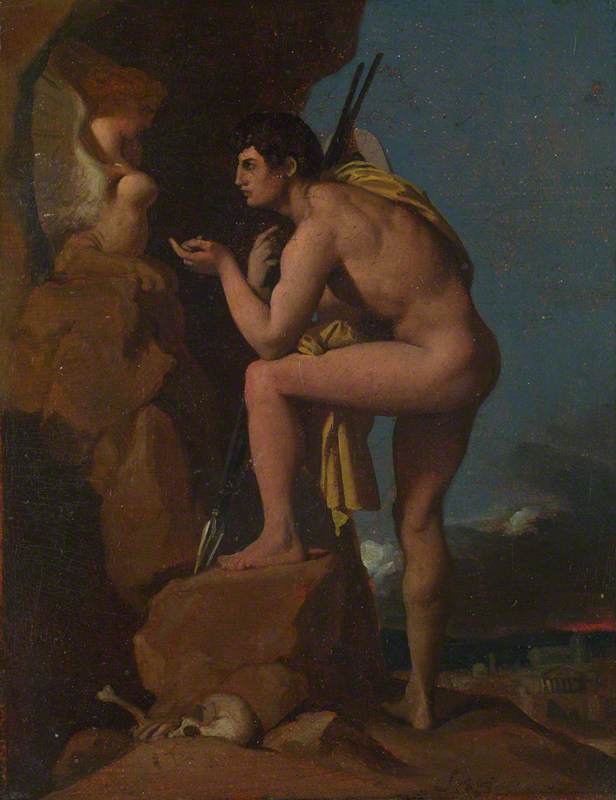
Warned that he would kill his father and marry his mother, Oedipus flees the only home he knows — and unknowingly does both, because the people he flees are not his real parents. His story is the West's defining image of a fate that cannot be escaped, only fulfilled.
Achilles is told he may have a long, obscure life or a short, glorious one. His mother Thetis knows the outcome and cannot change it. Fate here is not a trap sprung from outside, but a choice that is somehow also foreordained.
Prometheus — "forethought" — can see what is coming and still defies Zeus to help humankind. He embodies the strange freedom of acting against a fate you already foresee.
Stoicism embraced a fully determined universe — and located freedom in our judgments alone. We cannot control events, only our response to them. Epictetus' "dichotomy of control" is a whole ethics built on making peace with fate.
Nietzsche pushed acceptance further into affirmation: amor fati, the love of one's fate — to want your life, exactly as it is, so completely you would will it to recur forever. Not resignation, but embrace.
Philosophy still argues the question the myths posed. Hard determinists deny free will; libertarians defend it; compatibilists — heirs of the Stoics — argue that freedom and determinism can both be true. The thread the Fates spin has never quite been cut.
Public-domain depictions — click any image to view it full size.
“The fated will happen; not even the gods can turn it aside.”
after Greek tragic convention
“Some things are up to us, and some are not.”
Epictetus, Enchiridion
Forces beyond us — the gods, nature, character — that shape the course of a life.
The genuine power to choose, to act otherwise, to be responsible for what we do.
The three Moirai — Clotho, who spins the thread of life; Lachesis, who measures it; and Atropos, who cuts it. They personified destiny, and even the gods were bound by their decrees.
Almost never — and trying usually fulfilled it, as with Oedipus. Greek myth treats fate as something that can be delayed or dramatized but not finally avoided.
The Stoics accepted that the universe is determined but held that we remain responsible for our own judgments. Freedom, for them, lies in how we respond to what we cannot control.
When I am not reading Homer or Nietzsche, I tune databases, design high-availability systems, and run cloud migrations.