
When Galaxies Collide
Galaxies are not fixed and eternal — they crash into each other, tear each other apart, and merge into new forms. It's one of the main ways galaxies grow and change. And it's coming for our own: for decades textbooks said the Milky Way and Andromeda would inevitably collide. New data has just thrown that "certainty" into doubt.
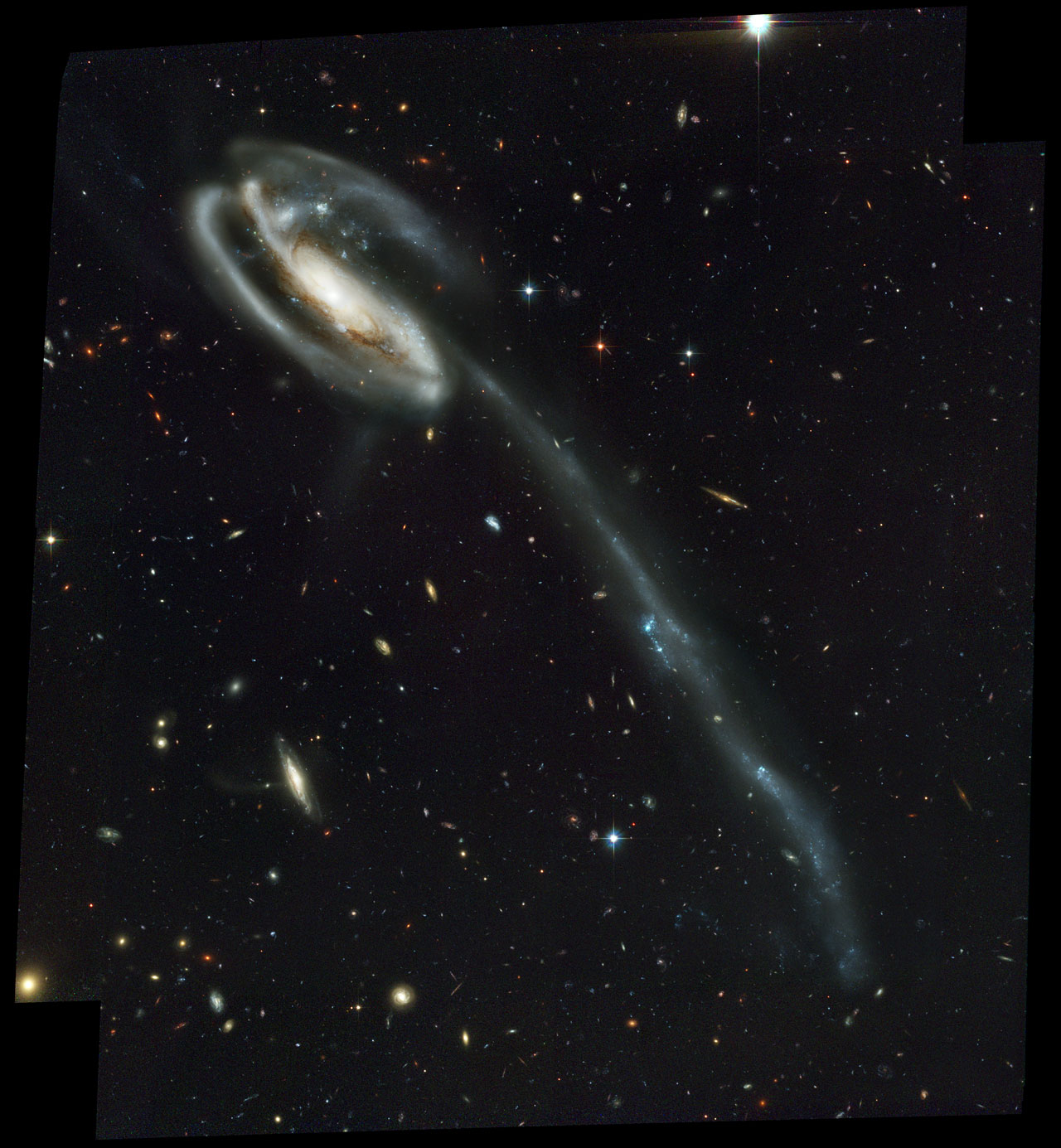
Image: NASA, H. Ford (JHU), the ACS Science Team & ESA. The Tadpole Galaxy — a spiral whose brush with a passing galaxy flung out a 280,000-light-year "tail" of stars and gas, the signature wreckage of a galactic near-miss.
A crash where almost nothing crashes
The word "collision" is misleading. Galaxies are overwhelmingly empty space — the stars inside them are so tiny compared to the distances between them that when two galaxies pass through each other, individual stars almost never hit. It's less a car crash than two swarms of gnats flying through one another; the swarms are reshaped, but the gnats sail past. What actually interacts is gravity (which stretches both galaxies into tidal tails, bridges, and rings) and their gas clouds (which do slam together, compress, and ignite bursts of furious new star formation called starbursts).
Over hundreds of millions of years, if the two galaxies don't have enough speed to escape, they fall back together again and again and eventually merge into one — often a smooth elliptical galaxy, built from the wreckage of two spirals. Galaxy mergers are a primary engine of cosmic growth: the biggest galaxies in the universe are cannibals, assembled by swallowing others. Even our own Milky Way has eaten smaller galaxies throughout its history.
Collisions caught in the act
The Antennae (NGC 4038/4039)
The nearest and most famous ongoing major collision — two spiral galaxies mid-merger, with long curving "antennae" of stars flung out by the encounter and brilliant knots of starburst where their gas clouds are colliding.
The Whirlpool (M51)
A textbook interaction you can find in a backyard scope: the grand spiral M51 is being visibly disturbed by the small companion galaxy tugging at the end of one of its arms — a slow-motion gravitational dance.
The Mice (NGC 4676)
A pair of colliding galaxies whose tidal tails, stretched by their mutual gravity, look like two long-tailed mice — a snapshot of the tails that a merger throws out.
The Tadpole (UGC 10214)
A single spiral disrupted by a smaller galaxy that has since sped away, leaving an enormous trailing tail of displaced stars — proof that even a passing brush leaves lasting scars.
Milkomeda — the collision that may not happen
For years the story was told as settled fact: in about 4.5 billion years, the Milky Way and the Andromeda Galaxy — hurtling toward each other — would smash together and eventually merge into a single giant elliptical, nicknamed "Milkomeda." It became a fixture of documentaries and textbooks. The Sun would likely survive, flung to a new orbit, and any beings on Earth would see Andromeda swell to fill the night sky before the merger.
But here's the honest, up-to-date science: that collision is no longer considered certain. In 2025, astronomers re-ran the numbers using precise new measurements from the Gaia and Hubble space telescopes, and across 100,000 simulations found only about a 50% chance of a merger within the next 10 billion years — and just a 2% chance of the classic head-on collision in 4–5 billion years. The wildcards turned out to be the smaller galaxies nearby: the Large Magellanic Cloud and M33 tug on the orbits enough to make the outcome a genuine coin-flip. It's a perfect example of science working: a "fact" everyone repeated for a decade turned out to rest on measurements too uncertain to support it. The fate of our galaxy is, once again, an open question.
"No man ever steps in the same river twice, for it is not the same river and he is not the same man."
— Heraclitus, c. 500 BC — even galaxies are rivers, not rocks
Straightening out the crash
"Stars will smash together." — Almost never; galaxies are so empty that the stars pass right by each other. "A collision is quick." — It takes hundreds of millions to billions of years — slower than any human, or any species, could ever witness. "The Milky Way–Andromeda merger is a certainty." — Not anymore; 2025 data put it at roughly a coin-flip over the next 10 billion years. "Earth would be destroyed." — Even if the merger happens, the odds of our Solar System being disrupted are small — the danger is wildly overstated; the sky would just look spectacular. Galaxy collisions are creative more than destructive: they trigger new stars and build bigger galaxies.
The Milky Way · Andromeda · Whirlpool · Galaxy Types · Star Formation · Galaxies Hub · Glossary
Return to Michael Paycer
Explore Michael Paycer's professional SQL Server, cloud, ETL, API, automation, and consulting pages, or continue browsing the personal interests section.