Who is Sol Invictus?
Sol Invictus — the “Unconquered Sun” — was a solar deity who became especially prominent in the later Roman Empire. The emperor Aurelian established a major state cult and temple for him in Rome in 274 CE, and the sun-god became a powerful symbol of universal imperial order and of the emperor's victory beneath the sun. Yet the title invictus and Roman solar worship both had earlier histories; Aurelian raised and organized something that already existed rather than conjuring it out of nothing.
Sol Invictus is best understood as late-Roman solar religion at its most politically charged — a cult that fused cosmic imagery with the ideology of empire, and that continues to attract both serious study and a great deal of oversimplification.
Origins & history
Roman solar worship was old, but Sol Invictus crystallized in the later empire as its most conspicuous form. Aurelian's foundation of 274 CE gave the Unconquered Sun a temple, a priesthood, and a prominent place in state religion, backed by strong imperial coinage that broadcast the god across the empire. The cult sat within a wider late-antique interest in solar symbolism and, some have argued, in tendencies toward a solar monotheism — though claims of a single universal solar religion should be made cautiously. What is clear is that the sun became a favored emblem of imperial power in this period.
Cult & worship
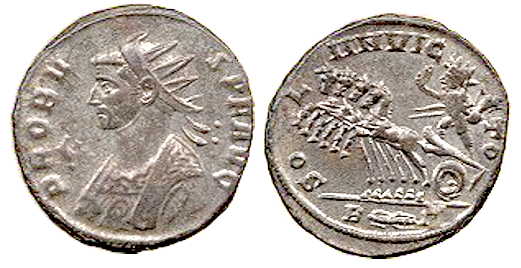
Under Aurelian, Sol Invictus received official state sponsorship: a major temple in Rome and a public cult tied closely to the emperor and to imperial victory. The god's presence is felt strongly in the coinage of the era, where solar imagery served as propaganda for a universal, divinely favored order. The securely attested core of the cult is precisely this public, imperial, and material dimension — temple, state sponsorship, and the sun as a sign of sovereignty — rather than any surviving body of doctrine or sacred speech.
Roman adoption & context
Sol Invictus is not a straightforward import with a single “Greek equivalent,” and that is exactly the point. Late Roman solar religion absorbed and interacted with Syrian, Greek, Roman, and imperial traditions, but it should not be flattened into a synonym for Mithras, for Elagabal, for Apollo, or for every eastern sun god. Crucially, Roman conceptions of Sol were not merely a passive borrowing of Greek Helios. The relationships among Sol, Sol Indiges, Sol Invictus, Elagabal, Mithras, and Apollo are genuinely complex; these were not simply one god under interchangeable names. Set beside the civic sovereignty of Jupiter, Sol Invictus represents a later, imperial reworking of divine kingship, in which the sun itself becomes the emblem of an order without rival.
Key episodes
Aurelian and the state cult of 274 CE
The defining moment is Aurelian's establishment of a major state cult and temple for Sol Invictus in Rome in 274 CE. Backed by imperial coinage, the Unconquered Sun became a symbol of universal order and of the emperor's own victory. It is the clearest instance of a Roman ruler elevating solar religion to the summit of the state.
The December 25 question
A famous claim holds that the Christian celebration of Christmas on December 25 was simply copied from a festival of Sol Invictus. This is too confident. The chronology and the causal relationship between the two remain debated in scholarship, and the evidence does not support a simple story of “direct copying.” The honest position is that this is a genuinely open scholarly question, not a settled fact.
The problem of syncretism
Sol Invictus is often swept together with Mithras, Elagabal, Apollo, and various eastern sun gods into one undifferentiated solar religion. The evidence resists this. Late Roman solar cult was a web of related but distinct identities; treating them as interchangeable names for a single deity flattens a real and interesting complexity.
Legacy & influence
Sol Invictus casts a long shadow over late Roman art and imperial iconography, and over the enduring imagery of the radiant, haloed ruler. He sits at the center of scholarly debates about the Christianization of the empire and about how one religious world gave way to another. Much popular writing overstates his role; the durable legacy is more sober — a key exhibit in the study of religious transition in late antiquity.
Symbolism
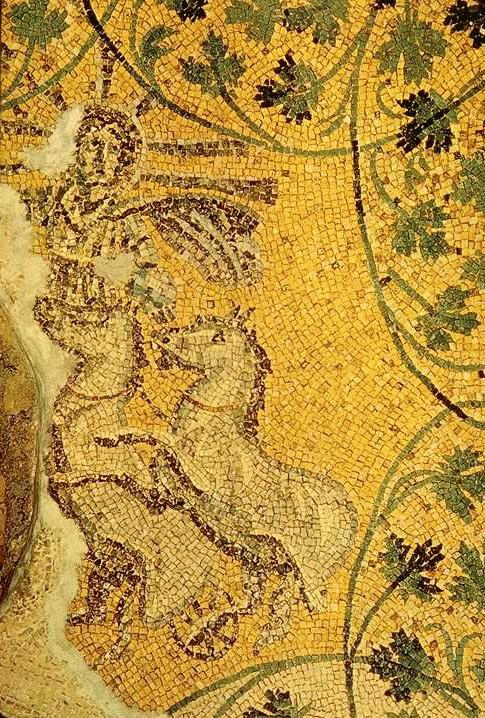
His imagery is the argument. The radiate crown of sun-rays marks the god — and, by extension, the emperor who claimed his favor — as a source of light and unconquered power; the sun itself stands for a universal order that shines on all; and the imperial coinage that carried these images turned theology into propaganda, broadcasting the Unconquered Sun to every corner of the empire. Together they express what the cult meant in its own moment: sovereignty imagined as light that cannot be overcome.
Famous public-domain depictions — click any image to view it full size.
 Michael Paycer