An empire of movement
“Foreign” is a misleading word for these cults. It does not mean marginal, and it does not mean un-Roman. The Roman Empire was a vast, mobile, multilingual world in which soldiers, merchants, migrants, enslaved people, emperors, and whole local communities carried their gods across regions. Adoption was never a one-way process of Rome simply copying outsiders. Divine identities were translated, combined, localized, and politically reorganized — a Syrian goddess read through Greek categories, an Egyptian god given a Greek face, a provincial storm-god fused with Jupiter himself. To watch these cults travel is to watch Roman religion doing what it always did.
An honest note on evidence: most of these gods left no doctrine. They were mystery cults or provincial traditions whose insiders wrote no surviving handbook, so no secure scripture or verbatim creed survives for Serapis, Sabazius, Epona, or Jupiter Dolichenus. What survives instead is material: inscriptions, reliefs, sanctuaries, sculpture, and ritual objects such as the bronze “hands of Sabazius.” That evidence is often strong on where and how widely a cult spread, but weak on precise theology — so confident claims about secret meanings usually go beyond what can be known.
Gods of the eastern Mediterranean
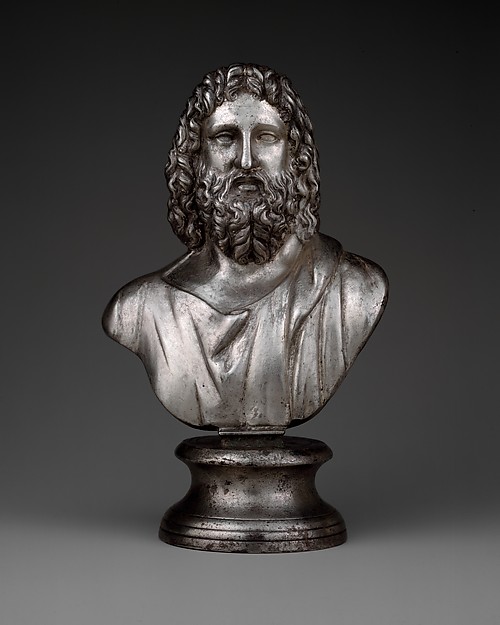
Serapis
A syncretic god developed in Ptolemaic Egypt and worshipped widely across the Roman world. His identity combined Egyptian and Greek elements — museums describe him as a deity in Hellenistic guise associated with Osiris, Apis, and Ptah, while other traditions connected him with Hades and Asklepios. He was underworld ruler, healer, fertility power, royal god, and consort of Isis, and his Greek anthropomorphic image helped the cult cross cultural boundaries. Ancient and modern writers disagree over how deliberately rulers “created” him, but syncretism should not be mistaken for invention from nothing. Evidence: A.
Sabazius
A Thracian-Phrygian deity whose cult spread into the Greek and Roman worlds, sometimes associated with Zeus or Jupiter, though exact identifications varied. His most distinctive traces are archaeological: the bronze “hands of Sabazius,” complex assemblages of religious symbols preserved in collections such as the British Museum and the Walters Art Museum. The symbolism of those hands is not fully decoded, and confident modern explanations tend to outrun the evidence. He exemplifies both syncretism and religious mobility. Evidence: B.
Atargatis
A major Syrian goddess whose cult spread through the Hellenistic and Roman worlds, associated with fertility, water, and protection — a central form of the “Syrian Goddess” tradition. Her identity could be translated through Greek and Roman categories yet stayed rooted in Syrian religious landscapes, with fish, water, and distinctive priestly practices appearing in ancient descriptions. The treatise De Dea Syria (“On the Syrian Goddess”), traditionally transmitted under Lucian's name, is a major witness — but its authorship, irony, and reliability all demand caution. Evidence: A/B.
Gods of the frontier and the provinces
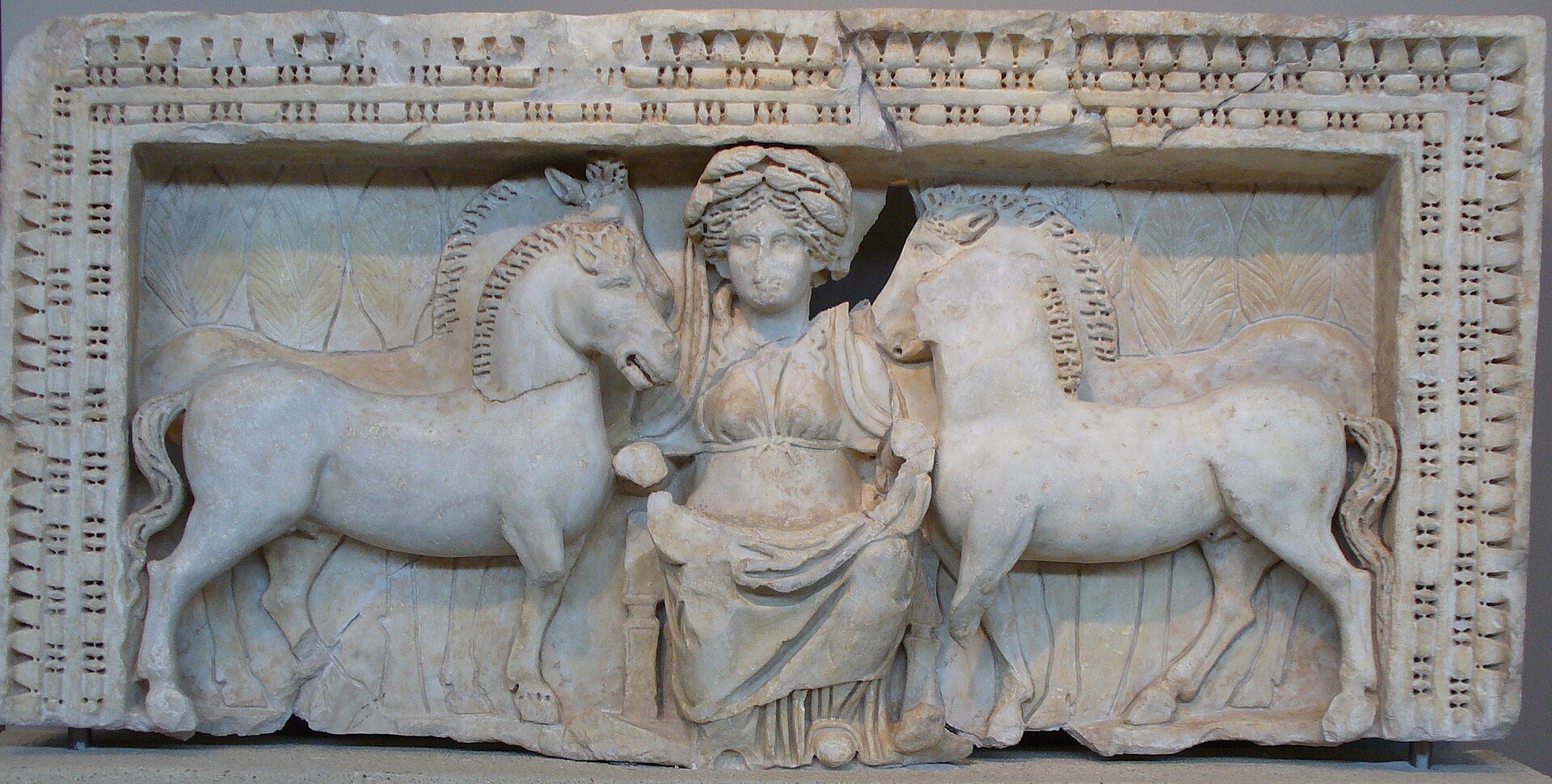
Epona
A Celtic goddess of horses, ponies, donkeys, and equestrian protection whose worship spread widely across the empire — remarkable as a provincial deity adopted far beyond her original region and reportedly given a Roman festival date. Her cult is a strong example of religious mobility and interpretatio that did not erase a deity's non-Roman name. Popular among cavalry and transport communities, she is known chiefly through inscriptions and images showing her among horses; her precise myths are poorly preserved. She survives today in equestrian culture, Celtic studies, and modern fantasy. Evidence: A/B.
Jupiter Dolichenus
A Roman-period god whose cult originated at Doliche in Commagene, in what is now southeastern Turkey. He combined aspects of Jupiter with a local storm-god tradition and became popular especially in military environments in the second and third centuries CE. Often shown standing on a bull with thunderbolt and double axe, he embodies Roman-provincial fusion rather than the simple replacement of one god by another. No doctrinal scripture defines the cult — inscriptions, sanctuaries, reliefs, and military archaeology are the key evidence — and it declined sharply in the third century. Evidence: A/B.
Famous public-domain depictions — click any image to view it full size.
Roman religion angle“Foreign” is a Roman category, not a verdict on importance. The empire was a machine for moving people, and gods moved with them. Watching Serapis, Epona, or Jupiter Dolichenus travel is watching Roman religion do what it always did: translate, combine, and localize rather than simply replace.
Does “foreign” mean these cults were marginal?
No. “Foreign” does not mean marginal or non-Roman. The Roman Empire was a vast, mobile, multilingual world in which soldiers, merchants, migrants, enslaved people, emperors, and local communities carried cults across regions. Adoption was not a one-way process of Rome simply copying outsiders; divine identities were translated, combined, localized, and politically reorganized.
Who was Serapis?
Serapis was a syncretic god developed in Ptolemaic Egypt and widely worshipped across the Roman world. His identity combined Egyptian and Greek elements — associated with Osiris, Apis, and Ptah, and also connected with Hades and Asklepios — and he served as underworld ruler, healer, fertility power, and consort of Isis. His Greek anthropomorphic image helped the cult travel across cultural boundaries.
Why do so many of these gods lack sacred texts or quotations?
Many were mystery or provincial cults that left little or no doctrinal writing. No secure scripture or verbatim creed survives for Serapis, Sabazius, Epona, or Jupiter Dolichenus. The key evidence is instead archaeological — inscriptions, reliefs, sanctuaries, and ritual objects such as the bronze “hands of Sabazius” — so their theology is often reconstructed with real uncertainty.
What is Jupiter Dolichenus?
Jupiter Dolichenus was a Roman-period god whose cult originated at Doliche in Commagene, in what is now southeastern Turkey. He fused aspects of Jupiter with a local storm-god tradition and became popular especially in military environments in the second and third centuries CE. He is often shown standing on a bull with a thunderbolt and double axe — an emblem of Roman-provincial religious fusion rather than simple replacement of one god by another.
 Michael Paycer