Who is Isis?
Isis was an Egyptian goddess whose cult spread far beyond Egypt through the Hellenistic and Roman Mediterranean. In the Roman world she was invoked as mother, healer, magician, savior, protector of sailors, and even as a universal goddess who gathered many divine roles into one. Her worship offered something Roman civic cult generally did not: initiation and a deeply personal religious experience.
Her rise is a reminder that a “foreign” cult was not a marginal one. By the first century CE, Isiac worship had become deeply embedded in imperial religious life. Isis did not so much replace traditional cult as sit alongside it, offering something additional — personal salvation and belonging — to those who sought it.
Origins & history
Isis came from Egypt, where she was already an ancient and powerful goddess. As her cult moved into the Greek and then Roman worlds it was carried by merchants, sailors, migrants, and devotees along the sea lanes of the Mediterranean. In Rome the reception was uneven: periods of suspicion and outright exclusion gave way, over time, to enormous popularity and increasingly structured public worship. What looks in hindsight like a smooth triumph was in fact a long negotiation between an eastern cult and a wary Roman establishment.
That trajectory — suspicion, then acceptance, then embedded prominence — makes Isis one of the best-documented examples of how foreign cults were translated and localized rather than simply copied into Roman religion.
Cult & worship
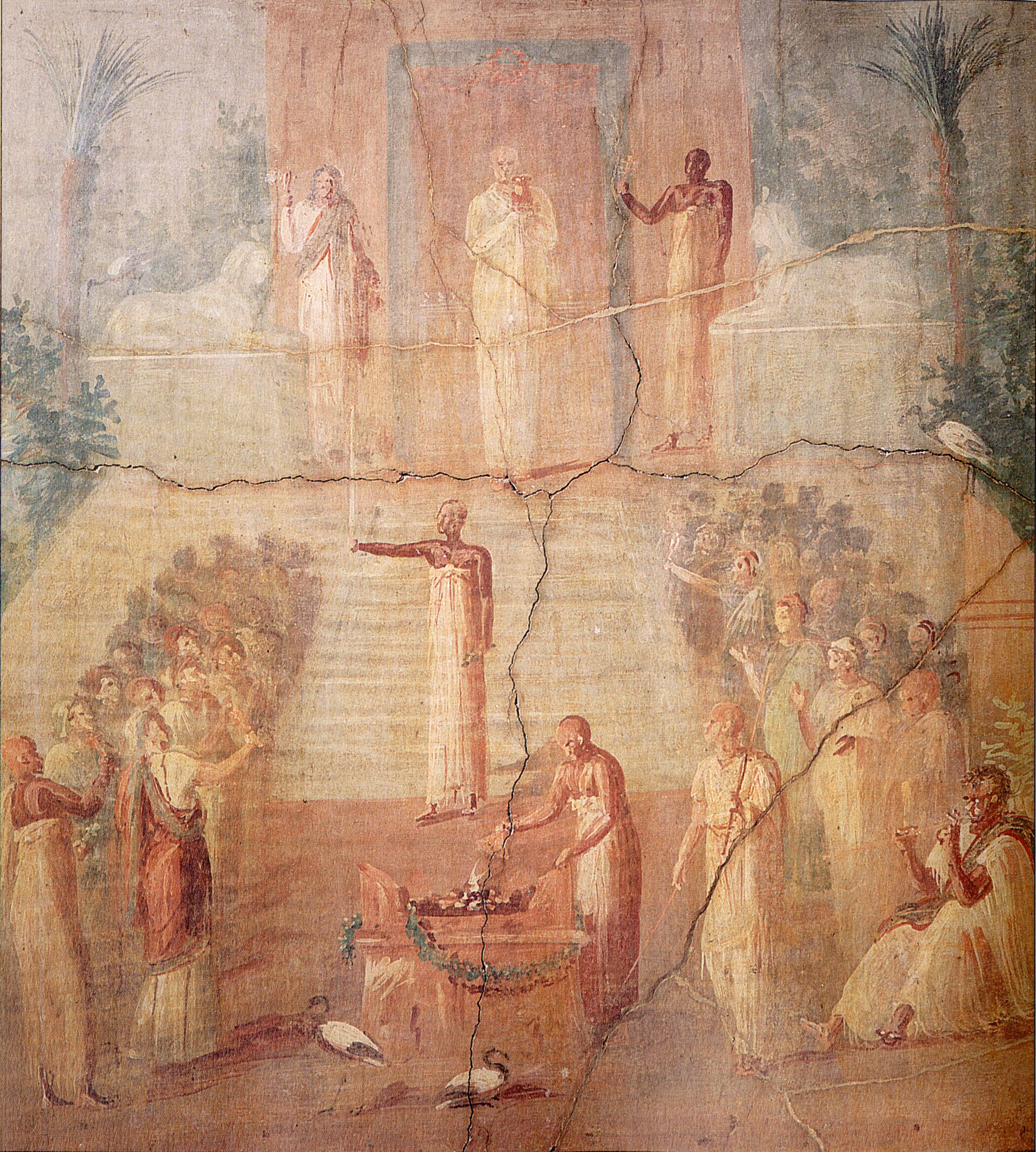
Isiac religion combined two registers. There was public, structured worship — temples, priesthoods, and processions that any city-dweller could witness. And there was the mystery: initiation into a more private religious experience of the goddess, promising personal restoration and a bond with Isis that outlasted the crises of ordinary life. In Apuleius's Metamorphoses, the goddess appears at the climax of the protagonist Lucius's spiritual crisis and restores him, then draws him toward initiation. Because this was a mystery cult, the precise doctrines of that initiation are not fully recoverable today; the ancient testimony describes the experience without handing us a doctrinal manual.
Roman adoption & context
Isis has no tidy “Greek equivalent” to be measured against; the more important question is how an Egyptian goddess became a Roman one. Her path ran from exclusion to devotion. Early Roman authorities treated the Egyptian cult with suspicion, yet its appeal proved durable, and by the imperial period it was woven into Roman religious life. Even then, occasional suppression episodes show that popularity did not erase political suspicion. Two cautions follow. First, Roman literary depictions of Isis should not be taken as descriptions of Egyptian religion unchanged — her identity was reshaped in transit. Second, the “mystery” label means real limits on what we can know. Set beside a civic god such as Jupiter, whose meaning was public and political, Isis represents the more personal, initiatory current that foreign cults brought into the Roman world.
Key episodes
From suspicion to devotion
The arc of Isis in Rome is itself the story: a cult first met with suspicion and exclusion becomes one of the most successful religions of the ancient Mediterranean. Its embedding in imperial life by the first century CE — without ever fully shedding official wariness — captures how Rome absorbed a foreign god on its own terms.
Lucius and the goddess
In Apuleius's Metamorphoses 11, Isis appears to the suffering Lucius as the resolution of his long ordeal, restores him, and leads him toward initiation. The scene is literary rather than reportage, but it is an ancient witness to the personal, saving relationship the cult offered its devotees.
Universal goddess, protector of sailors
Isis was praised as a goddess of nearly universal reach — mother, healer, magician, savior — and as a protector of those who sailed the sea. That combination of cosmic scope and practical protection helped her cult travel and take root across a maritime empire.
Legacy & influence
Isis remains one of antiquity's most influential goddesses. She is central to the study of ancient religion and religious identity, to the history of mystery cults, and to later esotericism and modern Egyptomania. Her image — the universal, saving mother — echoes through art and religious imagination long after her temples closed. As a case study she shows how thoroughly a cult could cross cultures while remaining recognizably itself.
Symbolism
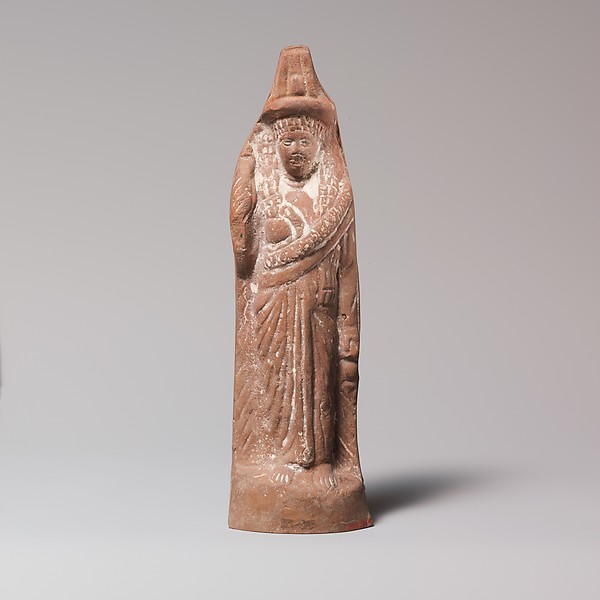
Her signs express her range. The sistrum, the sacred rattle of her worship, marks the rites that set Isiac devotion apart; the throne recalls the queenly, maternal authority carried in her name; and her association with the sea and safe voyage ties the cosmic goddess to the very practical hope of sailors and travelers. Together they say what the cult promised: a goddess vast enough to be called mistress of all the elements, yet near enough to save a single frightened traveler.
Famous public-domain depictions — click any image to view it full size.
 Michael Paycer